allopurinol brands
14 registered brands containing allopurinol in Kenya.
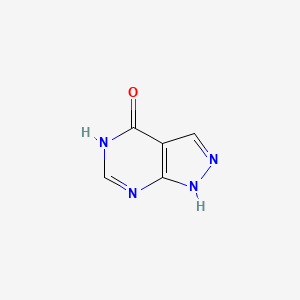
2D structure
Allopurinol
PubChem CID 135401907Molecular formula: C5H4N4O
Allopurinol is a structural analog of the natural purine base, hypoxanthine. After ingestion, allopurinol is metabolized to its active metabolite, oxypurinol (_alloxanthine_) in the liver, which acts as an inhibitor of xanthine oxidase enzyme. Allopurinol and its active metabolite inhibit xanthine oxidase, the enzyme that converts hypoxanthine to xanthine and xanthine to uric acid. Inhibition of this enzyme is responsible for the effects of allopurinol. This drug increases the reutilization of hypoxanthine and xanthine for nucleotide and nucleic acid synthesis by a process that involves the enzyme hypoxanthine-guanine phosphoribosyltransferase (HGPRTase). This process results in an increased nucleotide concentration, which causes feedback inhibition of de novo purine synthesis. The end result is decreased urine and serum uric acid concentrations, which decreases the incidence of gout symptoms. Accompanying the reduction of serum uric acid by allopurinol is an increase in the serum and urine concentrations of hypoxanthine and xanthine (due to inhibition of xanthine oxidase). In the absence of allopurinol, regular urinary excretion of oxypurines almost entirely occurs in the form of uric acid. After the ingestion of allopurinol, the contents of excreted urine are hypoxanthine, xanthine, and uric acid. Because each substance has its own individual solubility, the concentration of uric acid in plasma is decreased without exposing the renal tissues to a high load of uric acid, thereby decreasing the risk of crystalluria. By lowering the uric acid concentration in the plasma below its limits of solubility, allopurinol encourages the dissolution of gout tophi. Although the levels of hypoxanthine and xanthine are found to be increased after allopurinol ingestion, the risk of deposition in renal tissues is less than that of uric acid, as they become more soluble and are rapidly excreted by the kidney. Allopurinol inhibits xanthine oxidase, the enzyme that catalyzes the conversion of hypoxanthine to xanthine and of xanthine to uric acid. Oxypurinol, a metabolite of allopurinol, also inhibits xanthine oxidase. By inhibiting xanthine oxidase, allopurinol and its metabolite block conversion of the oxypurines (hypoxanthine and xanthine) to uric acid, thus decreasing serum and urine concentrations of uric acid. The drug differs, therefore, from uricosuric agents which lower serum urate concentrations by promoting urinary excretion of uric acid. Xanthine oxidase concentrations are not altered by long-term administration of the drug. Allopurinol does not directly interfere with purine nucleotide or nucleic acid synthesis. The drug, however, indirectly increases oxypurine and allopurinol ribonucleotide concentrations and decreases phosphoribosylpyrophosphate concentrations, thus decreasing de novo purine biosynthesis by pseudofeedback inhibition. In addition, allopurinol increases the incorporation of hypoxanthine and xanthine into DNA and RNA, thereby further decreasing serum urate concentrations. Allopurinol may produce a deficit of total purines (uric acid and oxypurines) amounting to several hundred mg daily. Accompanying the decrease in uric acid produced by allopurinol is an increase in serum and urine concentrations of hypoxanthine and xanthine. Plasma concentrations of these oxypurines do not, however, rise commensurately with the fall in serum urate concentrations and are often 20-30% less than would be expected in view of urate concentrations prior to allopurinol therapy. This discrepancy occurs because renal clearance of the oxypurines is at least 10 times greater than that of uric acid. In addition, normal urinary purine output is almost exclusively uric acid, but after treatment with allopurinol, it is composed of uric acid, xanthine, and hypoxanthine, each having independent solubility. Thus, the risk of crystalluria is reduced. Alkalinization of the urine increases the solubility of the purines, further minimizing the risk
Source: PubChem (NCBI) · compound 135401907
| Product | Manufacturer | Status | Country |
|---|---|---|---|
| ALEZE-100 TABLETS 100MG |
Metro Pharmaceuticals | Registered | Kenya |
| ALEZE-300 TABLETS 300MG |
Metro Pharmaceuticals | Registered | Kenya |
| ALLOFLAM 300 ALLOPURINOL TABLETS USP 300 MG |
Harleys | Registered | Kenya |
| ALLOGOUT-300 300MG |
Pharma Life Science | Registered | Kenya |
| ALLUNO 300 300MG TABLET |
Pro Med Pharmaceuticals | Registered | Kenya |
| G-OUT 100 100 MG |
Psm Pharmaceuticals | Registered | Kenya |
| G-OUT 300 300MG |
Psm Pharmaceuticals | Registered | Kenya |
| LOGOUT TABLETS ALLOPURINOL 100MG |
Sai Pharmaceuticals | Registered | Kenya |
| STRADUMEL 100MG ALLOPURINOL 100MG |
Goodman Agencies | Registered | Kenya |
| STRADUMEL 300MG ALLOPURINOL 300MG |
Goodman Agencies | Registered | Kenya |
| ZYLORIC 100MG TABLETS 100MG |
Beta Healthcare | Registered | Kenya |
| Zyloric 100mg Tablets Tablet |
Beta Healthcare International Limited | Retained | Kenya |
| ZYLORIC 300MG TABLETS 300MG |
Beta Healthcare | Registered | Kenya |
| Zyloric 300mg Tablets Tablet |
Beta Healthcare International Limited | Retained | Kenya |