alprazolam brands
2 registered brands containing alprazolam in Malawi.
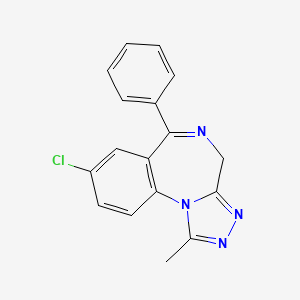
2D structure
Alprazolam
PubChem CID 2118Molecular formula: C17H13ClN4
Neurotransmission relies on excitatory and inhibitory signalling. γ-aminobutyric acid (GABA) type-A receptors (GABA<sub>A</sub>Rs) are members of the pentameric ligand-gated ion channel (PLGIC) superfamily located synaptically and perisynaptically to mediate phasic inhibition and extrasynaptically to mediate tonic inhibition. GABA<sub>A</sub>Rs comprise a variety of subunits from a homologous family whose members are named based on sequence identity as one of α1-6, β1-3, γ1-3, δ, ε, θ, π, and ρ1-3. Each subunit possesses an extracellular (ECD), transmembrane (TMD), and intracellular (ICD) domain; inter-subunit interfaces are the primary points of neurotransmitter and modulator binding, described by coordination of the principal (+) and complementary (-) sites in each subunit. Binding of GABA to GABA<sub>A</sub>Rs induces pore opening, rapid flow of chloride ions, and synaptic hyperpolarization, which in turn manifests as an inhibitory signal. The most prevalent GABA<sub>A</sub>Rs _in vivo_ are the α1β2γ2 receptors, which contain both GABA (β+/α-) and benzodiazepine (BZD, α+/γ-) binding sites in the intersubunit interfaces of the relevant subunits. In general, any receptors containing an α<sub>x</sub>/γ<sub>z</sub> interface, where x = 1-3,5 and z = 1-3, have potential high-affinity BZD binding sites, although small sequence differences between subunits may alter binding affinity to individual molecules. The α4 and α6 subunits, in which an otherwise conserved histidine is replaced by arginine, do not bind traditional BZD ligands such as diazepam and hence are considered "diazepam-insensitive". GABA binding results in a series of conformational changes in the ECDs of GABA<sub>A</sub>R β subunits, "locking" each to its neighbouring α- interface. The binding of alprazolam in the high-affinity BZD site stabilizes the α+/γ- interface and facilitates the conformational changes that lead to pore opening, hence functioning as a positive allosteric modulator. The exact manner in which GABA<sub>A</sub>R allosteric modulation mediates the therapeutic and unwanted effects of benzodiazepines remains unclear. Earlier studies suggested that the primary factor was the α subunit composition, with α1-containing receptors mediating the sedative effects, α2/3-containing receptors the anxiolytic effects, and α5-containing receptors the memory effects of benzodiazepines. More recent studies suggest a more complex set of factors including subunit composition, physiological location, neuronal circuit, and nerve cell type. To further complicate matters, there may be up to five distinct BZD binding sites on GABA<sub>A</sub>Rs, with site 1 corresponding to the classical high-affinity α+/γ- interface. The effects of binding at sites 2-4 are not fully understood and likely impart greater complexity to benzodiazepine pharmacological action. In animals, benzodiazepines protect against seizures induced by electrical stimulation and by pentylenetetrazol; benzodiazepines appear to act, at least partly, by augmenting presynaptic inhibition. The drugs suppress the spread of seizure activity but do not abolish the abnormal discharge from a focus in experimental models of epilepsy. In usual doses, benzodiazepines appear to have very little effect on the autonomic nervous system, respiration, or the cardiovascular system. /Benzodiazepines/ CNS agents of the 1,4 benzodiazepine class presumably exert their effects by binding at stereo specific receptors at several sites within the central nervous system. Their exact mechanism of action is unknown. Clinically, all benzodiazepines cause a dose-related central nervous system depressant activity varying from mild impairment of task performance to hypnosis. Anxiolytic and possibly paradoxical CNS stimulatory effects of benzodiazepines are postulated to result from release of previously suppressed responses (disinhibition). After usual doses of benzodiazepines for several days, the drugs cause a moderate decrease in rapid
Source: PubChem (NCBI) · compound 2118
| Product | Manufacturer | Status | Country |
|---|---|---|---|
| ALPRAF 0.25 0.25MG TABLET TABLET |
- | Registered | Malawi |
| TRANISOL 0.5MG TABLET TABLET |
- | Registered | Malawi |