bortezomib brands
14 registered brands containing bortezomib in South Africa.
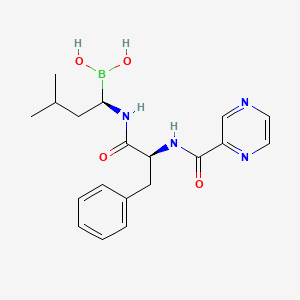
2D structure
Bortezomib
PubChem CID 387447Molecular formula: C19H25BN4O4
The ubiquitin-proteasome pathway is a homeostatic proteolytic pathway for intracellular protein degradation: proteins marked with a poly-ubiquitin chain are degraded to small peptides and free ubiquitin by the proteasome, which is a large multimeric protease. Aberrant proteasome-dependent proteolysis, as seen in some malignancies, can lead to uncontrolled cell division, leading to tumorigenesis, cancer growth, and spread. Bortezomib is a reversible inhibitor of the 26S proteasome, which is made up of a 20S core complexed with a 19S regulatory complex. Individual β-subunits allow specific catalytic action of the 20S core. In mammalian cells, bortezomib is a potent inhibitor of the proteasome’s chymotryptic-like activity, which is attributed to the β5-subunit of the 20S core particle. Bortezomib binds to the active site of the threonine hydroxyl group in the β5-subunit. A probing study showed bortezomib also binding to and inhibiting the β1-subunit, which mediates the caspase-like activity of the proteasome, and β1i-subunit, which is an altered subunit that is expressed to form immunoproteasomes in response to cell stress or inflammation. By inhibiting the proteasome-mediated degradation of key proteins that promote cell apoptosis, bortezomib induces a cell cycle arrest during the G2-M phase. It is believed that multiple mechanisms, other than proteasome inhibition, may be involved in the anticancer activity of bortezomib. The anticancer activity of bortezomib was largely associated with suppression of the NF-κB signalling pathway, resulting in the downregulation of anti-apoptotic target genes and expression of anti-apoptic proteins. This may be explained by bortezomib preventing uncontrolled degradation of IκB, which is an inhibitory protein of NF-κB. NOXA, which is a pro-apoptotic factor, induced by bortezomib selectively in cancer cells; thus, it is suggested to be another key mechanism of bortezomib. Bortezomib, a modified dipeptidyl boronic acid, is an antineoplastic agent. The drug reversibly inhibits the 26S proteasome, a large protein complex that degrades ubiquitinated proteins. The ubiquitin-proteasome pathway plays an essential role in regulating the intracellular concentration of specific proteins, thereby maintaining homeostasis within cells. Inhibition of the 26S proteasome by bortezomib prevents targeted proteolysis and causes disruption of normal homeostatic mechanisms, which can lead to cell death. In vitro studies indicate that bortezomib is cytotoxic to a variety of cancer cell types. Bortezomib has been shown to cause a delay in tumor growth in vivo in tumor models, including multiple myeloma. ... The mechanisms underlying /bortezomib/ cancer cell toxicity are complex. A growing body of evidence suggests proteasome inhibition-dependent regulation of the BCL-2 family is a critical requirement. In particular, the stabilization of BH3-only proteins BIK, NOXA and BIM, appear to be essential for effecting BAX- and BAK-dependent cell death. ... Proteasome inhibition is a novel, targeted approach in cancer therapy. Both natural and synthetic proteasome inhibitors selectively penetrate cancer cells, disrupting the orderly destruction of key regulatory proteins involved in tumorigenesis and metastasis. Disrupting the orderly destruction of regulatory proteins causes an imbalance of these proteins within the cell, which interferes with the systematic activation of signaling pathways required to maintain tumor cell growth and survival; therefore, cellular replication is inhibited and apoptosis ensues. ... Bortezomib (PS-341, Velcade) is a potent and selective inhibitor of the proteasome that is currently under investigation for the treatment of solid malignancies. /Investigators/ have shown previously that bortezomib has activity in pancreatic cancer models and that the drug induces endoplasmic reticulum (ER) stress but also suppresses the unfolded protein response (UPR). Because the UPR is an important cytoprotective
Source: PubChem (NCBI) · compound 387447
| Product | Manufacturer | Status | Country |
|---|---|---|---|
| BERTRED 3,5 | - | Registered | South Africa |
| BORTEZOMIB ADCO | - | Registered | South Africa |
| BORTIV 1 mg/0,4 ml | - | Registered | South Africa |
| BORTIV 2,5 mg/1,0 ml | - | Registered | South Africa |
| BORTIV 3,5 mg/1,4 ml | - | Registered | South Africa |
| BORTURAS 3,5 mg | - | Registered | South Africa |
| MIBLEX | - | Registered | South Africa |
| ONBORT 1 mg/0,4 ml | - | Registered | South Africa |
| ONBORT 2,5 mg/1,0 ml | - | Registered | South Africa |
| ONBORT 3,5 mg/1,4 ml | - | Registered | South Africa |
| SPALBORT 3,5 mg | - | Registrered | South Africa |
| VALTIB | - | Registered | South Africa |
| VALTIB 1,0 mg | - | Registered | South Africa |
| VELBOR IV | - | Registered | South Africa |