budesonide brands
11 registered brands containing budesonide in South Africa.
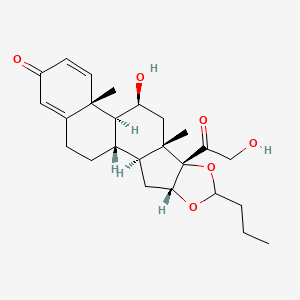
2D structure
Budesonide
PubChem CID 5281004Molecular formula: C25H34O6
The short term effects of corticosteroids are decreased vasodilation and permeability of capillaries, as well as decreased leukocyte migration to sites of inflammation. Corticosteroids binding to the glucocorticoid receptor mediates changes in gene expression that lead to multiple downstream effects over hours to days. Glucocorticoids inhibit neutrophil apoptosis and demargination; they inhibit phospholipase A2, which decreases the formation of arachidonic acid derivatives; they inhibit NF-Kappa B and other inflammatory transcription factors; they promote anti-inflammatory genes like interleukin-10. Lower doses of corticosteroids provide an anti-inflammatory effect, while higher doses are immunosuppressive. High doses of glucocorticoids for an extended period bind to the mineralocorticoid receptor, raising sodium levels and decreasing potassium levels. To investigate the roles of signal transduction and activator of transcription 6 (STAT6) and orosomucoid 1-like 3 (ORMDL3) in airway remodeling among asthmatic mice and to observe the effects of budesonide (BUD) on their expression, thirty mice were randomly divided into control, asthma, and BUD intervention group. The mice were sensitized and challenged with ovalbumin (OVA) to establish a mouse model of asthma. The BUD intervention group received aerosol inhalation of BUD dissolved in normal saline 30 minutes before each OVA challenge, while normal saline was used instead of OVA solution in the control group. The pathological changes in the airway were observed by hematoxylin-eosin staining and Masson staining. The interleukin-13 (IL-13) level in lung homogenate was measured by enzyme-linked immunosorbent assay. The mRNA expression of STAT6 and ORMDL3 was measured by RT-PCR. The asthma group showed more pathological changes in the airway than the control and BUD intervention groups, and the BUD intervention group had reduced pathological changes in the airway compared with the asthma group. The asthma and BUD intervention groups had significantly higher IL-13 levels and mRNA expression of STAT6 and ORMDL3 than the control group (P<0.05), and these indices were significantly higher in the asthma group than in the BUD intervention group (P<0.05). The Pearson correlation analysis showed that STAT6 mRNA expression was positively correlated with ORMDL3 mRNA expression (r=0.676, P=0.032). STAT6 and ORMDL3 may be involved in the airway remodeling of mice, and BUD can reduce airway remodeling in asthmatic mice, possibly by down-regulating mRNA expression of STAT6 and ORMDL3. Mucus hypersecretion from airway epithelium is a characteristic feature of severe asthma. Glucocorticoids (GCs) may suppress mucus production and diminish the harmful airway obstruction. We investigated the ability of GCs to suppress mRNA expression and protein synthesis of a gene encoding mucin, MUC5AC, induced by transforming growth factor (TGF)-alpha in human mucoepidermoid carcinoma (NCI-H292) cells and the molecular mechanisms underlying the suppression. We determined if GCs such as dexamethasone (DEX), budesonide (BUD), and fluticasone (FP) could suppress MUC5AC production induced by a combination of TGF-alpha and double-strand RNA, polyinosinic-polycytidylic acid (polyI:C). MUC5AC mRNA expression and MUC5AC protein production were evaluated. The signaling pathways activated by TGF-alpha and their inhibition by GCs were tested using a phosphoprotein assay and MUC5AC promoter assay. DEX significantly suppressed the expression of MUC5AC mRNA and MUC5AC protein induced by TGF-alpha. The activation of the MUC5AC promoter by TGF-alpha was significantly inhibited by DEX. DEX did not affect activation of downstream pathways of the EGF receptor or mRNA stability of MUC5AC transcripts. DEX, BUD, and FP suppressed MUC5AC protein expression induced by a combination of TGF-alpha and polyI:C in a dose-dependent manner. GCs inhibited MUC5AC production induced by TGF-alpha alone or a combination of TGF-alpha and polyI
Source: PubChem (NCBI) · compound 5281004
| Product | Manufacturer | Status | Country |
|---|---|---|---|
| AEROMIDE | - | Registered | South Africa |
| BREZTRI AEROSPHERE | - | Registered | South Africa |
| BUDETRAM 160:4,5 INHALER | - | Registered | South Africa |
| BUDETRAM 80:4,5 INHALER | - | Registered | South Africa |
| BUDICO 0,25 mg/ml | - | Registered | South Africa |
| BUDICO 0,5 mg/ml | - | Registered | South Africa |
| BUDOFOR 160:4,5 INHALER | - | Registered | South Africa |
| BUDOFOR 80:4,5 INHALER | - | Registered | South Africa |
| FACET TURBUHALER 160:4,5 ug DOSE | - | Registered | South Africa |
| FACET TURBUHALER 80:4,5 ug DOSE | - | Registered | South Africa |
| FCET TURBUHALER 320:9 ug | - | Registered | South Africa |