calcitriol brands
3 registered brands containing calcitriol in Tanzania.
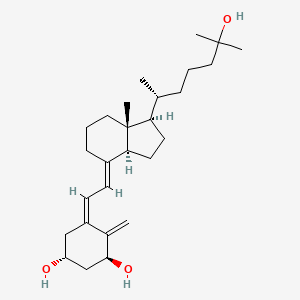
2D structure
Calcitriol
PubChem CID 5280453Molecular formula: C27H44O3
The mechanism of action of calcitriol in the treatment of psoriasis is accounted for by their antiproliferative activity for keratinocytes and their stimulation of epidermal cell differentiation. The anticarcinogenic activity of the active form of Calcitriol appears to be correlated with cellular vitamin D receptor (VDR) levels. Vitamin D receptors belong to the superfamily of steroid-hormone zinc-finger receptors. VDRs selectively bind 1,25-(OH)<sub>2</sub>-D3 and retinoic acid X receptor (RXR) to form a heterodimeric complex that interacts with specific DNA sequences known as vitamin D-responsive elements. VDRs are ligand-activated transcription factors. The receptors activate or repress the transcription of target genes upon binding their respective ligands. It is thought that the anticarcinogenic effect of Calcitriol is mediated via VDRs in cancer cells. The immunomodulatory activity of calcitriol is thought to be mediated by vitamin D receptors (VDRs) which are expressed constitutively in monocytes but induced upon activation of T and B lymphocytes. 1,25-(OH)<sub>2</sub>-D3 has also been found to enhance the activity of some vitamin D-receptor positive immune cells and to enhance the sensitivity of certain target cells to various cytokines secreted by immune cells. A study suggests that calcitriol plays an immunoregulatry role by suppressing the aryl hydrocarbon receptor (AhR) expression in human Th9, a pro-inflammatory CD4 T cell subset. This suppression subsequently leads to repressed expression of BATF, a transcription factor essential for Th9. Calcitriol has also been found to induce monocyte differentiation and to inhibit lymphocyte proliferation and production of cytokines, including interleukin IL-1 and IL-2, as well as to suppress immunoglobulin secretion by B lymphocytes. Ergocalciferol and doxercalciferol (1-hydroxyergocalciferol); cholecalciferol and calcifediol (25-hydroxycholecalciferol); and dihydrotachysterol in their activated forms (1,25-dihydroxyergocalciferol; 1,25-dihydroxycholecalciferol [calcitriol]; and 25-hydroxydihydrotachysterol; respectively), along with parathyroid hormone and calcitonin, regulate serum calcium concentrations; in addition to conversion to the active 1,25-dihydroxycholecalciferol, calcifediol also has intrinsic activity. Calcitriol (activated vitamin D) enhances the efficiency of intestinal calcium absorption along the entire small intestine, but principally in the duodenum and jejunum. Calcitriol also enhances phosphorus absorption along the entire small intestine, but principally in the jejunum and ileum. The activated forms of ergocalciferol, doxercalciferol, and cholecalciferol may have a negative feedback effect on parathyroid hormone (PTH) production. Calcitriol appears to act in intestine in manner that is analogous to the way steroid hormones such as estrogens act on target tissues. ... Cytosol of chicken intestinal cells contains a 3.7 S protein that binds calcitriol specifically and with high affinity. Formation of complex with this receptor facilitates transfer of calcitriol to nuclear chromatin. ... Calcitriol stimulates synthesis of RNA and at least two proteins in intestinal mucosa, alkaline phosphatase and a calcium-binding protein. ... It was proposed that the calcium-binding protein is involved in transport of calcium. ... /However/, it has been reported that calcitriol-induced stimulation of intestinal transport of phosphate precedes that of calcium, and it is possible that primary effect of the vitamin is on phosphate rather than calcium transport. The effects of 1,25-dihydroxyvitamin D3 (I) on the human promyelocytic leukemia cell line HL-60 were investigated. I induces the differentiation of HL-60 into mono- and multinucleated macrophage-like cells. Phenotypic change is evident within 24 hours and reaches a plateau at 72-96 hours of incubation. The changes are metabolite-specific and include adherence to substrate, acquisition of the morphological features
Source: PubChem (NCBI) · compound 5280453
| Product | Manufacturer | Status | Country |
|---|---|---|---|
| CURIOCAL Capsules |
Indichemie Health Specialities | Registered/Compliant | Tanzania |
| Meditrol Capsules |
Mega Lifesciences | Registered/Compliant | Tanzania |
| PHORCAL Ointment |
Kusum Healthcare | Registered/Compliant | Tanzania |