(nystatin · DailyMed)
CANSTAT 100 000U/G VAGINAL TABLET
NYSTATIN
What it does
Nystatin is an antifungal medicine used to treat infections caused by fungi.
Commonly used for: fungal infections, thrush (oral candidiasis), fungal skin infections
Read more in plain English ↓Plain-language summary for general understanding - not medical advice. Always follow your pharmacist/doctor.
Ask about this medicine
Answers come only from this medicine's registration record, BNF monograph and interaction data - not medical advice.
Medicine sourcing is available in Kenya only. We don't sell or dispense medicines - licensed pharmacies do.
Sourcing - Kenya onlyRegistration & product details
Source: Pharmacy and Medicines Regulatory Authority · fetched 2026-04-21 17:37:39 · updated 2026-09-15 04:32:43
About this medicine
Nystatin is an antifungal medicine used to treat infections caused by fungi.
What it treats
- fungal infections
- thrush (oral candidiasis)
- fungal skin infections
How it works
Nystatin works by stopping the growth of fungus, helping to clear up the infection.
Who it's for
Nystatin is suitable for adults and children who have fungal infections.
AI-assisted summary grounded in BNF data - general information only, not medical advice. Always confirm with your pharmacist or doctor.
Clinical monograph: Nystatin
BNF-referencedNystatin is a polyene antifungal agent primarily used to treat fungal infections, particularly those caused by Candida species. It is effective against oral and perioral candidiasis and is administered orally. Nystatin works by binding to sterols in the fungal cell membrane, leading to increased permeability and cell death. It is not active against bacteria or viruses and is available in forms such as oral suspension and tablets.
Indications
- Oral candidiasis
- Perioral fungal infections
- Oropharyngeal candidiasis
Dosage
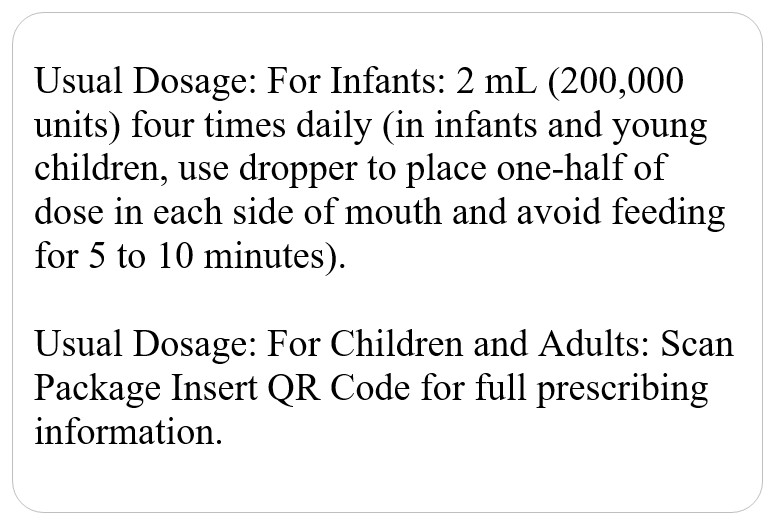
Children: 100,000 units by mouth 4 times a day, usually for 7 days, continued for 48 hours after lesions have resolved.
Adults: 100,000 units by mouth 4 times a day, usually for 7 days, continued for 48 hours after lesions have resolved.
Mechanism of action
Nystatin is a channel-forming ionophore that binds to ergosterol, a sterol found in fungal cell membranes, creating membrane-spanning pores. This disrupts the membrane's integrity, resulting in the leakage of intracellular components and loss of electrochemical gradients essential for cell function, leading to cell death.
Pharmacodynamics
Nystatin exhibits both fungistatic and fungicidal activity against a wide range of yeasts and yeast-like fungi, particularly _Candida albicans_. Resistance is minimal with _Candida albicans_ but may develop in other _Candida_ species. It is ineffective against bacteria, protozoa, or viruses and has significant systemic toxicity, limiting its use to topical and oral applications.
Pharmacokinetics
Nystatin is poorly absorbed from the gastrointestinal tract, which allows it to exert its effects locally within the gut and oral cavity. Because of its limited systemic absorption, it is primarily used for local treatment of fungal infections. The drug is not metabolized systemically and is excreted unchanged in the feces.
Contra-indications
- Infants with impaired swallowing
- Acute porphyrias
Adverse effects
- Abdominal distress
- Angioedema
- Diarrhoea
- Face oedema
- Nausea
- Sensitisation
- Skin reactions
- Stevens-Johnson syndrome
- Vomiting
Precautions
- Caution in patients with acute porphyrias
- Use with care in patients with a history of hypersensitivity to nystatin or other polyene antifungals
Pregnancy
Nystatin is generally considered safe in pregnancy; however, it should be used only if clearly needed and prescribed by a healthcare provider.
Breast-feeding
Nystatin is excreted in breast milk but is considered safe for use during breastfeeding as it is poorly absorbed systemically.
Storage
Store at room temperature, away from direct sunlight and moisture. Keep out of reach of children.
Formulations
- Nystatin oral suspension 100,000 units/ml
- Nystatin tablets
- Nystatin capsules
AI-synthesized from BNF references - general information only, not a substitute for professional medical advice or the current BNF. Verify doses with a pharmacist.
Molecular reference: Nystatin
PubChem CID 6433272Molecular formula: C47H75NO17
Mechanism of action
Nystatin is a channel-forming ionophore, meaning it exerts its therapeutic effect via formation of a membrane-spanning pore in the fungal plasma membrane. The formation of this pore results in a change in membrane permeability that allows for leakage of intracellular contents and the subsequent disruption of electrochemical gradients necessary for proper cell function. Selectivity for fungal cells over mammalian cells is due to nystatin’s greater binding affinity for ergosterol, a key sterol found in fungal cell walls, as opposed to its mammalian counterpart, cholesterol. Nystatin exerts its antifungal activity by binding to sterols in the fungal cell membrane. The drug is not active against organisms (e.g., bacteria) that do not contain sterols in their cell membrane. As a result of this binding, the membrane is no longer able to function as a selective barrier, and potassium and other cellular constituents are lost. ... /Antimicrobial/ agents that act directly on the cell membrane of the microorganism, affecting permeability and leading to leakage of intracellular compounds; these include ... the polyene antifungal agents nystatin ... which bind to cell-wall sterols ...
Pharmacodynamics
Nystatin is an antifungal that is both fungistatic and fungicidal in vitro against a wide variety of yeasts and yeast-like fungi. It exerts its antifungal effects via disruption of the fungal cell membrane. Resistance to nystatin is minimal in _Candida albicans_, but tends to develop in other species of _Candida_. Nystatin carries no significant activity against bacteria, protozoa, or viruses. It carries significant systemic toxicity and is currently unavailable in a formula appropriate for systemic use - its efficacy is currently restricted, therefore, to topical, oral, and gastrointestinal infections.
Source: PubChem (NCBI) · pathways from PathBank, Reactome, WikiPathways & PharmGKB.
This drug in other countries
The same active ingredient registered across other registries we cover - including different brands.
- CLOBEDERM NN OINTMENT · Globe Pharmacy
- DAWASTIN ORAL SUSPENSION · Dawa
- FEMIN - P · Opera Pharma
- FUNGISTIN ORAL SUSPENSION · Elys Chemical Industries
- GYNANFORT VAGINAL PESSARIES · Theralife Pharma
- GYNOSTAT PESSARIES · Macs Pharmaceuticals
- DAWASTIN ORAL SUSPENSION · Dawa
- GYNASTATIN BP · Bliss Gvs Pharma
- LABSTATIN TABLETS · Laboratory & Allied
- MYCOREN SUSPENSION · Rene Industries
- MYCOREN TABLET · Rene Industries
- MYCOREN-V PESSARIES · Rene Industries
- Candistatin · Galentic Pharma
- Demtris Cream · Laboratorios Vitoria
- Fungistin · Elys Chemical Industries
- Labstatin · Laboratory & Allied
- Labstatin V · Laboratory & Allied
- NEO-RAL · Lincoln Pharmaceuticals
- Dawastin suspension · Dawa
- Labstatin Suspension · Laboratory & Allied
- NYSTATIN VAGINAL TABLETS · Vardhman Exports
- Neovag vaginal tablets · Lincoln Parenteral
- Nystaleb suspension · Leben Laboratories
- Nystatin Oral Suspension · Test
- NYSTATIN ORAL SUSPENSION (Each 5ml contains Nystatin 100,000 IU) · Ciron Drugs And Pharmaceutical
- POLYGYNAX VAGINAL CAPSULES · Innothera Chouzy
- POSITON CREAM · Faes Farma
- RONYSTA SUSPENSION · Enicar Pharmaceutical
- RONYSTA VAGINAL TABLETS (Each uncoated vaginal tablet contains Nystatin 100000 I.U) · Ronak Exim
- WELLGYNAX SUPPOSITORIES · Bliss Gvs Pharma