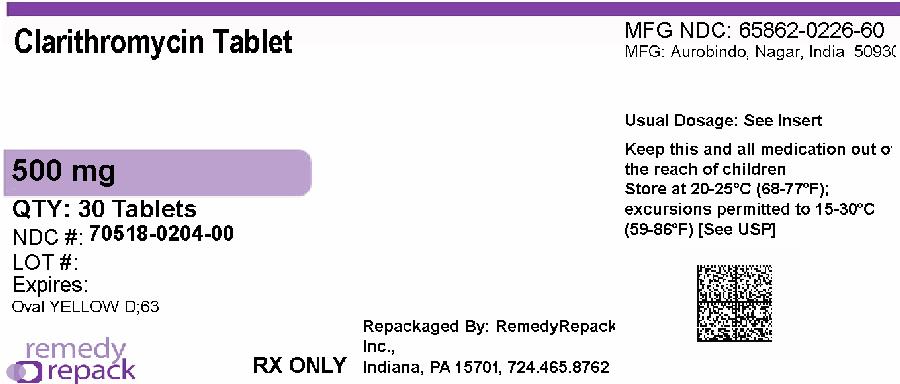
(clarithromycin · DailyMed)
CLARYL-500
CLARITHROMYCIN USP
What it does
Clarithromycin is an antibiotic used to treat infections caused by bacteria.
Commonly used for: bacterial infections, chest infections (pneumonia), skin infections, ear infections (otitis media)
Read more in plain English ↓Plain-language summary for general understanding - not medical advice. Always follow your pharmacist/doctor.
Ask about this medicine
Answers come only from this medicine's registration record, BNF monograph and interaction data - not medical advice.
Medicine sourcing is available in Kenya only. We don't sell or dispense medicines - licensed pharmacies do.
Sourcing - Kenya onlyRegistration & product details
Source: Rwanda Food and Drugs Authority · fetched 2026-03-11 22:07:04 · updated 2026-09-14 02:30:15
Drug Interactions
211Pharmacodynamic Warnings
Clarithromycin appears in TABLE 9: Drugs that prolong the QT interval
Severe (35)
Acalabrutinib - increases exposure
Clarithromycin is predicted to increase the exposure to acalabrutinib. Avoid.
Alprazolam - increases exposure
Clarithromycin moderately increases the exposure to benzodiazepines (alprazolam). Avoid.
Antihistamines,non-Sedating - increases exposure
Clarithromycin is predicted to increase the exposure to antihistamines, non-sedating (mizolastine). Avoid.
Avapritinib - increases exposure
Clarithromycin is predicted to increase the exposure to avapritinib. Avoid.
Benzodiazepines - increases exposure
Clarithromycin moderately increases the exposure to benzodiazepines (alprazolam). Avoid.
Moderate (50)
Alfentanil - increases exposure
Clarithromycin is predicted to increase the exposure to opioids (alfentanil, buprenorphine, fentanyl, oxycodone). Monitor and adjust dose.
Aminophylline - increases exposure
Clarithromycin is predicted to increase the exposure to aminophylline. Adjust dose.
Amlodipine - increases exposure
Clarithromycin is predicted to increase the exposure to calcium channel blockers (amlodipine, felodipine, lacidipine, nicardipine, nifedipine, nimodipine). Monitor and adjust dose.
Antiarrhythmics - increases exposure
Clarithromycin is predicted to increase the exposure to antiarrhythmics (propafenone). Monitor and adjust dose.
Anticholinesterases, Centrally Acting - increases exposure
Clarithromycin is predicted to increase the exposure to anticholinesterases, centrally acting (galantamine). Monitor and adjust dose.
Unknown (126)
Abemaciclib - increases exposure
Clarithromycin is predicted to increase the exposure to abemaciclib. Avoid or adjust abemaciclib dose, p. 1056.
Afatinib - increases exposure
Macrolides are predicted to increase the exposure to afatinib.
Alitretinoin - increases exposure
Clarithromycin is predicted to increase the exposure to retinoids (alitretinoin). Adjust alitretinoin dose, p. 1382.
Almotriptan - increases exposure
Clarithromycin increases the exposure to triptans (almotriptan).
Alphablockers - increases exposure
Clarithromycin is predicted to increase the exposure to alpha blockers (doxazosin).
Data from BNF 85 (British National Formulary). This is not a substitute for professional medical advice. Matched via: exact
About this medicine
Clarithromycin is an antibiotic used to treat infections caused by bacteria.
What it treats
- bacterial infections
- chest infections (pneumonia)
- skin infections
- ear infections (otitis media)
How it works
It works by stopping the growth of bacteria, helping your body to fight off the infection.
Who it's for
It is for adults and children with certain bacterial infections.
Drug class
Macrolides
Cautions
- • Be cautious if you are taking other medications that affect heart rhythm.
AI-assisted summary grounded in BNF data - general information only, not medical advice. Always confirm with your pharmacist or doctor.
Clinical monograph: Clarithromycin
BNF-referencedClarithromycin is a macrolide antibiotic effective against a range of bacterial infections. It is primarily used in the treatment of community-acquired pneumonia, skin infections, and as a prophylactic measure for certain infections. Clarithromycin works by inhibiting bacterial protein synthesis, making it a crucial agent in combating gram-positive and some gram-negative bacteria.
Indications
- Bacterial infections
- Community-acquired pneumonia
- Skin infections
- Prophylaxis for certain infections
Dosage
Adults: 500 mg once daily for
Mechanism of action
Clarithromycin is metabolized to 14-OH clarithromycin, which is active. It penetrates bacterial cell walls and reversibly binds to domain V of the 23S ribosomal RNA of the 50S ribosomal subunit, blocking the translocation of aminoacyl-tRNA and inhibiting polypeptide synthesis. It may be bactericidal in high concentrations against susceptible organisms, particularly Streptococcus pyogenes, S. pneumoniae, Haemophilus influenzae, and Chlamydia trachomatis. Additionally, clarithromycin inhibits the hepatic microsomal CYP3A4 isoenzyme and P-glycoprotein.
Pharmacodynamics
Clarithromycin exhibits a broad spectrum of activity against numerous gram-positive bacteria, including Staphylococcus aureus, Streptococcus pneumoniae, and Streptococcus pyogenes. It also shows activity against gram-negative bacteria such as Haemophilus influenzae and Moraxella catarrhalis, as well as against various anaerobic bacteria, mycobacteria, and other organisms like Mycoplasma, Ureaplasma, and Chlamydia. While typically bacteriostatic, it can sometimes demonstrate bactericidal properties depending on the concentration and the organism.
Pharmacokinetics
Clarithromycin is well absorbed after oral administration, with its bioavailability enhanced by food. It is extensively metabolized in the liver, primarily via CYP3A4, leading to active metabolites. The drug has a half-life of approximately 3 to 4 hours, but its active metabolite, 14-OH clarithromycin, has a longer half-life, contributing to its prolonged activity. Renal impairment can significantly affect its clearance, necessitating dosage adjustments in patients with reduced renal function.
Adverse effects
- Nausea
- Diarrhea
- Abdominal pain
- Dysgeusia
- Headache
- Rash
- Liver enzyme elevations
- QT prolongation
Interactions
- Clarithromycin + acalabrutinib: Severe (increases exposure)
- Clarithromycin + antiarrhythmics: Severe (increases exposure)
- Clarithromycin + dronedarone: Severe (increases exposure)
- Clarithromycin + non-sedating antihistamines: Severe (increases exposure)
- Clarithromycin + mizolastine: Severe (increases exposure)
- Clarithromycin + lurasidone: Severe (increases exposure)
- Clarithromycin + quetiapine: Severe (increases exposure)
- Clarithromycin + avapritinib: Severe (increases exposure)
- Clarithromycin + benzodiazepines: Severe (increases exposure)
- Clarithromycin + alprazolam: Severe (increases exposure)
Precautions
- Caution in hepatic impairment
- Use with caution in renal impairment
- Monitor for signs of QT prolongation
- Consider alternative therapy in patients with history of arrhythmias
- Use with caution in patients with myasthenia gravis due to potential exacerbation
Pregnancy
Manufacturers advise use only if adequate alternatives are not available.
Breast-feeding
Present in milk; use only if no suitable alternatives.
Storage
Store in a cool, dry place away from light. Keep out of reach of children.
Formulations
- Oral suspension 200 mg/5 mL
- Capsules 250 mg
AI-synthesized from BNF references - general information only, not a substitute for professional medical advice or the current BNF. Verify doses with a pharmacist.
Molecular reference: Clarithromycin
PubChem CID 84029Molecular formula: C38H69NO13
Mechanism of action
Clarithromycin is first metabolized to 14-OH clarithromycin, which is active and works synergistically with its parent compound. Like other macrolides, it then penetrates bacteria cell wall and reversibly binds to domain V of the 23S ribosomal RNA of the 50S subunit of the bacterial ribosome, blocking translocation of aminoacyl transfer-RNA and polypeptide synthesis. Clarithromycin also inhibits the hepatic microsomal CYP3A4 isoenzyme and P-glycoprotein, an energy-dependent drug efflux pump. Clarithromycin usually is bacteriostatic, although it may be bactericidal in high concentrations or against highly susceptible organisms. Bactericidal activity has been observed against Streptococcus pyogenes, S. pneumoniae, Haemophilus influenzae, and Chlamydia trachomatis. Clarithromycin inhibits protein synthesis in susceptible organisms by penetrating the cell wall and binding to 50S ribosomal subunits, thereby inhibiting translocation of aminoacyl transfer-RNA and inhibiting polypeptide synthesis. The site of action of clarithromycin appears to be the same as that of erythromycin, clindamycin, lincomycin, and chloramphenicol.
Pharmacodynamics
Clarithromycin is a macrolide antibiotic whose spectrum of activity includes many gram-positive (<i>Staphylococcus aureus, S. pneumoniae, and S. pyogenes</i>) and gram-negative aerobic bacteria (<i>Haemophilus influenzae, H. parainfluenzae, and Moraxella catarrhalis</i>), many anaerobic bacteria, some mycobacteria, and some other organisms including <i>Mycoplasma, Ureaplasma, Chlamydia, Toxoplasma</i>, and <i>Borrelia</i>. Other aerobic bacteria that clarithromycin has activity against include <i>C. pneumoniae and M. pneumoniae</i>. Clarithromycin has an in-vitro activity that is similar or greater than that of erythromycin against erythromycin-susceptible organisms. Clarithromycin is usually bacteriostatic, but may be bactericidal depending on the organism and the drug concentration.
Biological pathways
Source: PubChem (NCBI) · pathways from PathBank, Reactome, WikiPathways & PharmGKB.
This drug in other countries
The same active ingredient registered across other registries we cover - including different brands.
- ACEM 500 · Lazor Pharmaceuticals
- ACL KIT · Universal Corporation
- ASPYORI KIT · Opera Pharma
- AZICLAR 250MG TABLETS · Harleys
- AZICLAR 500 · Harleys
- AZICLAR 500MG TABLETS · Harleys
- CLANZAS SOFT CAPSULES · Aura Lifecare
- CLARIMOON - 500 TABLETS · Aura Lifecare
- CLARITHROMYCIN 500MG TABLETS · Gss Pharma
- CLARITHROMYCIN TABLETS · Vega Biotec
- CLATHRO 500 TABLETS ( Each film coated tablet contains Clarithromycin 500mg · Mars Remedies Pvt Ltd
- Clagycin 250mg Tablet (Each film coated tablet contains Clarithromycin 250mg) · Bliss Gvs Pharma