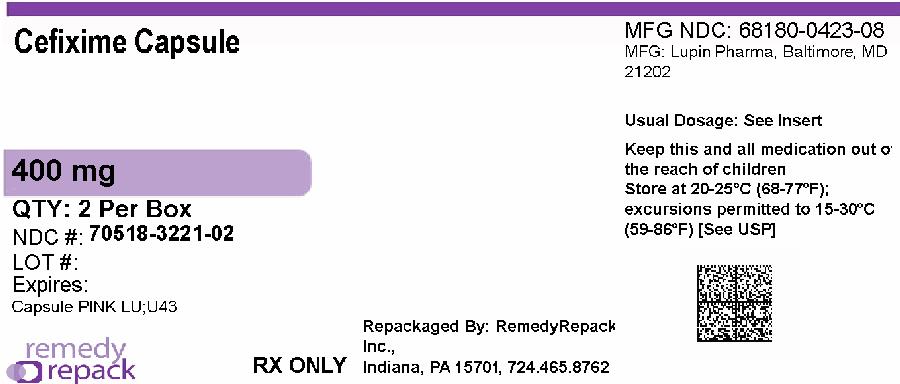
(cefixime · DailyMed)
CTAX T 200 200MG TABLET
CEFIXIME
What it does
Cefixime is an antibiotic used to treat various bacterial infections.
Commonly used for: bacterial infections, urinary tract infections, gonorrhea
Read more in plain English ↓Plain-language summary for general understanding - not medical advice. Always follow your pharmacist/doctor.
Ask about this medicine
Answers come only from this medicine's registration record, BNF monograph and interaction data - not medical advice.
Medicine sourcing is available in Kenya only. We don't sell or dispense medicines - licensed pharmacies do.
Sourcing - Kenya onlyRegistration & product details
Source: Pharmacy and Medicines Regulatory Authority · fetched 2026-04-21 17:37:38 · updated 2026-09-15 04:32:43
Drug Interactions
3Pharmacodynamic Warnings
Cefixime appears in TABLE 2: Drugs that cause nephrotoxicity
Unknown (3)
Cephalosporins - increases exposure
Leflunomideispredictedtoincreasetheexposureto cephalosporins(cefaclor).oTheoretical
Cephalosporins - increases exposure
Nitisinone is predicted to increase the exposure to cephalosporins (cefaclor).
Cephalosporins - increases exposure
Teriflunomide is predicted to increase the exposure to cephalosporins (cefaclor).
Data from BNF 85 (British National Formulary). This is not a substitute for professional medical advice. Matched via: class
About this medicine
Cefixime is an antibiotic used to treat various bacterial infections.
What it treats
- bacterial infections
- urinary tract infections
- gonorrhea
How it works
Cefixime works by stopping the growth of bacteria, helping the body to fight off the infection.
Who it's for
Cefixime is for people with bacterial infections that can be treated with this type of antibiotic.
Drug class
Cephalosporins
Cautions
- • Be cautious if taking other medications that can harm the kidneys.
AI-assisted summary grounded in BNF data - general information only, not medical advice. Always confirm with your pharmacist or doctor.
Clinical monograph: Cefixime
BNF-referencedCefixime is a third-generation cephalosporin antibiotic, effective against a range of Gram-positive and Gram-negative bacterial infections. It works by inhibiting bacterial cell wall synthesis, leading to cell lysis. As a broad-spectrum antibiotic, cefixime is particularly useful in treating infections caused by bacteria that produce beta-lactamase enzymes, which typically confer resistance to other penicillins and cephalosporins.
Indications
- Bacterial infections due to sensitive Gram-positive and Gram-negative bacteria
- Surgical prophylaxis
- Haemophilus influenzae epiglottitis
- Acute infections
- Meningitis (emergency treatment)
- Uncomplicated gonorrhoea
- Disseminated gonococcal infection
Dosage
Children: In children aged 1 month to 11 years
Adults: For adults, the typical dosage is 1 g every 12 hours for severe infections, or 400 mg for a single dose in cases of uncomplicated gonorrhoea.
Mechanism of action
Cefixime binds to penicillin-binding proteins (PBPs) located in the bacterial cell wall. This binding inhibits the transpeptidase activity essential for peptidoglycan cross-linking, thereby disrupting cell wall synthesis and integrity, which ultimately leads to bacterial cell lysis, especially in rapidly growing bacteria.
Pharmacodynamics
Cefixime exhibits bactericidal activity by preventing the final stages of bacterial cell wall synthesis. It is stable against certain beta-lactamases, making it effective against some resistant bacterial strains. The drug can cause hypersensitivity reactions and is associated with a risk of Clostridium difficile-associated diarrhea. It may also lead to a decrease in prothrombin activity, necessitating caution in susceptible populations.
Pharmacokinetics
Cefixime is well-absorbed after oral administration, with a bioavailability of approximately 40-50%. Peak plasma concentrations occur within 2-6 hours post-dose. It is widely distributed in body tissues and fluids, including urine. The drug is primarily eliminated via the kidneys, with dose adjustments required in patients with renal impairment. Cefixime has a half-life of about 3-4 hours, necessitating multiple doses for sustained therapeutic effect.
Contra-indications
- Hypersensitivity to cefixime or other cephalosporins
- Severe renal impairment
Adverse effects
- Acute kidney injury
- Arthralgia
- Drug fever
- Dyspepsia
- Dyspnoea
- Edema
- Flatulence
- Genital pruritus
- Hypereosinophilia
- Jaundice
- Serum sickness-like reaction
- Thrombocytosis
Interactions
- Probenecid may increase cefixime levels
- Cephalosporins may interact with anticoagulants and increase bleeding risk
- Certain antibiotics may have additive effects
Precautions
- Caution in patients with a history of gastrointestinal disease, particularly colitis
- Monitor renal function in patients with renal impairment
- Use with caution in patients on dialysis
Pregnancy
Not known to be harmful.
Breast-feeding
Present in milk in low concentrations; use with caution.
Storage
Store in a cool, dry place away from direct light. Keep out of reach of children.
Formulations
- Oral tablets
- Injection (intravenous and intramuscular)
AI-synthesized from BNF references - general information only, not a substitute for professional medical advice or the current BNF. Verify doses with a pharmacist.
Molecular reference: Cefixime
PubChem CID 5362065Molecular formula: C16H15N5O7S2
Mechanism of action
The bacterial cell wall, which is located at the periphery of Gram-positive bacteria and within the periplasm of Gram-negative bacteria, comprises a glycopeptide polymer synthesized through cross-linking of glycans to peptide stems on alternating saccharides, which is known commonly as peptidoglycan. Cell wall formation, recycling, and remodelling require numerous enzymes, including a family of enzymes with similar active site character despite distinct and sometimes overlapping roles as carboxypeptidases, endopeptidases, transpeptidases, and transglycosylases, known as "penicillin-binding proteins" (PBPs). The number of PBPs differs between bacteria, in which some are considered essential and others redundant. In general, inhibition of one or more essential PBPs results in impaired cell wall homeostasis, loss of cell integrity, and is ultimately bactericidal. Cefixime is a cephalosporin and cephalosporins work by using their beta-lactam rings to inhibit bacterial cell wall synthesis by binding to the penicillin-binding proteins transpeptidases on bacteria. The inhibition of synthesis of the bacteria cell wall will cause lysis, particularly in fast growing organisms such as bacteria. Specifically, cephalosporins inhibit penicillin-sensitive enzymes responsible for the final 3D structure of the bacterial cell wall which in turn inhibit bacterial cell wall peptidoglycan synthesis.
Pharmacodynamics
Cefixime, a broad-spectrum antibiotic, is an orally-active third-generation semisynthetic cephalosporin. Like other cephalosporins, the antibacterial action of cefixime results from inhibition of cell wall synthesis. Also like other cephalosporins, cefixime is stable when in the presence of certain beta-lactamase enzymes, which means certain organisms resistant to penicillins and some cephalosporins due to the presence of beta-lactamases could be susceptible to cefixime. Use of cefixime can result in hypersensitivity reactions including anaphylactic/anaphylactoid reactions and _Clostridium difficile_-associated diarrhea (CDAD); it may also be associated with a fall in prothrombin activity. Cefixime doses should be adjusted for patients that have renal impairment and patients undergoing continuous ambulatory peritoneal dialysis (CAPD) and hemodialysis (HD), while patients on dialysis should be monitored while taking cefixime.
Source: PubChem (NCBI) · pathways from PathBank, Reactome, WikiPathways & PharmGKB.
This drug in other countries
The same active ingredient registered across other registries we cover - including different brands.