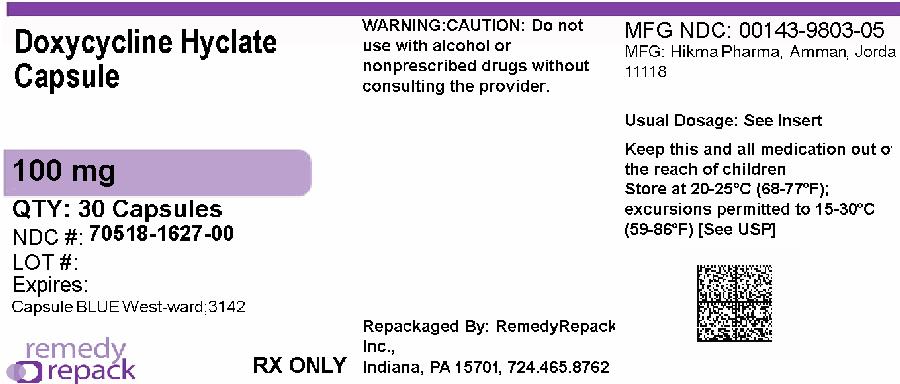
(doxycycline · DailyMed)
DOXAN CAPSULES
DOXYCYCLINE HYDROCLORIDE
What it does
Doxycycline is an antibiotic used to treat various infections.
Commonly used for: bacterial infections, acne, respiratory infections, malaria prevention
Read more in plain English ↓Plain-language summary for general understanding - not medical advice. Always follow your pharmacist/doctor.
Ask about this medicine
Answers come only from this medicine's registration record, BNF monograph and interaction data - not medical advice.
Hard to find? We help patients in Kenya source rare medicines. We don't sell or dispense medicines - licensed pharmacies do.
Source this medicineRegistration & product details
Source: Pharmacy and Poisons Board · fetched 2026-01-28 22:13:13 · updated 2026-03-23 04:58:25
Drug Interactions
11Pharmacodynamic Warnings
Doxycycline appears in TABLE 1: Drugs that cause hepatotoxicity
Severe (1)
Tetracyclines - decreases absorption
Strontium is predicted to decrease the absorption of tetracyclines. Avoid. Theoretical Sucralfate
Moderate (5)
Doxycycline - decreases concentration
Fosphenytoin is predicted to decrease the concentration of tetracyclines (doxycycline). Adjust dose.
Doxycycline - decreases exposure
Rifampicin modestly decreases the exposure to tetracyclines (doxycycline). Adjust dose.
Lithium - increases risk of lithium toxicity
Tetracyclines are predicted to increase the risk of lithium toxicity when given with lithium. Avoid or adjust dose.
Tetracyclines - decreases concentration
Fosphenytoin is predicted to decrease the concentration of tetracyclines (doxycycline). Adjust dose.
Tetracyclines - decreases exposure
Rifampicin modestly decreases the exposure to tetracyclines (doxycycline). Adjust dose.
Unknown (5)
Ciclosporin - increases concentration
Doxycyclineispredictedtoincreasetheconcentrationof ciclosporin.rTheoretical
Tetracyclines - decreases exposure
Mitotane is predicted to decrease the exposure to tetracyclines (eravacycline). Adjust eravacycline dose, p. 625.
Tetracyclines - decreases exposure
Rifampicin is predicted to decrease the exposure to tetracyclines (eravacycline). Adjust eravacycline dose, p. 625.
Tetracyclines - decreases exposure
St John's wort is predicted to decrease the exposure to tetracyclines (eravacycline). Adjust eravacycline dose, p. 625.
Tetracyclines - decreases absorption
Oralzincispredictedtodecreasetheabsorptionof tetracyclines.Separateadministrationby2to3hours. oTheoretical https://www.facebook.c (Books-Courses-Medic
Data from BNF 85 (British National Formulary). This is not a substitute for professional medical advice. Matched via: class
About doxycycline
Doxycycline is an antibiotic used to treat various infections.
What it treats
- bacterial infections
- acne
- respiratory infections
- malaria prevention
How it works
It works by stopping the growth of bacteria.
Who it's for
It is for adults and children who need treatment for bacterial infections.
Drug class
Tetracyclines
Cautions
- • Be cautious if taking other medications that can harm the liver.
AI-assisted summary grounded in BNF data - general information only, not medical advice. Always confirm with your pharmacist or doctor.
About hydrocloride
Hydrochloride is a medication that may be used for various health conditions.
How it works
Hydrochloride works by affecting certain chemicals in the body to help treat specific conditions.
Who it's for
This medication is generally prescribed based on individual health needs.
AI-assisted summary grounded in BNF data - general information only, not medical advice. Always confirm with your pharmacist or doctor.
Clinical monograph: Doxycycline
BNF-referencedDoxycycline is a broad-spectrum tetracycline antibiotic effective against a variety of bacterial infections. It acts by inhibiting protein synthesis in susceptible bacteria, thereby halting their growth and replication. It is commonly used for treating infections such as chlamydia, rickettsia, and mycoplasma, and is also indicated for acne and certain periodontal diseases.
Indications
- Bacterial infections
- Acne
- Destructive (refractory) periodontal disease
- Exacerbations of chronic bronchitis
- Leptospirosis
- Chlamydia infections
- Rickettsial infections
- Mycoplasma infections
- Acute necrotising ulcerative gingivitis
Dosage
Children: For children aged 12–17 years, initially 200 mg daily in 1–2 divided doses for the
Adults: Initially 200 mg daily in 1–2 divided doses for the first day, then maintenance 100 mg daily.
Mechanism of action
Doxycycline exerts its antibacterial effects by binding to the 30S ribosomal subunit of bacterial ribosomes, inhibiting the binding of aminoacyl-tRNA to the mRNA-ribosome complex. This inhibition of protein synthesis is crucial for bacterial growth and is the primary mechanism by which doxycycline exhibits its antimicrobial activity. It also impacts cellular metabolism and has been associated with non-genotoxic carcinogenic effects.
Pharmacodynamics
Doxycycline has a broad spectrum of activity against Gram-positive, Gram-negative bacteria, and some protozoa. Its bacteriostatic action is particularly effective against certain resistant strains, including MRSA. The drug's efficacy may vary based on the sensitivity of the bacteria, and resistance can develop through various mechanisms, such as efflux pumps and ribosomal protection.
Pharmacokinetics
Doxycycline is well absorbed from the gastrointestinal tract, with peak plasma concentrations typically reached within 2 hours after oral administration. It has a high volume of distribution and is approximately 90% protein-bound. The drug is metabolized in the liver and excreted primarily in feces, with a smaller fraction eliminated in urine. The half-life of doxycycline is approximately 18 to 22 hours, allowing for once or twice daily dosing in most cases.
Contra-indications
- Pregnancy
- Breastfeeding
- Hypersensitivity to doxycycline or other tetracyclines
- Myasthenia gravis
- Severe hepatic impairment
Adverse effects
- Photosensitivity
- Dizziness
- Headache
- Nausea
- Vomiting
- Diarrhoea
- Angioedema
- Skin reactions
- Pseudomembranous enterocolitis
- Tooth discolouration
- Intracranial hypertension
- Thrombocytopenia
- Stevens-Johnson syndrome
- Pancreatitis
Interactions
- Fosphenytoin (decreases concentration)
- Rifampicin (decreases exposure)
- Ciclosporin (unknown effect on concentration)
- Antacids containing aluminium or magnesium (reduce absorption)
- Iron supplements (reduce absorption)
- Warfarin (may enhance anticoagulant effect)
Precautions
- Use with caution in renal impairment
- May cause increased intracranial pressure
- Risk of superinfection (e.g., fungal infections)
- Avoid exposure to sunlight or sun lamps
- Monitor liver function in patients receiving prolonged therapy
Pregnancy
Should not be given to pregnant women; effects on skeletal development have been documented in the first trimester in animal studies. Administration during the second or third trimester may cause discoloration of the child's teeth, and maternal hepatotoxicity has been reported with large parenteral doses.
Breast-feeding
Should not be given to women who are breastfeeding; absorption may lead to discoloration of teeth in the infant.
Storage
Store in a cool, dry place away from light. Keep out of reach of children.
Formulations
- Tablets
- Capsules
- Oral suspension
- Oral solution
AI-synthesized from BNF references - general information only, not a substitute for professional medical advice or the current BNF. Verify doses with a pharmacist.
Clinical monograph: hydrocloride
BNF-referencedHydrochloride, commonly referred to as hydrogen chloride when in aqueous solution, is a strong acid that is highly soluble in water. It is utilized in various clinical settings due to its potent acidic properties. Hydrogen chloride dissociates in water to form hydronium ions, which are responsible for its biological activity. This compound can induce cellular injury and necrosis due to its highly reactive nature.
Indications
- Acid-base balance disorders
- pH adjustment in various medical solutions
- Chemical burns in controlled settings
Dosage
Children: Refer to specific clinical guidelines for appropriate dosing as it can vary based on the condition and clinical scenario.
Adults: Refer to specific clinical guidelines for appropriate dosing as it can vary based on the condition and clinical scenario.
Mechanism of action
The biological activity of hydrogen chloride is associated with its high solubility in water, where it dissociates almost completely. The hydrogen ion interacts with water molecules to form the hydronium ion, which acts as a proton donor with catalytic properties, allowing it to react with organic molecules. This interaction can lead to cellular injury and necrosis.
Pharmacodynamics
Hydrochloride exerts its effects primarily through the formation of hydronium ions, which lower the pH of the surrounding environment and can disrupt cellular processes. The acidic nature of this compound facilitates various chemical reactions that may affect cellular integrity and function.
Pharmacokinetics
As an acid, hydrochloride does not undergo traditional pharmacokinetic processes such as absorption, distribution, metabolism, and excretion in the same way as conventional drugs. Its effects are immediate upon exposure, as it dissociates in solution to exert its acidic properties.
Pregnancy
Hydrochloric acid is classified as category C, meaning risk cannot be ruled out. Use only if the potential benefit justifies the potential risk to the fetus.
Breast-feeding
It is not known whether hydrochloric acid is excreted in human milk. Caution should be exercised when administered to breastfeeding women.
Storage
Store in a cool, dry place, away from light and tightly sealed to prevent moisture absorption.
AI-synthesized from BNF references - general information only, not a substitute for professional medical advice or the current BNF. Verify doses with a pharmacist.
Molecular reference: Doxycycline
PubChem CID 54671203Molecular formula: C22H24N2O8
Biological pathways
Source: PubChem (NCBI) · pathways from PathBank, Reactome, WikiPathways & PharmGKB.
Molecular reference: hydrocloride
PubChem CID 313Molecular formula: ClH
Mechanism of action
The biological activity of hydrogen chloride is associated with its high solubility in water i.e., 23 moles/L at 0 °C. ... The hydrogen chloride in water dissociates almost completely, with the hydrogen ion captured by the water molecules to form the hydronium ion. The hydronium ion becomes a donor of a proton that possesses catalytic properties and thus is capable of reacting with organic molecules. This may explain the ability of hydrogen chloride to induce cellular injury and necrosis.
Biological pathways
Source: PubChem (NCBI) · pathways from PathBank, Reactome, WikiPathways & PharmGKB.
This drug in other countries
The same active ingredient registered across other registries we cover - including different brands.
- AMPROLIUM 20% WATER SOLUBLE POWDER · Shijiazhuang Jinding Pharmaceutical
- CENTRE TYLODOXINE FORTE WSP · Aether Centre Biology
- CENTRE- ERYSTREP SOLUBLE POWDER · Aether Centre Biology
- CENTRE-NEODOX SOLUBLE POWDER (Each 1g contains Neomycin sulphate/ Doxycycline hydrochloride 200mg/100mg) · Aether Centre Biology
- CENTRE-TIAMDOX WATER SOLUBLE POWDER · Aether Center Biology
- CRDSTOP WATER SOLUBLE POWDER · Maridav Ghana
- ASDOXIN 100MG CAPSULE
- DORYX 100MG CAPSULE
- DOXACIL 100MG CAPSULES
- DOXCYL 100 MG CAPSULE
- DOXICON 100MG CAPSULE
- DOXIMED 100MG CAPSULE
- AGODOX · Agog Pharma
- AURASERT 100 · Aurobindo Pharma
- AURASERT 50 · Aurobindo Pharma
- Ashidox-G · Ashish Life Science
- Baoxycilin 50 wsp · Hebei Yuanzheng Pharmaceutical
- Batylosin Plus · Hebei Yuanzheng Pharmaceutical
- AGODOX CAPSULES · Agog Pharma
- Biodox capsules · Biodeal Laboratories
- DOXIL-100 · Maxtar Bio-genics
- DOXY 200 · Gracure Pharmaceuticals
- DOXY CAPSULES · Laboratory & Allied
- DOXY-DENK 100 · Artesan Pharma