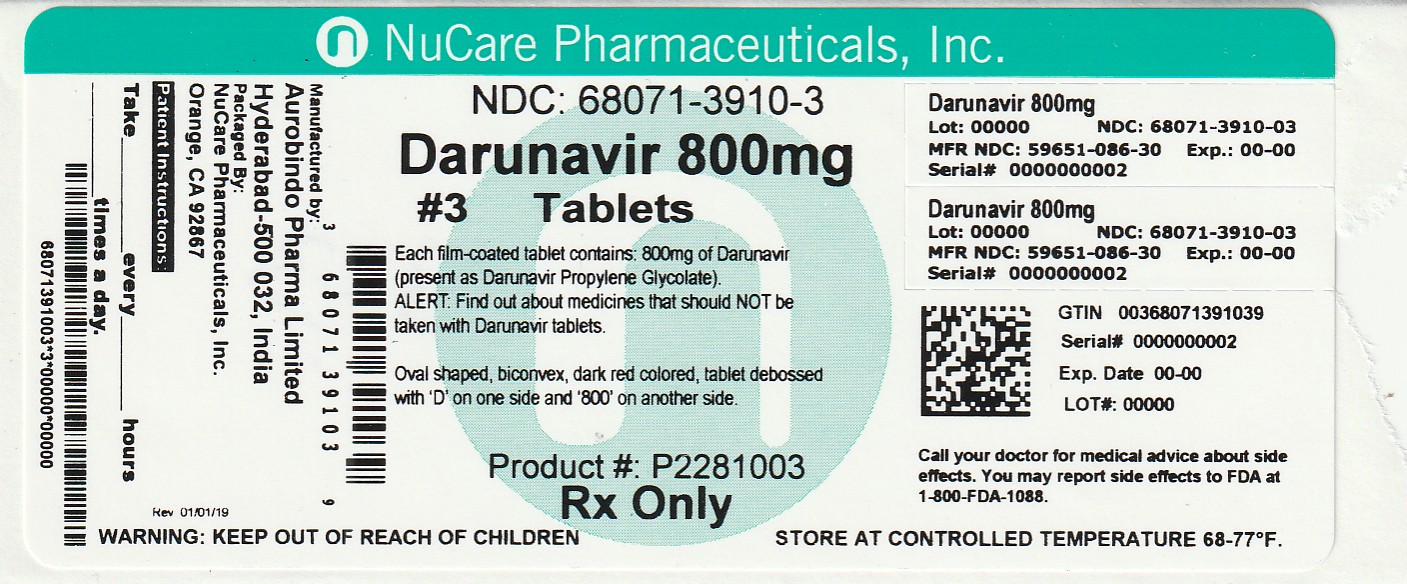
(darunavir · DailyMed)
Durart 800
Darunavir Ethanolate 800 mg
What it does
Darunavir is an antiviral medicine used to treat HIV infection.
Commonly used for: HIV infection, human immunodeficiency virus (HIV)
Read more in plain English ↓Plain-language summary for general understanding - not medical advice. Always follow your pharmacist/doctor.
Ask about this medicine
Answers come only from this medicine's registration record, BNF monograph and interaction data - not medical advice.
Medicine sourcing is available in Kenya only. We don't sell or dispense medicines - licensed pharmacies do.
Sourcing - Kenya onlyRegistration & product details
Source: Tanzania Medicines and Medical Devices Authority · fetched 2026-03-11 23:53:54 · updated 2026-09-14 03:00:45
Drug Interactions
1Unknown (1)
Raltegravir - increases risk of rash
Darunavir increases the risk of rash when given with raltegravir.
Data from BNF 85 (British National Formulary). This is not a substitute for professional medical advice. Matched via: exact
About darunavir
Darunavir is an antiviral medicine used to treat HIV infection.
What it treats
- HIV infection
- human immunodeficiency virus (HIV)
How it works
It helps to control the virus, allowing the immune system to work better.
Who it's for
This medicine is for people living with HIV.
AI-assisted summary grounded in BNF data - general information only, not medical advice. Always confirm with your pharmacist or doctor.
About ethanolate
Ethanolate is a medication that can be used in certain treatments.
What it treats
- alcohol dependence
- alcohol use disorder
How it works
Ethanolate helps to reduce cravings for alcohol and aids in achieving sobriety.
Who it's for
This medication is for adults who are trying to overcome alcohol dependence.
AI-assisted summary grounded in BNF data - general information only, not medical advice. Always confirm with your pharmacist or doctor.
Clinical monograph: Darunavir
BNF-referencedDarunavir is a potent HIV protease inhibitor used in the treatment of HIV infection. It is utilized as part of highly active antiretroviral therapy (HAART) and is effective in suppressing viral replication, leading to improved immune function and reduced morbidity and mortality associated with HIV infection. Darunavir is typically administered in combination with other antiretroviral agents to enhance therapeutic efficacy.
Indications
- HIV infection in combination with other antiretroviral drugs in patients previously treated with antiretroviral therapy
- HIV infection in combination with other antiretroviral drugs in treatment-naive patients
Dosage
Children: For children weighing 14-20 kg: 0.5 tablet twice daily; for children weighing 30 kg and above: 1 tablet twice daily. Refer to BNF for Children for detailed dosing guidelines.
Adults: 800 mg once daily or 600 mg twice daily, depending on previous treatment history and viral load.
Mechanism of action
Darunavir functions by binding to the HIV-1 protease enzyme, which is critical for viral protein processing and maturation necessary for HIV replication. By inhibiting the protease, darunavir prevents the cleavage of Gag-Pol proteins in infected cells, thus halting the formation of mature and infectious virions. Its ability to interact with multiple sites on the protease enzyme contributes to its effectiveness, particularly against resistant strains of HIV.
Pharmacodynamics
As a protease inhibitor, darunavir effectively lowers HIV viral load and enhances CD4 cell counts when used in combination with ritonavir and other antiretroviral medications. This mechanism leads to a significant decrease in morbidity and mortality rates in patients with HIV infection, improving overall health outcomes.
Pharmacokinetics
Darunavir is well-absorbed following oral administration. It has a high protein binding rate, primarily to albumin and alpha-1 acid glycoprotein. The drug undergoes hepatic metabolism, primarily via the cytochrome P450 system, particularly CYP3A4, and has a half-life that allows for once or twice daily dosing. The pharmacokinetics may vary based on the presence of food and other medications.
Adverse effects
- rash
- nausea
- diarrhea
- headache
- fatigue
- hepatotoxicity
- gastrointestinal disorders
- depression
- memory loss
- gynaecomastia
- nephrolithiasis
- severe cutaneous adverse reactions (SCARs)
Interactions
- darunavir + cobicistat: increased risk of adverse reactions
- darunavir + ritonavir: synergistic effect on HIV suppression
- darunavir + raltegravir: unknown interaction, increased risk of rash
Precautions
- monitor liver function tests
- watch for signs of severe skin reactions
- caution in patients with a history of drug allergies
- monitor for signs of nephrolithiasis
- consider potential drug interactions with other antiretrovirals
Pregnancy
Darunavir is generally considered safe to use during pregnancy; however, it should be used under the guidance of a healthcare provider as part of a comprehensive antiretroviral therapy plan.
Breast-feeding
Darunavir is excreted in breast milk; the decision to breastfeed while on darunavir should involve a risk-benefit assessment with a healthcare provider.
Storage
Store at room temperature, protect from moisture and light. Keep out of reach of children.
Formulations
- Darunavir oral suspension 100 mg/ml
- Darunavir 400 mg tablets
- Darunavir 600 mg tablets
- Darunavir 800 mg tablets
- Darunavir 75 mg tablets
- Darunavir 150 mg tablets
AI-synthesized from BNF references - general information only, not a substitute for professional medical advice or the current BNF. Verify doses with a pharmacist.
Clinical monograph: ethanolate
BNF-referencedEthanolate, also known as sodium ethoxide, is a chemical compound with the molecular formula C2H5O. It is primarily used as a reagent in organic synthesis and has applications in various industrial processes. It acts as a strong base and nucleophile, making it valuable in the production of various chemical compounds.
Dosage
Children: Refer to specific guidelines for dosing based on the clinical context, as ethanolate is primarily used as a reagent rather than a therapeutic agent.
Adults: Refer to specific guidelines for dosing based on the clinical context, as ethanolate is primarily used as a reagent rather than a therapeutic agent.
Mechanism of action
Ethanolate acts as a strong base, facilitating deprotonation reactions in organic synthesis. It can also act as a nucleophile, attacking electrophilic centers in various organic compounds, leading to the formation of new covalent bonds. This property makes it useful in the synthesis of esters, ethers, and other organic molecules.
Pharmacodynamics
As a strong base, ethanolate can increase the pH of solutions, affecting the ionization of other compounds. Its reactivity allows for the formation of various intermediates in chemical reactions, which can lead to diverse synthetic pathways in organic chemistry. However, specific pharmacodynamic effects in clinical settings are not well documented, as its primary use is in laboratory and industrial contexts.
Pharmacokinetics
Ethanolate is not typically administered in a clinical setting, so detailed pharmacokinetic data is limited. In general, when used in laboratory settings, its effects and interactions can vary depending on the specific organic compounds involved in the reaction. It is important to handle ethanolate with care due to its reactivity and potential hazards.
Pregnancy
There are no adequate and well-controlled studies in pregnant women. Use only if clearly needed.
Breast-feeding
Ethanolate is excreted in human milk, caution should be exercised when administering to a nursing woman.
Storage
Store in a cool, dry place, away from light. Keep out of reach of children.
AI-synthesized from BNF references - general information only, not a substitute for professional medical advice or the current BNF. Verify doses with a pharmacist.
Molecular reference: Darunavir
PubChem CID 213039Molecular formula: C27H37N3O7S
Mechanism of action
The HIV-1 protease enzyme is necessary for viral precursor protein processing and viral maturation in preparation for infection, and is therefore a target for antiretroviral therapy for HIV. Protease inhibitors are used as a part of highly active antiretroviral therapy (HAART) in patients diagnosed with HIV infection. It has been shown to effectively suppress the virus, leading to significantly decreased morbidity and mortality rates. Darunavir, a HIV protease inhibitor, prevents HIV replication through binding to the enzyme, stopping the dimerization and the catalytic activity of HIV-1 protease. In particular, it inhibits the cleavage of HIV encoded Gag-Pol proteins in cells that have been infected with the virus, halting the formation of mature virus particles, which spread the infection. The close contact that darunavir makes with the primary chains of the active site amino acids (Asp-29 and Asp-30) on the protease likely contributes to its potency and efficacy against resistant variants of HIV-1. Darunavir is known to bind to different sites on the enzyme: the active site cavity and the surface of one of the flexible flaps in the protease dimer. Darunavir can adapt to changes in the shape of a protease enzyme due to its molecular flexibility. Darunavir as a protease inhibitor inhibits the cleavage of HIV encoded gag-pol polyproteins in virus infected cells, thereby preventing the formation of mature and infectious new virions. It was selected for its potency against wild type HIV-1 and HIV strains resistant to currently approved protease inhibitors. Darunavir is an inhibitor of the HIV-1 protease. It selectively inhibits the cleavage of HIV encoded Gag-Pol polyproteins in infected cells, thereby preventing the formation of mature virus particles.
Pharmacodynamics
Darunavir is an inhibitor of the human immunodeficiency virus (HIV) protease, which prevents HIV viral replication. When administered with ritonavir in combination antiretroviral therapy, darunavir significantly decreases viral load and increases CD4 cell counts, decreasing the morbidity and mortality of HIV infection.
Source: PubChem (NCBI) · pathways from PathBank, Reactome, WikiPathways & PharmGKB.
Molecular reference: ethanolate
PubChem CID 119440Molecular formula: C2H5O-
Source: PubChem (NCBI) · pathways from PathBank, Reactome, WikiPathways & PharmGKB.
This drug in other countries
The same active ingredient registered across other registries we cover - including different brands.
- DARUNAVIR AND RITONAVIR TABLETS · Unisel
- DARUNAVIR TABLETS 400MG · Dawa
- DARUNAVIR TABLETS 400MG · Unisel
- DARUNAVIR TABLETS 400MG · Laurus Labs Limited
- DARUNAVIR TABLETS 600MG · Dawa
- DARUNAVIR TABLETS 600MG · Unisel
- DARUNAVIR 400MG TABLET
- DARUNAVIR 600MG TABLET
- DARUNAVIR 600MG TABLET
- DARUNAVIR 800MG TABLET
- DARUNAVIR+COBICISTAT 800/150MG TABLET
- DARUNAVIR+RITONAVIR 400/50MG TABLET
- DARUNAVIR AND RITONAVIR TABLETS · Hetero Labs
- DARUNAVIR AND RITONAVIR TABLETS · Hetero Labs
- DARUNAVIR TABLETS 600 MG · Hetero Labs
- DARUNAVIR)-600 · Cipla
- DARUNAVIR-400 · Cipla
- DURART 600 · Mylan Laboratories
- DURART 600 · Mylan Laboratories
- DURART 800 · Mylan Laboratories
- Darunavir 400mg Tablets · Laurus Labs Ltd
- Darunavir 400mg+ Ritonavir 50mg Tablets · Hetero Labs
- Darunavir 600 tablets · Hetero Labs
- Darunavir 600mg Tablets · Laurus Labs Ltd
- DARUNAVIR · Cipla
- DARUNAVIR · Laurus Labs
- DARUNAVIR · Laurus Labs
- DARUNAVIR · Laurus Labs
- DARUNAVIR AND RITONAVIR TABLETS 800MG/100MG · Hetero Labs
- DARUNAVIR; RITONAVIR · Mylan Laboratories