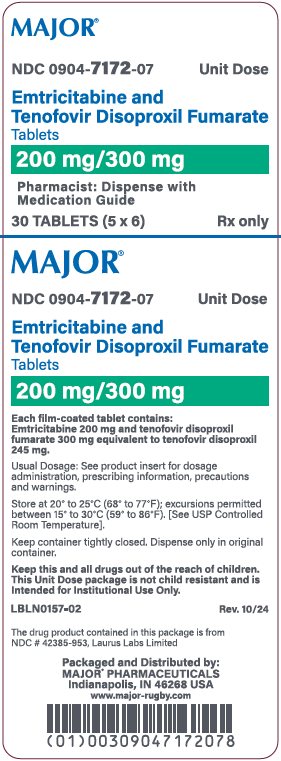
(emtricitabine · DailyMed)
EMFANEF
Emtricitabine 200mg
What it does
Emtricitabine is an antiviral medication used to treat HIV infection.
Commonly used for: HIV infection (human immunodeficiency virus)
Read more in plain English ↓Plain-language summary for general understanding - not medical advice. Always follow your pharmacist/doctor.
Ask about this medicine
Answers come only from this medicine's registration record, BNF monograph and interaction data - not medical advice.
Medicine sourcing is available in Kenya only. We don't sell or dispense medicines - licensed pharmacies do.
Sourcing - Kenya onlyRegistration & product details
Source: Botswana Medicines Regulatory Authority · fetched 2026-09-15 04:31:55
About this medicine
Emtricitabine is an antiviral medication used to treat HIV infection.
What it treats
- HIV infection (human immunodeficiency virus)
How it works
It helps to control the virus and improve the immune system.
Who it's for
This medication is for adults and children living with HIV.
AI-assisted summary grounded in BNF data - general information only, not medical advice. Always confirm with your pharmacist or doctor.
Clinical monograph: Emtricitabine
BNF-referencedEmtricitabine is an antiretroviral medication used primarily in the treatment of HIV-1 infection. It is a synthetic nucleoside analog of cytidine that functions as a reverse transcriptase inhibitor. By preventing the conversion of viral RNA into DNA, emtricitabine effectively reduces viral load in the body. It is typically administered once daily and is available in capsule and oral solution forms.
Indications
- HIV infection
Dosage
Children: Child 4 months–17 years (body-weight up to 33 kg): 6 mg/kg once daily. Child 4 months–17 years (body-weight 33 kg and above): 240 mg once daily.
Adults: 200 mg once daily by mouth using capsules or 240 mg once daily by mouth using oral solution.
Mechanism of action
Emtricitabine is a cytidine analog that, when phosphorylated to emtricitabine 5'-triphosphate, competes with deoxycytidine 5'-triphosphate for HIV-1 reverse transcriptase. It incorporates itself into the viral DNA during replication, leading to chain termination. This prevents the incorporation of additional nucleotides and inhibits the transcription of viral RNA into DNA, thereby preventing viral replication.
Pharmacodynamics
Emtricitabine acts by competing with natural substrates of HIV-1 reverse transcriptase, leading to the termination of viral DNA synthesis. It has a long duration of action, allowing for once-daily dosing. Clinicians should monitor for potential side effects, including lactic acidosis and hepatomegaly with steatosis, which can occur with nucleoside analogs.
Pharmacokinetics
Emtricitabine is absorbed well following oral administration, with peak plasma concentrations occurring approximately 1 to 2 hours post-dose. It has a long half-life, allowing for its once-daily administration. Emtricitabine is primarily excreted through the kidneys, and dosage adjustments may be necessary in patients with renal impairment. It is metabolized minimally by the liver.
Contra-indications
- Severe hepatic impairment
- Severe renal impairment (creatinine clearance <30 mL/min)
Adverse effects
- Decreased appetite
- Asthenia
- Constipation
- Diarrhoea
- Dizziness
- Electrolyte imbalance
- Flatulence
- Gastrointestinal discomfort
- Headache
- Abnormal dreams
- Dyspepsia
- Hyperbilirubinaemia
- Hyperglycaemia
- Hypersensitivity reactions
- Hypertriglyceridaemia
- Neutropenia
- Pain
- Rash
- Pustular skin reactions
- Sleep disorders
- Angioedema (uncommon)
Interactions
- Cobicistat and elvitegravir may impact emtricitabine efficacy
- Potential for increased risk of treatment failure in pregnancy when used with elvitegravir
- Monitor for changes in drug levels when co-administered with other antiretrovirals
Precautions
- Caution in patients with hepatic impairment due to increased risk of side effects
- Monitor renal function regularly, particularly in those with existing renal impairment
- Patients should be advised on the risks of lactic acidosis and hepatomegaly with steatosis
Pregnancy
Not recommended for initiation during pregnancy due to risk of treatment failure and maternal-to-child transmission of HIV-1. Women who become pregnant during therapy should be switched to an alternative regimen.
Breast-feeding
Emtricitabine is excreted in human breast milk, caution is advised when administering to breastfeeding mothers.
Storage
Store in the original container, protected from moisture, and keep out of reach of children.
Formulations
- 200 mg capsules
- 240 mg oral solution
AI-synthesized from BNF references - general information only, not a substitute for professional medical advice or the current BNF. Verify doses with a pharmacist.
Molecular reference: Emtricitabine
PubChem CID 60877Molecular formula: C8H10FN3O3S
Mechanism of action
Emtricitabine is a cytidine analog which, when phosphorylated to emtricitabine 5'-triphosphate, competes with deoxycytidine 5'-triphosphate for HIV-1 reverse transcriptase. As HIV-1 reverse transcriptase incorporates emtricitabine into forming DNA strands, new nucleotides are unable to be incorporated, leading to viral DNA chain termination. Inhibition of reverse transcriptase prevents transcription of viral RNA into DNA, therefore the virus is unable to incorporate its DNA into host DNA and replicate using host cell machinery. This reduces viral load. Emtricitabine, a synthetic nucleoside analog of cytosine, is phosphorylated by cellular enzymes to form emtricitabine 5'-triphosphate. Emtricitabine 5'-triphosphate inhibits the activity of the HIV-1 reverse transcriptase by competing with the natural substrate deoxycytidine 5'-triphosphate and by being incorporated into nascent viral DNA which results in chain termination. Emtricitabine 5'-triphosphate is a weak inhibitor of mammalian DNA polymerase alpha, beta, epsilon and mitochondrial DNA polymerase gamma.
Pharmacodynamics
Emtricitabine is a cytidine analog that competes with the natural substrate of HIV-1 reverse transcriptase to be incorporated into newly formed DNA, terminating its transcription. It is administered once daily so it has a long duration of action. Patients should be counselled regarding the risk of lactic acidosis and hepatomegaly with steatosis.
Source: PubChem (NCBI) · pathways from PathBank, Reactome, WikiPathways & PharmGKB.
This drug in other countries
The same active ingredient registered across other registries we cover - including different brands.
- ATRIPLA · Imperial Managed Solutions
- AVIRODAY · Sun Pharma
- BIKTARVY · Phillips Therapeutics
- DESCOVY 200 MG/25MG · Phillips Therapeutics
- DESCOVY 200MG/10MG · Phillips Therapeutics
- DOLUTEGRAVIR, EMTRICITABINE AND TENOFOVIR ALAFENAMIDE TABLETS 50 MG / 200 MG / 25 MG · Unisel
- ADCO_EMTEVIR 200/300MG TABLET
- AVIRODAY-EM 600MG/200MG/300MG TABLET
- DOLUTEGRAVIR_+EMTRICITABINE_&TENOFOVIIR_ALAFENAMIDE 50/200/25MG TABLET
- DOLUTEGRAVIR_EMTRICITABIE&_TENOFIVIR_ALAFENAMIDE 50/200/25MG TABLET
- EFAVIRENZ/EMTRICITABINE/TDF 600MG , 200MG , 300MG TABLET
- EFAVIRENZ/EMTRICITABINE/TDF 600/200/300MG TABLET
- DOBATAF-3 · Apl Healthcare
- Dolutegravir, Emtricitabine and Tenofovir Alafenamide Tablets 50 mg / 200 mg / 25 mg · Hetero Labs
- EMTRICITABINE + TENOFOVIR DISOPROXIL FUMARATE · Laurus Labs
- EMTRICITABINE/TENOFOVIR DISOPROXIL FUMARATE 200MG/300MG TABLETS · Lupin
- EMTRICITABINE/TENOFOVIR DISOPROXIL FUMARATE FILM COATED TABLETS 200 MG/300 MG · Mylan Laboratories
- Emtricitabine and Tenofovir Alafenamide Tablets 200 mg/25 mg · Mylan Laboratories
- DOBATAF-3 TABLETS Each contains Emtricitabine/Tenofovir Alafenamide 200mg/25mg) · Aurobindo Pharma
- DOBATAF-EM TABLETS (Each film-coated tablet contains Emtricitabine/Tenofovir Alafenamide /200mg/25mg) · Apl Healthcare
- EMFANEF TABLETS · Mylan Laboratories
- EMTRICITABINE / TENOFOVIR ALAFENAMIDE TABLETS (Each tablet contains 200 / 25mg) · Lupin
- EMTRICITABINE AND TENOFOVIR ALAFENAMIDE TABLETS · Cipla
- EMTRICITABINE/TENOFOVIR DISOPROXIL FUMARATE TABLETS · Hetero Labs