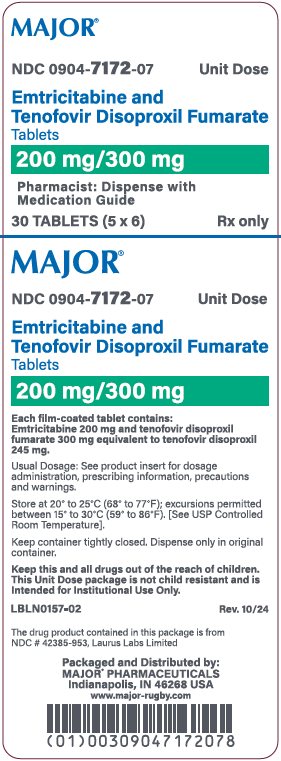
(emtricitabine · DailyMed)
EMTRITAF 200/25
Emtricitabine, Tenofovir Alafenamide Fumarate equivalent to Tenofovir Alafenamide
What it does
Alafenamide is a medicine used to treat certain viral infections, particularly HIV.
Commonly used for: HIV infection (human immunodeficiency virus), AIDS (acquired immunodeficiency syndrome)
Read more in plain English ↓Plain-language summary for general understanding - not medical advice. Always follow your pharmacist/doctor.
Ask about this medicine
Answers come only from this medicine's registration record, BNF monograph and interaction data - not medical advice.
Medicine sourcing is available in Kenya only. We don't sell or dispense medicines - licensed pharmacies do.
Sourcing - Kenya onlyRegistration & product details
Source: South African Health Products Regulatory Authority · fetched 2026-04-15 21:29:52 · updated 2026-09-20 04:02:14
About alafenamide
Alafenamide is a medicine used to treat certain viral infections, particularly HIV.
What it treats
- HIV infection (human immunodeficiency virus)
- AIDS (acquired immunodeficiency syndrome)
How it works
Alafenamide helps to stop the virus from multiplying in the body, helping to manage the infection.
Who it's for
This medicine is for adults and children who have been diagnosed with HIV.
AI-assisted summary grounded in BNF data - general information only, not medical advice. Always confirm with your pharmacist or doctor.
About emtricitabine
Emtricitabine is an antiviral medication used to treat HIV infection.
What it treats
- HIV infection (human immunodeficiency virus)
How it works
It helps to control the virus and improve the immune system.
Who it's for
This medication is for adults and children living with HIV.
AI-assisted summary grounded in BNF data - general information only, not medical advice. Always confirm with your pharmacist or doctor.
About tenofovir
Tenofovir is an antiviral medication used to treat certain viral infections.
What it treats
- HIV infection
- chronic hepatitis B (liver infection)
How it works
Tenofovir works by blocking the virus's ability to multiply, helping to reduce the amount of virus in the body.
Who it's for
It is prescribed for people living with HIV or those with chronic hepatitis B.
AI-assisted summary grounded in BNF data - general information only, not medical advice. Always confirm with your pharmacist or doctor.
Clinical monograph: Emtricitabine
BNF-referencedEmtricitabine is an antiretroviral medication used primarily in the treatment of HIV-1 infection. It is a synthetic nucleoside analog of cytidine that functions as a reverse transcriptase inhibitor. By preventing the conversion of viral RNA into DNA, emtricitabine effectively reduces viral load in the body. It is typically administered once daily and is available in capsule and oral solution forms.
Indications
- HIV infection
Dosage
Children: Child 4 months–17 years (body-weight up to 33 kg): 6 mg/kg once daily. Child 4 months–17 years (body-weight 33 kg and above): 240 mg once daily.
Adults: 200 mg once daily by mouth using capsules or 240 mg once daily by mouth using oral solution.
Mechanism of action
Emtricitabine is a cytidine analog that, when phosphorylated to emtricitabine 5'-triphosphate, competes with deoxycytidine 5'-triphosphate for HIV-1 reverse transcriptase. It incorporates itself into the viral DNA during replication, leading to chain termination. This prevents the incorporation of additional nucleotides and inhibits the transcription of viral RNA into DNA, thereby preventing viral replication.
Pharmacodynamics
Emtricitabine acts by competing with natural substrates of HIV-1 reverse transcriptase, leading to the termination of viral DNA synthesis. It has a long duration of action, allowing for once-daily dosing. Clinicians should monitor for potential side effects, including lactic acidosis and hepatomegaly with steatosis, which can occur with nucleoside analogs.
Pharmacokinetics
Emtricitabine is absorbed well following oral administration, with peak plasma concentrations occurring approximately 1 to 2 hours post-dose. It has a long half-life, allowing for its once-daily administration. Emtricitabine is primarily excreted through the kidneys, and dosage adjustments may be necessary in patients with renal impairment. It is metabolized minimally by the liver.
Contra-indications
- Severe hepatic impairment
- Severe renal impairment (creatinine clearance <30 mL/min)
Adverse effects
- Decreased appetite
- Asthenia
- Constipation
- Diarrhoea
- Dizziness
- Electrolyte imbalance
- Flatulence
- Gastrointestinal discomfort
- Headache
- Abnormal dreams
- Dyspepsia
- Hyperbilirubinaemia
- Hyperglycaemia
- Hypersensitivity reactions
- Hypertriglyceridaemia
- Neutropenia
- Pain
- Rash
- Pustular skin reactions
- Sleep disorders
- Angioedema (uncommon)
Interactions
- Cobicistat and elvitegravir may impact emtricitabine efficacy
- Potential for increased risk of treatment failure in pregnancy when used with elvitegravir
- Monitor for changes in drug levels when co-administered with other antiretrovirals
Precautions
- Caution in patients with hepatic impairment due to increased risk of side effects
- Monitor renal function regularly, particularly in those with existing renal impairment
- Patients should be advised on the risks of lactic acidosis and hepatomegaly with steatosis
Pregnancy
Not recommended for initiation during pregnancy due to risk of treatment failure and maternal-to-child transmission of HIV-1. Women who become pregnant during therapy should be switched to an alternative regimen.
Breast-feeding
Emtricitabine is excreted in human breast milk, caution is advised when administering to breastfeeding mothers.
Storage
Store in the original container, protected from moisture, and keep out of reach of children.
Formulations
- 200 mg capsules
- 240 mg oral solution
AI-synthesized from BNF references - general information only, not a substitute for professional medical advice or the current BNF. Verify doses with a pharmacist.
Clinical monograph: alafenamide
Alafenamide is an antiviral medication primarily used in the treatment of HIV-1 infection. It is a prodrug of tenofovir, which is an analog of adenosine monophosphate. Alafenamide is designed to improve the bioavailability of tenofovir and reduce renal toxicity. It is often combined with other antiretroviral agents in multi-drug regimens.
Indications
- HIV-1 infection
- HIV pre-exposure prophylaxis (PrEP)
Dosage
Children: Refer to the BNF for Children for appropriate dosing recommendations in pediatric populations.
Adults: Refer to the BNF for specific dosing guidelines based on individual patient factors and the presence of comorbidities.
Mechanism of action
Alafenamide is converted to its active form, tenofovir diphosphate, which inhibits the HIV reverse transcriptase enzyme. This inhibition interferes with viral RNA replication, preventing the virus from multiplying and reducing the viral load in the body. Additionally, tenofovir diphosphate is incorporated into viral DNA, leading to termination of the DNA chain and further impeding viral replication.
Pharmacodynamics
The pharmacodynamic profile of alafenamide is consistent with that of tenofovir, showing potent activity against HIV-1. Its mechanism involves the competitive inhibition of reverse transcriptase and incorporation into viral DNA, which results in reduced viral replication. Resistance can develop through mutations in the reverse transcriptase enzyme; however, alafenamide maintains activity against certain resistant strains.
Pharmacokinetics
Alafenamide has a high oral bioavailability, with peak plasma concentrations occurring within 0.5 to 1 hour after administration. It is rapidly converted to tenofovir after absorption. The drug has a tissue distribution that favors lymphoid tissues, where HIV is often harbored. Alafenamide is predominantly eliminated via renal pathways; however, its active metabolite, tenofovir, has a longer half-life, allowing for once-daily dosing regimens. The pharmacokinetics can be affected by renal function and other medications that impact renal clearance.
Adverse effects
- Nausea
- Diarrhea
- Headache
- Fatigue
- Rash
- Elevated liver enzymes
- Renal impairment
Interactions
- CYP3A4 inducers may decrease alafenamide levels
- CYP3A4 inhibitors may increase alafenamide levels
- Other medications that affect renal function may interact
Precautions
- Monitor renal function before and during treatment
- Assess for signs of liver toxicity
- Use caution in patients with a history of liver disease
Pregnancy
Use during pregnancy only if the potential benefit justifies the potential risk to the fetus. Data on human pregnancy are limited.
Breast-feeding
It is not known whether alafenamide is excreted in human milk. Caution is advised when administered to breastfeeding women.
Storage
Store at room temperature, away from moisture and heat. Keep out of reach of children.
Formulations
- Oral tablet
AI-synthesized from BNF references - general information only, not a substitute for professional medical advice or the current BNF. Verify doses with a pharmacist.
Clinical monograph: tenofovir
BNF-referencedTenofovir is an antiviral medication used primarily for the treatment of HIV infection and chronic hepatitis B. It belongs to the class of nucleotide reverse transcriptase inhibitors (NRTIs) and is effective in inhibiting viral replication by interfering with the viral reverse transcriptase enzyme. Tenofovir is known for its lower toxicity profile compared to other antiviral agents.
Indications
- HIV infection
- Chronic hepatitis B
Dosage
Children: Refer to BNF for Children for specific pediatric dosing information.
Adults: Refer to BNF for specific dosing information.
Mechanism of action
Once tenofovir is activated by bi-phosphorylation, it functions as an antiviral acyclic nucleoside phosphonate. It inhibits viral reverse transcriptase, exhibiting an inhibitory constant of approximately 0.022 micromolar. Tenofovir competes with deoxyadenosine 5'-triphosphate to generate new viral DNA, leading to chain termination and inhibition of viral replication. Its safety profile is maintained due to its low affinity for cellular DNA polymerases, including mitochondrial DNA polymerase gamma.
Pharmacodynamics
Tenofovir has demonstrated high efficacy in treatment-naive HIV patients, showing comparable effectiveness to efavirenz while exhibiting lower toxicity than some other antiretrovirals, such as stavudine. In patients with hepatitis B, tenofovir treatment has been associated with undetectable viral DNA levels after one year.
Pharmacokinetics
Tenofovir is absorbed after oral administration and is primarily eliminated by the kidneys. It has a half-life that allows for once-daily dosing and achieves therapeutic concentrations in plasma and tissues. The metabolism of tenofovir involves conversion to its active form, which is then incorporated into viral DNA, leading to its antiviral effects.
Contra-indications
- Hypersensitivity to tenofovir or any excipients in the formulation
- Severe renal impairment (CrCl < 30 mL/min) without appropriate dosage adjustment
Adverse effects
- Nausea
- Diarrhea
- Headache
- Fatigue
- Renal impairment
- Bone density loss
- Lactic acidosis
Interactions
- Antiepileptics (carbamazepine, fosphenytoin, oxcarbazepine, phenobarbital, phenytoin, primidone) with tenofovir alafenamide: Severe (decreases exposure)
- Tipranavir with tenofovir alafenamide: Severe (decreases exposure)
- Rifamycins with tenofovir alafenamide: Severe (decreases exposure)
- St John’s Wort with tenofovir alafenamide: Severe (decreases exposure)
- Fostemsavir with tenofovir disoproxil: Moderate (increases exposure)
- Fostemsavir with tenofovir alafenamide: Moderate (increases exposure)
- Ciclosporin with tenofovir alafenamide: Unknown (increases exposure)
- Ciclosporin with tenofovir disoproxil: Unknown (increases exposure)
- Eltrombopag with tenofovir alafenamide: Unknown (increases exposure)
- Eltrombopag with tenofovir disoproxil: Unknown (increases exposure)
Precautions
- Monitor renal function regularly during treatment
- Use with caution in patients with a history of renal disease
- Consider bone density monitoring in patients on long-term therapy
Pregnancy
Tenofovir is categorized as a pregnancy category B drug. Animal studies have not shown any harm, but human data is limited. Weigh risks and benefits when prescribing during pregnancy.
Breast-feeding
Tenofovir is excreted in breast milk, but the amount is considered low. The benefits of breastfeeding should be considered against the potential risk of HIV transmission.
Storage
Store at room temperature (20-25°C) in a tightly closed container. Keep away from light and moisture.
AI-synthesized from BNF references - general information only, not a substitute for professional medical advice or the current BNF. Verify doses with a pharmacist.
Molecular reference: Emtricitabine
PubChem CID 60877Molecular formula: C8H10FN3O3S
Mechanism of action
Emtricitabine is a cytidine analog which, when phosphorylated to emtricitabine 5'-triphosphate, competes with deoxycytidine 5'-triphosphate for HIV-1 reverse transcriptase. As HIV-1 reverse transcriptase incorporates emtricitabine into forming DNA strands, new nucleotides are unable to be incorporated, leading to viral DNA chain termination. Inhibition of reverse transcriptase prevents transcription of viral RNA into DNA, therefore the virus is unable to incorporate its DNA into host DNA and replicate using host cell machinery. This reduces viral load. Emtricitabine, a synthetic nucleoside analog of cytosine, is phosphorylated by cellular enzymes to form emtricitabine 5'-triphosphate. Emtricitabine 5'-triphosphate inhibits the activity of the HIV-1 reverse transcriptase by competing with the natural substrate deoxycytidine 5'-triphosphate and by being incorporated into nascent viral DNA which results in chain termination. Emtricitabine 5'-triphosphate is a weak inhibitor of mammalian DNA polymerase alpha, beta, epsilon and mitochondrial DNA polymerase gamma.
Pharmacodynamics
Emtricitabine is a cytidine analog that competes with the natural substrate of HIV-1 reverse transcriptase to be incorporated into newly formed DNA, terminating its transcription. It is administered once daily so it has a long duration of action. Patients should be counselled regarding the risk of lactic acidosis and hepatomegaly with steatosis.
Source: PubChem (NCBI) · pathways from PathBank, Reactome, WikiPathways & PharmGKB.
Molecular reference: tenofovir
PubChem CID 464205Molecular formula: C9H14N5O4P
Mechanism of action
Once tenofovir is activated by a bi-phosphorylation it acts as an antiviral acyclic nucleoside phosphonate. It is a potent inhibitor of the viral reverse transcriptase with an inhibitory constant of approximately 0.022 micromolar. Once activated, tenofovir acts with different mechanisms including the inhibition of viral polymerase causing chain termination and the inhibition of viral synthesis. All these activities are attained by its competition with deoxyadenosine 5'-triphosphate in the generation of new viral DNA. Once tenofovir is incorporated in the chain, it induces a chain termination which in order inhibits viral replication. The safety of tenofovir relies on its low affinity towards the cellular DNA polymerase including the mitochondrial DNA polymerase gamma.
Pharmacodynamics
Tenofovir has been shown to be highly effective in patients that have never had an antiretroviral therapy and it seemed to have lower toxicity than other antivirals such as [stavudine]. In phase 3 clinical trials, tenofovir presented a similar efficacy than [efavirenz] in treatment-naive HIV patients. In hepatitis B infected patients, after one year of tenofovir treatment, the viral DNA levels were undetectable.
Biological pathways
Source: PubChem (NCBI) · pathways from PathBank, Reactome, WikiPathways & PharmGKB.
This drug in other countries
The same active ingredient registered across other registries we cover - including different brands.
- ---TENOFOVIR DISOPROXIL FUMERATE TABLETS. · Simba Pharmaceuticals
- ---Tenofovir Disoproxil fumerate tablets. · Aurobindo Pharma Limited Unit Iii
- ACRIPTEGA · Surgilinks
- ATRIPLA · Imperial Managed Solutions
- AVIRODAY · Sun Pharma
- AVONZA · Surgilinks
- ACRIPTEGA TABLETS (Each film-coated tablet contains Dolutegravir/Lamivudine/Tenofovir Disoproxil Fumarate 50mg/300mg/300mg) · Mylan Laboratories
- DOBATAF-3 TABLETS Each contains Emtricitabine/Tenofovir Alafenamide 200mg/25mg) · Aurobindo Pharma
- DOBATAF-EM TABLETS (Each film-coated tablet contains Emtricitabine/Tenofovir Alafenamide /200mg/25mg) · Apl Healthcare
- DOLTAVIR-X TABLETS · Ohad Pharmaceuticals
- DOLUTEGRAVIR/ LAMIVUDINE/ TENOFOVIR TABLETS · Micro Labs
- DOLUTEGRAVIR/LAMIVUDINE/TENOFOVIR DISOPROXIL FUMARATE TABLETS (Each tablet contains Dolutegravir/Lamivudine/Tenofovir Disoproxil Fumarate 500mg/300mg/300mg ) · Cipla
- ACRIPTEGA · Mylan Laboratories
- ACRIPTEGA · Mylan Laboratories Ltd
- AURO– EMTRICITABINE/ TENOFOVIR DISOPROXIL FUMARATE · Aurobindo Pharma
- DOLUTEGRAVIR , LAMIVUDINE & TENOFOVIR DISOPROXIL FUMARATE · Aurobindo Pharma
- DOLUTEGRAVIR , LAMIVUDINE & TENOFOVIR DISOPROXIL FUMARATE · Aurobindo Pharma Limited
- DOLUTEGRAVIR , LAMIVUDINE & TENOFOVIR DISOPROXIL FUMARATE · Aurobindo Pharma Limited