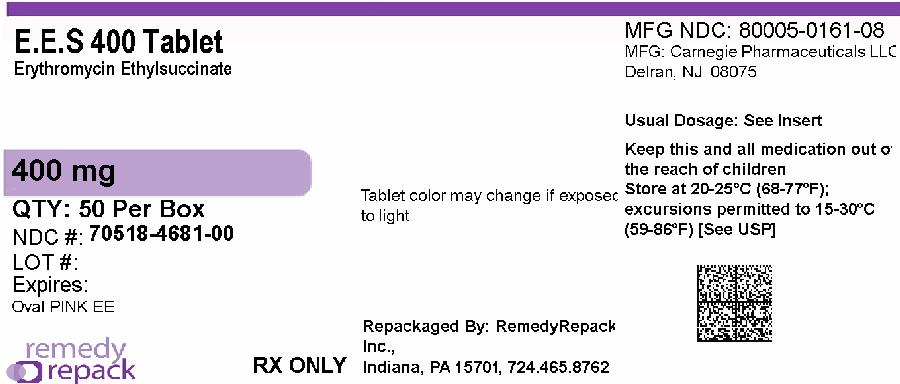
(erythromycin · DailyMed)
Ermyced
Erythromycin EthylSuccinate 125 mg/5mL
What it does
Erythromycin is an antibiotic used to treat various bacterial infections.
Commonly used for: bacterial infections, bronchitis, pneumonia, skin infections …
Read more in plain English ↓Plain-language summary for general understanding - not medical advice. Always follow your pharmacist/doctor.
Ask about this medicine
Answers come only from this medicine's registration record, BNF monograph and interaction data - not medical advice.
Medicine sourcing is available in Kenya only. We don't sell or dispense medicines - licensed pharmacies do.
Sourcing - Kenya onlyRegistration & product details
Source: Tanzania Medicines and Medical Devices Authority · fetched 2026-03-11 23:51:01 · updated 2026-09-14 03:00:45
Drug Interactions
151Pharmacodynamic Warnings
Erythromycin appears in TABLE 9: Drugs that prolong the QT interval
Severe (14)
Antipsychotics, Second Generation - increases exposure
Erythromycin is predicted to increase the exposure to antipsychotics, second generation (cariprazine). Avoid.
Cariprazine - increases exposure
Erythromycin is predicted to increase the exposure to antipsychotics, second generation (cariprazine). Avoid.
Eletriptan - increases exposure
Erythromycin moderately increases the exposure to triptans (eletriptan). Avoid.
Ergometrine - increases risk of ergotism
Macrolides (clarithromycin) are predicted to increase the risk of ergotism when given with ergometrine. Avoid.
Ergotamine - increases risk of ergotism
Macrolides (clarithromycin) are predicted to increase the risk of ergotism when given with ergotamine. Avoid.
Moderate (38)
Alfentanil - increases exposure
Erythromycinispredictedtoincreasetheexposuretoopioids (alfentanil,buprenorphine,fentanyl,oxycodone).Monitorand adjustdose.oStudy com/codemedicalapps/ cal Applications)
Amlodipine - increases exposure
Erythromycin is predicted to increase the exposure to calcium channel blockers (amlodipine, felodipine, lacidipine, lercanidipine, nicardipine, nifedipine, nimodipine). Monitor and adjust dose.
Antiarrhythmics - increases exposure
Erythromycin is predicted to increase the exposure to antiarrhythmics (propafenone). Monitor and adjust dose.
Antiepileptics - increases concentration
Erythromycin markedly increases the concentration of antiepileptics (carbamazepine). Monitor concentration and adjust dose.
Atorvastatin - increases exposure
Erythromycins slightly increases the exposure to statins (atorvastatin). Monitor and adjust dose.
Unknown (99)
Abemaciclib - increases exposure
Erythromycin is predicted to increase the exposure to abemaciclib.
Acalabrutinib - increases exposure
Erythromycin is predicted to increase the exposure to acalabrutinib. Avoid or monitor.
Afatinib - increases exposure
Macrolides are predicted to increase the exposure to afatinib.
Alphablockers - increases exposure
Erythromycin is predicted to increase the exposure to alpha blockers (tamsulosin).
Alprazolam - increases exposure
Erythromycin is predicted to increase the exposure to benzodiazepines (alprazolam).
Data from BNF 85 (British National Formulary). This is not a substitute for professional medical advice. Matched via: exact
About erythromycin
Erythromycin is an antibiotic used to treat various bacterial infections.
What it treats
- bacterial infections
- bronchitis
- pneumonia
- skin infections
- ear infections
How it works
It works by stopping the growth of bacteria, helping the body to fight off infections.
Who it's for
It is suitable for adults and children who have certain bacterial infections.
Drug class
Macrolides
Cautions
- • Be careful if you are taking other medications that can affect heart rhythm.
AI-assisted summary grounded in BNF data - general information only, not medical advice. Always confirm with your pharmacist or doctor.
About ethylsuccinate
Ethylsuccinate is a medication used to treat certain medical conditions. It is known for its ability to support various therapeutic effects.
What it treats
- certain metabolic disorders
- support in specific treatment plans
How it works
Ethylsuccinate works by helping to balance certain substances in the body, contributing to overall health.
Who it's for
This medication is generally given to individuals with specific metabolic issues or as part of a treatment regimen.
AI-assisted summary grounded in BNF data - general information only, not medical advice. Always confirm with your pharmacist or doctor.
Clinical monograph: Erythromycin
BNF-referencedErythromycin is a macrolide antibiotic effective against a range of bacterial infections. It works primarily by inhibiting protein synthesis in susceptible bacteria, making it a valuable choice for patients with penicillin hypersensitivity. Erythromycin is commonly used in treating respiratory tract infections, skin infections, and various other bacterial infections, including those caused by organisms like Propionibacterium acnes.
Indications
- Bacterial infections
- Acute otitis media
- Community-acquired pneumonia
- Skin and soft tissue infections
- Campylobacter enteritis
- Pertussis
- Syphilis (early stage)
- Chlamydia infections
- Impetigo
- Secondary bacterial infection of eczema
Dosage
Children: Child 1–23 months: 125 mg 4 times a day. Child 2–7 years: 250 mg 4 times a
Adults: 500 mg 4 times a day for 5 days, or alternatively 250–500 mg 4 times a day for 5–7 days.
Mechanism of action
Erythromycin exerts its antibacterial effect by binding to the 23S ribosomal RNA in the 50S subunit of bacterial ribosomes. This binding inhibits the transpeptidation and translocation steps of protein synthesis, effectively halting bacterial growth. The drug has a strong affinity for bacterial ribosomes, which contributes to its broad-spectrum activity against various pathogens.
Pharmacodynamics
Erythromycin acts as a bacteriostatic agent, preventing bacterial growth by inhibiting protein synthesis. It is effective against many strains of bacteria, although susceptibility testing is recommended due to increasing resistance. Notably, erythromycin does not impact nucleic acid synthesis and may lead to complications such as pseudomembranous colitis or hepatotoxicity in some patients.
Pharmacokinetics
Erythromycin is well-absorbed from the gastrointestinal tract, with bioavailability affected by food. It is widely distributed in body tissues, with higher concentrations in the lungs and liver. The drug undergoes hepatic metabolism and is primarily excreted in bile, with a small amount eliminated through urine. Erythromycin's half-life varies but generally ranges from 1.5 to 2 hours.
Contra-indications
- Hypersensitivity to erythromycin or any component of the formulation
- History of cholestatic jaundice or hepatic dysfunction associated with prior use of erythromycin
Adverse effects
- Gastrointestinal disturbances (nausea, vomiting, diarrhea)
- Cholestatic jaundice
- Hepatotoxicity
- Skin rashes
- QT interval prolongation
- Tinnitus
- Hearing loss (reversible)
- Pseudomembranous colitis
Interactions
- Erythromycin may significantly increase the exposure to certain drugs such as antipsychotics, simvastatin, and triptans due to its effect on cytochrome P450 enzymes
- Caution with concurrent use of drugs that prolong the QT interval
- Moderate interaction with aminophylline (decreases exposure)
Precautions
- Use with caution in patients with hepatic impairment or pre-existing liver disease
- Monitor for signs of pseudomembranous colitis in patients with diarrhea following antibiotic use
- Assess for potential drug interactions due to the impact on CYP450 metabolism
Pregnancy
Erythromycin crosses the placenta. It is generally considered safe for use during pregnancy, particularly for treating infections when no alternatives are available, but should be used with caution.
Breast-feeding
Erythromycin is excreted in breast milk. While generally considered safe, the infant should be monitored for potential side effects. Consult healthcare providers for specific recommendations.
Storage
Store in a cool, dry place away from direct sunlight. Keep out of reach of children. Check specific product information for any temperature requirements.
Formulations
- Oral suspension (125 mg/5 ml)
- Tablets (250 mg and 500 mg)
- Injectable solution (various strengths for intravenous administration)
AI-synthesized from BNF references - general information only, not a substitute for professional medical advice or the current BNF. Verify doses with a pharmacist.
Clinical monograph: ethyl
BNF-referencedEthyl, represented by the molecular formula C2H5, is a functional group derived from ethane. It is commonly found in various organic compounds and is often associated with the ethyl alcohol (ethanol) in pharmacology. Ethyl groups are integral in a wide array of chemical reactions and are fundamental in the synthesis of numerous medications and substances in both industrial and clinical settings.
Indications
- Alcohol use disorder
- Anxiety disorders
- Sedation
- Muscle relaxation
Dosage
Children: Refer to the BNF for Children for specific dosing guidelines in paediatric populations.
Adults: Refer to the specific BNF guidelines for dosing related to alcohol use disorder and other indications.
Mechanism of action
Ethyl groups serve primarily as substituents in organic chemistry, influencing the properties and reactivity of the parent molecules. In the context of ethanol, which contains an ethyl group, its mechanism of action involves the enhancement of gamma-aminobutyric acid (GABA) receptor activity, leading to increased inhibitory neurotransmission. This results in its sedative, anxiolytic, and muscle relaxant effects.
Pharmacodynamics
The pharmacodynamics of compounds containing the ethyl group, particularly ethanol, include its effects on the central nervous system, where it acts as a depressant. Ethanol enhances the effects of GABA, resulting in sedation, impaired motor function, and decreased anxiety. It can also affect the dopaminergic pathways, leading to the release of dopamine, which contributes to its reinforcing properties.
Pharmacokinetics
Ethanol is rapidly absorbed from the gastrointestinal tract, with peak blood concentrations typically reached within 30 to 90 minutes after consumption. It is metabolized primarily in the liver by alcohol dehydrogenase and aldehyde dehydrogenase, with a first-order elimination kinetics, typically at a rate of 10 to 15 mL of pure alcohol per hour. Ethanol is also known to exhibit a volume of distribution of approximately 0.5 to 0.7 L/kg in adults.
AI-synthesized from BNF references - general information only, not a substitute for professional medical advice or the current BNF. Verify doses with a pharmacist.
Clinical monograph: ethylsuccinate
BNF-referencedEthylsuccinate is an ester derived from succinic acid. It is utilized in various industrial applications and has potential therapeutic uses. As a chemical compound, it is recognized for its role in metabolic pathways and its contributions to the pharmacokinetics of certain medications.
Dosage
Children: Refer to specific clinical guidelines or a medical professional for dosing information.
Adults: Refer to specific clinical guidelines or a medical professional for dosing information.
Mechanism of action
Ethylsuccinate acts as a precursor in metabolic pathways, potentially influencing the synthesis of neurotransmitters and other biomolecules. It may also affect energy metabolism by participating in the tricarboxylic acid (TCA) cycle, enhancing cellular respiration and energy production.
Pharmacodynamics
Ethylsuccinate may exhibit effects related to energy metabolism and cellular function, contributing to the overall biochemical balance within the body. Its activity can influence metabolic rates and the efficiency of energy production in various tissues.
Pharmacokinetics
The pharmacokinetics of ethylsuccinate are not extensively characterized in standard references. However, like other esters, it is likely to undergo hydrolysis to its corresponding acid and alcohol, followed by conjugation and excretion. The exact parameters such as absorption, distribution, metabolism, and elimination are not well-documented.
Pregnancy
There is limited data on the use of ethylsuccinate in pregnancy. Caution is advised.
Breast-feeding
It is not known whether ethylsuccinate is excreted in human milk. Caution is advised.
Storage
Store in a cool, dry place away from light. Keep out of reach of children.
AI-synthesized from BNF references - general information only, not a substitute for professional medical advice or the current BNF. Verify doses with a pharmacist.
Molecular reference: Erythromycin
PubChem CID 12560Molecular formula: C37H67NO13
Mechanism of action
In order to replicate, bacteria require a specific process of protein synthesis, enabled by ribosomal proteins. Erythromycin acts by inhibition of protein synthesis by binding to the 23S ribosomal RNA molecule in the 50S subunit of ribosomes in susceptible bacterial organisms. It stops bacterial protein synthesis by inhibiting the transpeptidation/translocation step of protein synthesis and by inhibiting the assembly of the 50S ribosomal subunit. This results in the control of various bacterial infections. The strong affinity of macrolides, including erythromycin, for bacterial ribosomes, supports their broad‐spectrum antibacterial activities. Macrolide antibiotics are bacteriostatic agents that inhibit protein synthesis by binding reversibly to 50S ribosomal subunits of sensitive microorganisms, at or very near the site that binds chloramphenicol. Erythromycin does not inhibit peptide bond formation per se, but rather inhibits the translocation step wherein a newly synthesized peptidyl tRNA molecule moves from the acceptor site on the ribosome to the peptidyl donor site. Gram-positive bacteria accumulate about 100 times more erythromycin than do gram-negative bacteria. Cells are considerably more permeable to the un-ionized form of the drug, which probably explains the increased antimicrobial activity at alkaline pH. ... /Erythromycin/ inhibits the growth of susceptible organisms (principally Propionibacterium acnes) on the surface of the skin and reduces the concn of free fatty acids in sebum ... The reduction in free fatty acids in sebum may be an indirect result of the inhibition of lipase-producing organisms which convert triglycerides into free fatty acids or may be a direct result of interference with lipase production in these organisms. /In acne treatment regimens/ Although stromal-derived factor-1 (SDF-1) via its cognate receptor CXCR4 is assumed to play a critical role in migration of endothelial cells during new vessel formation after tissue injury, CXCR4 expression on endothelial cells is strictly regulated. Erythromycin (EM), a 14-membered ring macrolide, has an anti-inflammatory effect that may account for its clinical benefit in the treatment of chronic inflammatory diseases. However, the effects of EM on endothelial cells and especially their expression of CXCR4 have not been fully evaluated. In this study, we demonstrated that EM markedly induced CXCR4 surface expression on microvascular endothelial cells in vitro and lung capillary endothelial cells in vivo. This ability to induce CXCR4 surface expression on endothelial cells was restricted to 14-membered ring macrolides and was not observed in other antibiotics including a 16-membered ring macrolide, josamycin. Furthermore, this EM-induced expression of CXCR4 on endothelial cells was functionally significant as demonstrated by chemotaxis assays in vitro. These findings suggest that EM-induced CXCR4 surface expression on endothelial cells may promote migration of CXCR4-expressing endothelial cells into sites of tissue injury, which may be associated with the known anti-inflammatory activity of this macrolide.
Pharmacodynamics
Macrolides, such as erythromycin, stop bacterial growth by inhibiting protein synthesis and translation, treating bacterial infections. Erythromycin does not exert effects on nucleic acid synthesis. This drug has been shown to be active against most strains of the following microorganisms, effectively treating both in vitro and clinical infections. Despite this, it is important to perform bacterial susceptibility testing before administering this antibiotic, as resistance is a common issue that may affect treatment. **A note on antimicrobial resistance, pseudomembranous colitis, and hepatotoxicity** Many strains of Haemophilus influenzae are resistant to erythromycin alone but are found to be susceptible to erythromycin and sulfonamides used in combination. It is important to note that Staphylococci that are resistant to erythromycin may emerge during erythromycin and/or sulfonamide therapy. Pseudomembranous colitis has been reported with most antibacterial agents, including erythromycin, and may range in severity from mild to life-threatening. Therefore, the physician should consider this diagnosis in patients with diarrhea after the administration of antibacterial agents. Erythromycin can cause hepatic dysfunction, cholestatic jaundice, and abnormal liver transaminases, particularly when erythromycin estolate is administered.
Biological pathways
Source: PubChem (NCBI) · pathways from PathBank, Reactome, WikiPathways & PharmGKB.
Molecular reference: ethyl
PubChem CID 123138Molecular formula: C2H5
Source: PubChem (NCBI) · pathways from PathBank, Reactome, WikiPathways & PharmGKB.
Molecular reference: ethylsuccinate
PubChem CID 22057009Molecular formula: C6H8O4-2
Source: PubChem (NCBI) · pathways from PathBank, Reactome, WikiPathways & PharmGKB.
This drug in other countries
The same active ingredient registered across other registries we cover - including different brands.
- ASOMYCIN · Opera Pharma
- ASOMYCIN-500 · Opera Pharma
- BIOTROCIN SYRUP · Biodeal Laboratories
- ENMYCIN-250 · Twokay Chemicals
- ENMYCIN-500 · Twokay Chemicals
- EROCIN DRY SUSPENSION · Laboratory & Allied
- CENTRE- ERYSTREP SOLUBLE POWDER · Aether Centre Biology
- EMGIMYCIN TABLETS (Each tablet contains Erythromycin Stearate B.P equivalent to Erythromycin 250mg) · M&g Pharmaceuticals
- ENAMYCIN 250 TABLETS · Ernest Chemist
- ENAMYCIN SUSPENSION · Ernest Chemists
- ERNSERYL WATER SOLUBLE POWDER · Jiangx Bolai Pharmacy
- ERYCONOR WATER SOLUBLE POWDER · Hebei Kexing Pharmaceutical