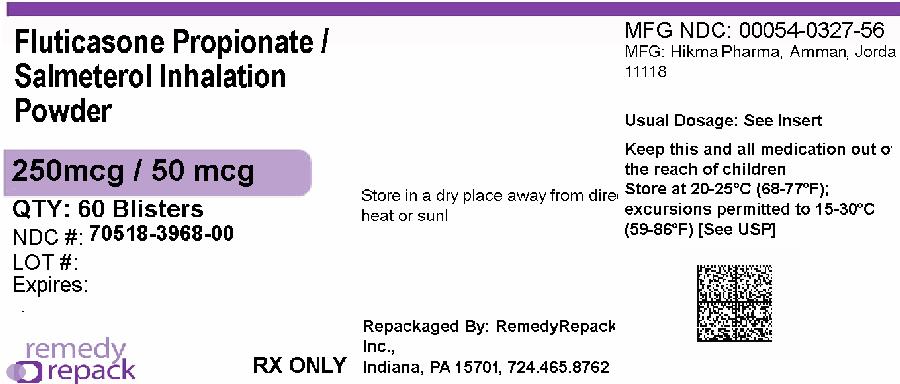
(salmeterol · DailyMed)
FLUSAL 125 HFA 125/25mcg INHALER
FLITICASONEPROPIONATE & SALMETEROL XINEFOATE
What it does
Fluticasone propionate is a medication used to reduce inflammation and improve breathing in certain conditions.
Commonly used for: asthma, chronic obstructive pulmonary disease (COPD), allergic rhinitis (hay fever)
Read more in plain English ↓Plain-language summary for general understanding - not medical advice. Always follow your pharmacist/doctor.
Ask about this medicine
Answers come only from this medicine's registration record, BNF monograph and interaction data - not medical advice.
Medicine sourcing is available in Kenya only. We don't sell or dispense medicines - licensed pharmacies do.
Sourcing - Kenya onlyRegistration & product details
Source: Pharmacy and Medicines Regulatory Authority · fetched 2026-04-21 17:37:43 · updated 2026-09-22 04:33:04
Drug Interactions
3Pharmacodynamic Warnings
Salmeterol appears in TABLE 17: Drugs that reduce serum potassium
Moderate (1)
Salmeterol - decreases exposure
Cenobamateispredictedtodecreasetheexposureto salmeterol.Adjustdose.oTheoretical
Unknown (2)
Salmeterol - increases exposure
Cobicistatispredictedtoincreasetheexposuretosalmeterol. Avoid.rStudy
Salmeterol - increases exposure
Idelalisibispredictedtoincreasetheexposuretosalmeterol. Avoid.rStudy
Data from BNF 85 (British National Formulary). This is not a substitute for professional medical advice. Matched via: exact
About fliticasonepropionate
Fluticasone propionate is a medication used to reduce inflammation and improve breathing in certain conditions.
What it treats
- asthma
- chronic obstructive pulmonary disease (COPD)
- allergic rhinitis (hay fever)
How it works
It works by decreasing inflammation in the airways, making it easier to breathe.
Who it's for
It is for people with asthma, COPD, or allergies affecting their breathing.
AI-assisted summary grounded in BNF data - general information only, not medical advice. Always confirm with your pharmacist or doctor.
About salmeterol
Salmeterol is a medication used to help manage breathing problems by relaxing the muscles in the airways.
What it treats
- asthma
- chronic obstructive pulmonary disease (COPD)
How it works
It works by opening up the airways in the lungs, making it easier to breathe.
Who it's for
This medication is for people with asthma or COPD who need help controlling their symptoms.
Cautions
- • Be cautious if you are taking medications that lower potassium levels in the blood.
AI-assisted summary grounded in BNF data - general information only, not medical advice. Always confirm with your pharmacist or doctor.
About xinefoate
Xinefoate is a medication used to treat certain conditions related to inflammation and pain.
What it treats
- inflammatory conditions
- pain relief
How it works
Xinefoate works by reducing inflammation and relieving pain in the body.
Who it's for
This medication is suitable for adults and children who need treatment for inflammation or pain.
AI-assisted summary grounded in BNF data - general information only, not medical advice. Always confirm with your pharmacist or doctor.
Clinical monograph: Salmeterol
BNF-referencedSalmeterol is a long-acting beta-2 adrenergic agonist (LABA) used primarily in the management of asthma and chronic obstructive pulmonary disease (COPD). It works by relaxing bronchial smooth muscles, leading to bronchodilation and improved airflow. Salmeterol is indicated for patients requiring long-term bronchodilator therapy and is not intended for the immediate relief of acute asthma symptoms.
Indications
- Reversible airways obstruction in patients requiring long-term regular bronchodilator therapy
- Nocturnal asthma
- Chronic asthma in patients who regularly use an inhaled corticosteroid
- Prevention of exercise-induced bronchospasm
Dosage
Children: For children aged 5-11 years, the recommended dose is 50 micrograms twice daily. In
Adults: The typical adult dose is 50 micrograms twice daily, with the possibility of increasing to 100 micrograms twice daily in cases of more severe airway obstruction.
Mechanism of action
Salmeterol exerts its effects through stimulation of beta-2 adrenoceptors, causing relaxation of bronchial smooth muscle and bronchodilation. It binds to both the active site and an exo-site of the beta-2 adrenoceptor. The saligenin moiety attaches to the active site, while the hydrophilic tail interacts with leucine residues in the exo-site, leading to a prolonged action. Additionally, salmeterol inhibits the release of mast cell mediators and attenuates allergen-induced bronchial hyper-responsiveness.
Pharmacodynamics
As a long-acting beta-2 adrenergic receptor agonist, salmeterol has a longer duration of action compared to short-acting beta agonists like salbutamol. It enhances intracellular cAMP levels, which promotes smooth muscle relaxation. Patients should be aware of potential risks such as hypokalemia and hypoglycemia, and the importance of not using it as monotherapy for asthma management.
Pharmacokinetics
Salmeterol is administered via inhalation, with an onset of action within 15 minutes and a duration of effect lasting approximately 12 hours at recommended doses. It undergoes hepatic metabolism and is eliminated primarily via the feces. The pharmacokinetic profile allows for twice-daily dosing to maintain therapeutic effects.
Adverse effects
- Tachycardia
- Palpitations
- Tremors
- Headache
- Dizziness
- Nervousness
- Hypokalemia
- Hyperglycemia
Interactions
- cenobamate+salmeterol: Moderate (decreases exposure)
- cobicistat+salmeterol: Unknown (increases exposure)
- idelalisib+salmeterol: Unknown (increases exposure)
Precautions
- Use with caution in patients with cardiovascular disorders.
- Monitor for signs of hypokalemia, especially if used with diuretics.
- Not to be used as monotherapy for asthma; should be used with an inhaled corticosteroid.
Pregnancy
Salmeterol is classified as category C. Use only if the potential benefit justifies the potential risk to the fetus.
Breast-feeding
Salmeterol is excreted in breast milk. Use with caution, weighing the benefits against potential risks.
Storage
Store in a cool, dry place, away from direct sunlight. Keep out of reach of children.
Formulations
- Inhalation powder - Serevent Accuhaler (50 micrograms per dose)
- Pressurised inhalation - Neovent (25 micrograms per dose)
- Pressurised inhalation - Serevent Evohaler (50 micrograms per dose)
- Inhalation powder - Soltel (25 micrograms per dose)
AI-synthesized from BNF references - general information only, not a substitute for professional medical advice or the current BNF. Verify doses with a pharmacist.
Clinical monograph: fliticasonepropionate
Fluticasone propionate is a synthetic corticosteroid with potent anti-inflammatory properties. It is commonly used in the management of respiratory conditions, particularly asthma and allergic rhinitis. Fluticasone helps to reduce inflammation in the airways, improving breathing and decreasing the frequency of asthma attacks. It is available in various formulations including nasal sprays, inhalers, and topical preparations.
Indications
- Asthma
- Chronic obstructive pulmonary disease (COPD)
- Allergic rhinitis
- Nasal polyps
- Skin conditions such as eczema and psoriasis (topical use)
Dosage
Children: Refer to the BNF for Children for specific dosing guidelines.
Adults: Refer to the BNF for specific dosing guidelines.
Mechanism of action
Fluticasone propionate exerts its effects by binding to glucocorticoid receptors in target tissues, leading to the regulation of gene expression. This results in the inhibition of inflammatory cytokines and mediators, thereby reducing inflammation and immune response. It also decreases the production of mucus and enhances the responsiveness of beta-adrenergic receptors in the airways.
Pharmacodynamics
The drug demonstrates a high affinity for the glucocorticoid receptor and exhibits potent anti-inflammatory effects. Fluticasone propionate has been shown to reduce airway hyperreactivity and improve pulmonary function in patients with asthma and chronic obstructive pulmonary disease (COPD). Its anti-inflammatory action is dose-dependent, and therapeutic effects can be seen with regular use, although it may take several days to achieve optimal control of symptoms.
Pharmacokinetics
Fluticasone propionate is rapidly absorbed following inhalation, with peak plasma concentrations occurring within a few hours. The drug undergoes extensive first-pass metabolism in the liver, primarily by cytochrome P450 3A4, resulting in a low bioavailability of less than 1% when administered via inhalation. The elimination half-life is approximately 7.8 hours. It is primarily excreted in the feces, with a small percentage eliminated in urine as metabolites.
Contra-indications
- Hypersensitivity to fluticasone propionate or any excipients
- Active or untreated infections
- Severe hypersensitivity reactions
Adverse effects
- Oropharyngeal candidiasis
- Dysphonia
- Cough
- Nasal irritation
- Headache
- Nasal bleeding
- Systemic corticosteroid effects (with high doses or long-term use)
Interactions
- CYP3A4 inhibitors (may increase systemic exposure to fluticasone)
- Ritonavir (increased effects and potential for systemic side effects)
- Other immunosuppressants (may increase risk of infections)
Precautions
- Use with caution in patients with active or latent tuberculosis
- Caution in patients with untreated fungal, bacterial, or viral infections
- Monitor for adrenal suppression in long-term use
- Use cautiously in patients with cardiovascular disorders
Pregnancy
Fluticasone propionate should only be used during pregnancy if the benefits outweigh the risks. Consultation with a healthcare provider is recommended.
Breast-feeding
Fluticasone propionate is excreted in breast milk, caution is advised when administered to nursing mothers.
Storage
Store at room temperature, away from moisture and heat. Protect from light. Do not freeze.
Formulations
- Nasal spray
- Inhaler (metered dose inhaler)
- Topical cream
- Topical ointment
AI-synthesized from BNF references - general information only, not a substitute for professional medical advice or the current BNF. Verify doses with a pharmacist.
Clinical monograph: xinefoate
Xinefoate is an antifungal agent primarily used for the treatment of infections caused by dermatophytes, yeasts, and certain molds. It works by inhibiting fungal growth and is utilized in various topical formulations to manage superficial fungal infections.
Indications
- Tinea pedis (athlete's foot)
- Tinea corporis (ringworm)
- Tinea cruris (jock itch)
- Candidiasis (fungal infections caused by Candida species)
- Dermatophyte infections
Dosage
Children: Refer to the BNF for Children for appropriate dosing guidance in paediatric patients.
Adults: Refer to specific product guidelines for dosing recommendations, as they may vary based on the formulation and severity of the fungal infection.
Mechanism of action
Xinefoate exerts its effects by inhibiting the synthesis of ergosterol, an essential component of the fungal cell membrane. This disruption in ergosterol production compromises the integrity of the cell membrane, leading to increased permeability and ultimately cell death.
Pharmacodynamics
The pharmacodynamics of xinefoate involve its action on the fungal cell membrane, resulting in the inhibition of fungal growth and replication. It demonstrates fungicidal properties against a range of fungi, making it effective in treating conditions like tinea pedis, tinea corporis, and candidiasis.
Pharmacokinetics
Xinefoate is typically applied topically, leading to localized action with minimal systemic absorption. It is metabolized in the skin and excreted primarily through the skin and urine. The onset of action usually occurs within days of application, depending on the severity of the infection and the formulation used.
Pregnancy
Use in pregnancy should be avoided unless the benefits outweigh the risks, as safety in pregnant women has not been established.
Breast-feeding
Caution is advised when administering to breastfeeding women, as it is not known if xinefoate is excreted in human milk.
Storage
Store at room temperature, away from moisture and heat. Keep out of reach of children.
AI-synthesized from BNF references - general information only, not a substitute for professional medical advice or the current BNF. Verify doses with a pharmacist.
Molecular reference: Salmeterol
PubChem CID 5152Molecular formula: C25H37NO4
Mechanism of action
Beta-2 adrenoceptor stimulation causes relaxation of bronchial smooth muscle, bronchodilation, and increased airflow. Salmeterol is hypothesized to bind to 2 sites on the beta-2 adrenoceptor. The saligenin moiety binds to the active site of the beta-2 adrenoceptor. The hydrophilic tail of salmeterol binds to leucine residues in the exo-site of the beta-2 adrenoceptor almost irreversibly, allowing salmeterol to persist in the active site, which is responsible for it's long duration of action. Another hypothesis is that the lipophilic drug diffuses into lipid bilayer of smooth muscle cells and provides a depot of drug to the cells over a longer period of time. In vitro tests show that salmeterol is a potent and long-lasting inhibitor of the release of mast cell mediators, such as histamine, leukotrienes, and prostaglandin D2, from human lung. Salmeterol inhibits histamine-induced plasma protein extravasation and inhibits platelet activating factor-induced eosinophil accumulation in the lungs of guinea pigs when administered by the inhaled route. In humans, single doses of salmeterol attenuate allergen-induced bronchial hyper-responsiveness. The pharmacologic effects of beta2-adrenoceptor agonist drugs, including salmeterol, are at least in part attributable to stimulation of intracellular adenyl cyclase, the enzyme that catalyzes the conversion of adenosine triphosphate (ATP) to cyclic-3',5'-adenosine monophosphate (cyclic AMP). Increased cyclic AMP levels cause relaxation of bronchial smooth muscle and inhibition of release of mediators of immediate hypersensitivity from cells, especially from mast cells. Salmeterol is a long-acting beta-adrenergic agonist. In vitro studies and in vivo pharmacologic studies demonstrate that salmeterol is selective for beta2-adrenoceptors compared with isoproterenol, which has approximately equal agonist activity on beta1- and beta2-adrenoceptors. In vitro studies show salmeterol to be at least 50 times more selective for beta2-adrenoceptors than albuterol. Although beta2-adrenoceptors are the predominant adrenergic receptors in bronchial smooth muscle and beta1-adrenoceptors are the predominant receptors in the heart, there are also beta2-adrenoceptors in the human heart comprising 10% to 50% of the total beta-adrenoceptors. The precise function of these is not yet established, but they raise the possibility that even highly selective beta2-agonists may have cardiac effects. Salmeterol ... membrane binding is non-competitive and dissociation is slow so that its effects last for many hours. Despite this, salmeterol does not accumulate in tissues. Its mechanism of action can be explained by binding to a specific exo-site domain of the beta 2-receptor protein to produce continuous stimulation of the active site of the receptor, which gives salmeterol a profile of pharmacological activity unlike that of other beta 2-agonists. Due to its potent and prolonged activation of beta 2-adrenoceptors in airway smooth muscle cells, endothelial cells, mast cells and epithelial cells, salmeterol induces prolonged bronchodilatation, reduced vascular permeability, inhibition of inflammatory mediators, stimulation of ciliary function and modulation of ion and water transport across the bronchial mucosa.
Pharmacodynamics
Salmeterol is a long acting beta-2 adrenergic receptor agonist that binds to both the active and exo sites of the beta-2 adrenergic receptor. Salmeterol has a longer duration of action than other beta-2 agonists like [salbutamol]. Patients should be counselled regarding the risks of long acting beta agonist (LABA) monotherapy, hypokalemia, hypoglycemia, and not to take this drug with another LABA.
Biological pathways
Source: PubChem (NCBI) · pathways from PathBank, Reactome, WikiPathways & PharmGKB.
This drug in other countries
The same active ingredient registered across other registries we cover - including different brands.
- AIRFLUSAL FORSPIRO · Nvs Kenya
- AIRFLUSAL FORSPIRO · Nvs Kenya
- BEXITROL HFA INHALATION AEROSOL · Madawa Pharmaceuticals
- BEXITROL-F 50/250 MAXHALER · Madawa Pharmaceuticals
- BEXITROL-F 50/500 MAXHALER · Madawa Pharmaceuticals
- BEXITROL-F HFA 25/125 INHALATION AEROSOL · Madawa Pharmaceuticals
- AVASALF 500/50 · Elpen Pharmaceutical Co.
- Avasalf 250/50 Inhaler · Innovata Pharmaceuticals
- Avasalf 100/50 Inhaler · Elpen Pharmaceutical Co.
- Combiwave SF 125 Inhaler · Glenmark Pharmaceuticals
- Combiwave SF 250 Inhaler · Glenmark Pharmaceuticals
- Flusal 125 HFA Inhaler · Midas-Care Pharmaceuticals
- BEXITROL-F · Beximco Pharmaceuticals
- BEXITROL-F 25/125 · Beximco Pharmaceuticals
- COMBIWAVE SF 125 · Glenmark Pharmaceuticals
- Combiwave SF 250 · Glenmark Pharmaceuticals
- FLUTIAIR-S 250 PUFFCAPS · Sava Healthcare
- Saltraget Inhaler 25mcg + 125mcg · Getz Pharma Private Limited
- FLUZOMEX 125 INHALATION AEROSOL · Midas Care Pharmaceuticals
- FLUZOMEX 250 INHALATION AEROSOL · Midas Care Pharmaceuticals
- SERETIDE ACCUHALER INHALATION POWDER · GlaxoSmithKline
- SERETIDE ACCUHALER INHALATION POWDER · GlaxoSmithKline
- SEROCORT 125 SYNCHROBREATHE SB (Each actuation contains Fluticasone Propionate/Salmeterol Xinafoate 125mcg/25mcg) · Cipla Ltd
- SEROCORT 250 SYNCHROBREATHE SB (Each actuation contains Fluticasone Propionate/Salmeterol Xinafoate 250mcg/25mcg) · Cipla Ltd