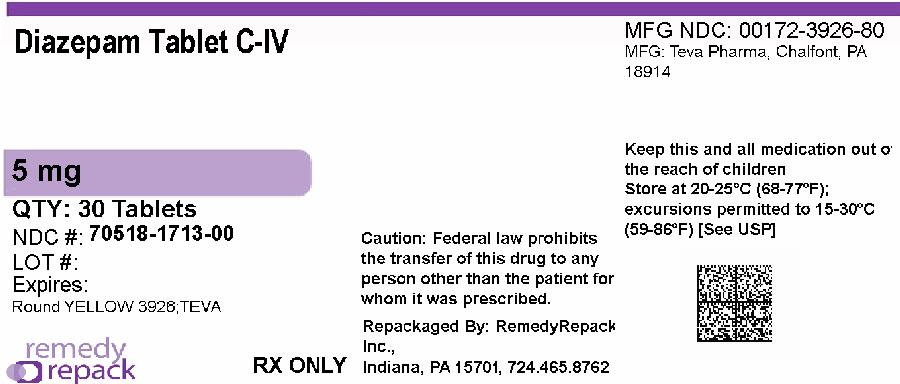
(diazepam · DailyMed)
ESKAZEPAM TABLET
Diazepam
What it does
Diazepam is a medication that belongs to a class called benzodiazepines. It is used to help relieve anxiety, muscle spasms, and seizures.
Commonly used for: anxiety (nervousness), muscle spasms, seizures (epilepsy)
Read more in plain English ↓Plain-language summary for general understanding - not medical advice. Always follow your pharmacist/doctor.
Ask about this medicine
Answers come only from this medicine's registration record, BNF monograph and interaction data - not medical advice.
Medicine sourcing is available in Kenya only. We don't sell or dispense medicines - licensed pharmacies do.
Sourcing - Kenya onlyRegistration & product details
Source: Food and Drugs Authority · fetched 2026-04-18 08:37:30 · updated 2026-09-25 04:00:12
Drug Interactions
52Pharmacodynamic Warnings
Diazepam appears in TABLE 11: Drugs with CNS depressant effects
Severe (13)
Benzodiazepines - increases exposure
Cobicistat moderately increases the exposure to benzodiazepines (alprazolam). Avoid.
Benzodiazepines - increases exposure
Ritonavir is predicted to increase the exposure to benzodiazepines (diazepam, flurazepam). Avoid.
Benzodiazepines - increases exposure
Idelalisib moderately increases the exposure to benzodiazepines (alprazolam). Avoid.
Benzodiazepines - decreases exposure
Lorlatinib moderately decreases the exposure to benzodiazepines (midazolam). Avoid.
Benzodiazepines - decreases exposure
Lumacaftor is predicted to decrease the exposure to benzodiazepines (midazolam). Avoid.
Moderate (18)
Benzodiazepines - increases exposure
Miconazole is predicted to increase the exposure to benzodiazepines (alprazolam). Use with caution and adjust dose.
Benzodiazepines - decreases exposure
Monoclonal antibodies (tocilizumab) are predicted to decrease the exposure to benzodiazepines (alprazolam, diazepam, midazolam). Monitor and adjust dose.
Benzodiazepines - increases exposure
Berotralstat moderately increases the exposure to benzodiazepines (midazolam). Monitor and adjust dose.
Benzodiazepines - increases concentration
Cenobamate might increase the concentration of benzodiazepines (clobazam). Monitor and adjust dose. Also see TABLE 11 p. 1519.
Benzodiazepines - decreases exposure
Cenobamatemoderatelydecreasestheexposureto benzodiazepines(midazolam).Adjustdose.oStudy → AlsoseeTABLE11p.1519
Unknown (21)
Benzodiazepines - decreases exposure
Apalutamide is predicted to decrease the exposure to benzodiazepines (diazepam). Avoid or monitor.
Benzodiazepines - increases exposure
Dronedarone is predicted to increase the exposure to benzodiazepines (alprazolam).
Benzodiazepines - increases concentration
Stiripentol increases the concentration of benzodiazepines (clobazam).
Benzodiazepines - increases exposure
Antifungals, azoles (fluconazole, isavuconazole, posaconazole) are predicted to increase the exposure to benzodiazepines (alprazolam).
Benzodiazepines - increases exposure
Bulevirtideslightlyincreasestheexposuretobenzodiazepines (midazolam).oTheoretical
Data from BNF 85 (British National Formulary). This is not a substitute for professional medical advice. Matched via: class
About this medicine
Diazepam is a medication that belongs to a class called benzodiazepines. It is used to help relieve anxiety, muscle spasms, and seizures.
What it treats
- anxiety (nervousness)
- muscle spasms
- seizures (epilepsy)
How it works
Diazepam works by calming the brain and nerves, helping to reduce anxiety and relax muscles.
Who it's for
Diazepam is for adults and sometimes children who need relief from anxiety, muscle tightness, or certain types of seizures.
Drug class
Benzodiazepines
Cautions
- • Be careful if you are taking other medications that can depress the central nervous system, as they can increase the effects of diazepam.
AI-assisted summary grounded in BNF data - general information only, not medical advice. Always confirm with your pharmacist or doctor.
Clinical monograph: Diazepam
BNF-referencedDiazepam is a benzodiazepine tranquilliser known for its anxiolytic, sedative, muscle relaxant, anticonvulsant, and amnesic properties. It is commonly used in the management of anxiety disorders, muscle spasms, seizures, and as a premedication for medical procedures. Diazepam acts by enhancing the effects of the inhibitory neurotransmitter gamma-aminobutyric acid (GABA) in the central nervous system, leading to a calming effect.
Indications
- Anxiety disorders
- Muscle spasms
- Seizure disorders (including status epilepticus)
- Premedication for medical procedures
- Sedation in dental procedures
- Acute alcohol withdrawal symptoms
Dosage
Adults: For anxiety: 2 mg to 15-30 mg daily in divided doses. For muscle spasms: 5-10 mg 1-2 hours before the procedure. For seizures: 3-10
Mechanism of action
Diazepam binds to specific sites on GABA-A receptors in the brain and spinal cord, enhancing the inhibitory effects of GABA. This increased GABAergic activity results in reduced neuronal excitability and has various effects including anxiolytic, sedative, muscle relaxant, and anticonvulsant actions. It may also affect other neurotransmitter systems, contributing to its broader impact on mood and cognition.
Pharmacodynamics
The pharmacodynamic effects of diazepam are primarily mediated through its action on GABA-A receptors, leading to increased chloride ion influx, hyperpolarization of neurons, and decreased neuronal excitability. This results in a reduction of anxiety, muscle relaxation, sedation, and anticonvulsant activity. The drug's properties make it useful in acute management scenarios, including seizures and muscle spasms.
Pharmacokinetics
Diazepam is well absorbed after oral administration, with peak plasma concentrations typically occurring within 1 to 2 hours. It has a long half-life, ranging from 20 to 50 hours, allowing for once or twice daily dosing. Diazepam is extensively metabolized in the liver, primarily by CYP2C19 and CYP3A4 enzymes, producing active metabolites. It is excreted mainly through the urine. Its pharmacokinetics can be affected by age, liver function, and concurrent medications.
Contra-indications
- Severe respiratory insufficiency
- Myasthenia gravis
- Sleep apnoea syndrome
- Hypersensitivity to diazepam or any of its components
- Acute narrow-angle glaucoma
Adverse effects
- Drowsiness
- Fatigue
- Ataxia
- Confusion
- Paradoxical reactions (agitation, aggression)
- Dependence and withdrawal symptoms
Interactions
- Severe interaction with NNRTIs (e.g., efavirenz) leading to increased exposure
- Severe interaction with ritonavir leading to increased exposure
- Severe interaction with rifampicin leading to decreased exposure
- Moderate interaction with antiepileptics affecting concentration
- Moderate interaction with monoclonal antibodies decreasing exposure
Precautions
- Use with caution in patients with a history of substance abuse
- Caution in elderly patients due to increased sensitivity and risk of falls
- Monitor for signs of respiratory depression
- Adjust dosage in patients with hepatic impairment
Pregnancy
Use during pregnancy only if the potential benefit justifies the potential risk to the fetus. Risk of teratogenic effects.
Breast-feeding
Diazepam is excreted in breast milk. Caution is recommended; consider alternative treatments.
Storage
Store in a cool, dry place away from direct sunlight. Keep out of reach of children.
Formulations
- Oral tablets (2 mg, 5 mg, 10 mg)
- Oral solution
- Injectable solution (IV, IM)
- Rectal solution
AI-synthesized from BNF references - general information only, not a substitute for professional medical advice or the current BNF. Verify doses with a pharmacist.
Molecular reference: Diazepam
PubChem CID 3016Molecular formula: C16H13ClN2O
Mechanism of action
Diazepam is a benzodiazepine tranquilliser with anticonvulsant, sedative, muscle relaxant and amnesic properties. Benzodiazepines, such as diazepam, bind to receptors in various regions of the brain and spinal cord. This binding increases the inhibitory effects of gamma-aminobutyric acid (GABA). GABAs functions include CNS involvement in sleep induction. Also involved in the control of hypnosis, memory, anxiety, epilepsy and neuronal excitability. Diazepam is a benzodiazepine that exerts anxiolytic, sedative, muscle-relaxant, anticonvulsant and amnestic effects. Most of these effects are thought to result from a facilitation of the action of gamma aminobutyric acid (GABA), an inhibitory neurotransmitter in the central nervous system. Benzodiazepines are widely used in clinical anesthesia as premedication, but also to induce general anesthesia. Recent in vitro studies suggest that gamma-aminobutyric acid type A receptors, harboring a classical high-affinity benzodiazepine binding site, possess another "nonclassical" binding site for benzodiazepines. At present, it is unclear if, and to what extent, this novel nonclassical binding site is of relevance for the actions of benzodiazepines in the central nervous system. Because neocortex is involved in mediating the sedative and hypnotic properties of general anesthetics, ... the actions of diazepam /were quantified/ over a wide range of concentrations (from 10 nM up to 100 uM) in organotypic slice cultures using extracellular multiunit recordings of spontaneous action potential activity. Up to a concentration of 6.25 uM, diazepam reduced the activity of neocortical neurons, approaching a maximum of approximately 20%. This action was nullified by the benzodiazepine antagonist flumazenil. At concentrations >12.5 uM, diazepam evoked a second concentration-dependent dampening of network activity. Unlike the low concentration effect, this high concentration component was resistant to flumazenil. Diazepam induced a biphasic attenuation of spontaneous action potential firing of neocortical neurons. Low to moderate concentrations caused a monotonic, mild depression that is mediated via the classical binding site as it is antagonized by flumazenil. However, the effects of diazepam observed at high concentrations were not affected by flumazenil. Hence, these findings support the concept of at least 2 different binding sites for benzodiazepines on gamma-aminobutyric acid type A receptors. Furthermore, /these/ results are consistent with the hypothesis that the classical high-affinity binding site mediates low-dose diazepam actions, such as amnesia, anxiolysis, and sedation, while a second, nonclassical and independent site contributes to the anesthetic effects of diazepam, such as hypnosis and immobility. Benzodiazepine site agonists or inverse agonists enhance or reduce gamma-aminobutyric acid(A) (GABA(A)) receptor-mediated inhibition of neurons, respectively. Recently, it was demonstrated that the point mutation gamma 2F77I causes a drastic change in the affinity of a variety of benzodiazepine agonists or inverse agonists in receptor binding studies. Here we investigated the potency and efficacy of 10 benzodiazepine site ligands from 6 structural classes in wild-type and gamma 2F77I point mutated recombinant GABA(A) receptors composed of alpha 1 beta 3 gamma 2, alpha 2 beta 3 gamma 2, alpha 3 beta 3 gamma 2, alpha 4 beta 3 gamma 2, alpha 5 beta 3 gamma 2, and alpha 6 beta 3 gamma 2 subunits. Results indicate that the effects of the benzodiazepine site ligands zolpidem, zopiclone, Cl218872, L-655,708 and DMCM were nearly completely eliminated in all mutated receptors up to a 1 microM concentration. The effects of bretazenil, Ro15-1788 or abecarnil were eliminated in some, but not all mutated receptors, suggesting that the gamma 2F77I mutation differentially influences the actions of these ligands in different receptor subtypes. In addition, this point mutation also influences the efficacy o
Pharmacodynamics
Diazepam is a benzodiazepine that exerts anxiolytic, sedative, muscle- relaxant, anticonvulsant and amnestic effects. Most of these effects are thought to result from facilitation of the action of gamma aminobutyric acid (GABA), an inhibitory neurotransmitter in the central nervous system.
Biological pathways
Source: PubChem (NCBI) · pathways from PathBank, Reactome, WikiPathways & PharmGKB.
This drug in other countries
The same active ingredient registered across other registries we cover - including different brands.
- ANXOL · Reddys Pharma
- ANXOL INJECTION 10 MG · Sai Pharmaceuticals
- AROGIUM SOLUTION FOR INJECTION · Tasa Pharma
- BIOZEPAM TABLETS · Biodeal Laboratories
- CALM-5 TABLETS · B Braun Pharmaceuticals
- COZEPAM 5 TABLETS · Cosmos
- BETAPAM 5MG TABLET
- CALM-5 5MG TABLET
- DA-ZEPAM 5MG TABLET
- DAMCY_5 5MG TABLET
- DIAZEPAM 10MG 10MG
- DIAZEPAM 10MG/2ML INJECTION