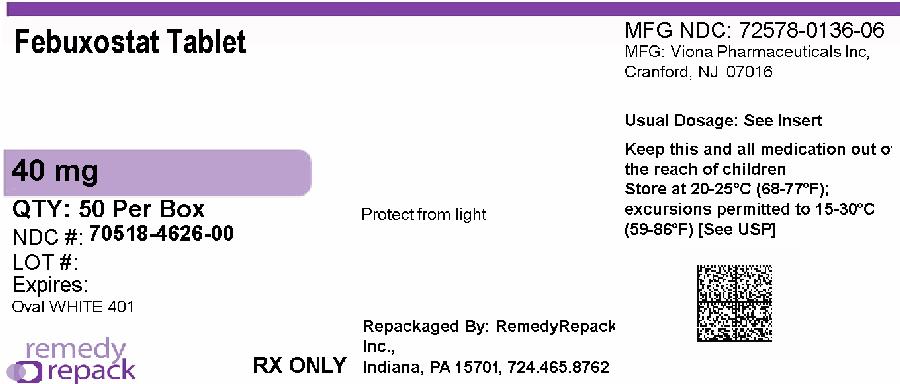
(febuxostat · DailyMed)
FEBUDAY 80MG TABLETS
Febuxostat
What it does
Febuxostat is a medication used to lower high levels of uric acid in the blood, helping to prevent gout attacks.
Commonly used for: gout, hyperuricemia (high uric acid levels)
Read more in plain English ↓Plain-language summary for general understanding - not medical advice. Always follow your pharmacist/doctor.
Ask about this medicine
Answers come only from this medicine's registration record, BNF monograph and interaction data - not medical advice.
Medicine sourcing is available in Kenya only. We don't sell or dispense medicines - licensed pharmacies do.
Sourcing - Kenya onlyRegistration & product details
Source: Food and Drugs Authority · fetched 2026-04-18 08:33:08 · updated 2026-06-30 04:00:14
Drug Interactions
2Severe (2)
Azathioprine - increases exposure
Febuxostatispredictedtoincreasetheexposureto azathioprine.Avoid.rTheoretical
Mercaptopurine - increases exposure
Febuxostatispredictedtoincreasetheexposureto mercaptopurine.Avoid.rTheoretical
Data from BNF 85 (British National Formulary). This is not a substitute for professional medical advice. Matched via: exact
About this medicine
Febuxostat is a medication used to lower high levels of uric acid in the blood, helping to prevent gout attacks.
What it treats
- gout
- hyperuricemia (high uric acid levels)
How it works
It works by reducing the production of uric acid in the body.
Who it's for
Febuxostat is for adults who have high uric acid levels or gout.
AI-assisted summary grounded in BNF data - general information only, not medical advice. Always confirm with your pharmacist or doctor.
Clinical monograph: Febuxostat
BNF-referencedFebuxostat is a selective xanthine oxidase inhibitor used primarily in the management of chronic hyperuricaemia associated with gout and hyperuricaemia related to cancer chemotherapy. It functions by inhibiting the enzyme xanthine oxidoreductase, which is crucial in the production of uric acid, thereby lowering serum uric acid levels and preventing the formation of urate crystals that can cause inflammation and gout attacks.
Indications
- Chronic hyperuricaemia in gout
- Prophylaxis of hyperuricaemia associated with cancer chemotherapy
Dosage
Adults: Initially 80 mg once daily, may increase to 120 mg once daily based on serum uric acid levels after 2-4 weeks. In the context of cancer therapy, the initial dose is 20 mg once daily, to be started 2 days prior to chemotherapy.
Mechanism of action
Febuxostat inhibits xanthine oxidoreductase (XOR), blocking both its oxidase and dehydrogenase activities. This inhibition reduces the conversion of hypoxanthine and xanthine to uric acid, effectively decreasing serum uric acid levels. By binding to a specific site in the XOR enzyme, febuxostat prevents the formation of reactive oxygen species associated with vascular inflammation.
Pharmacodynamics
Febuxostat is a novel, selective xanthine oxidase inhibitor that reduces serum uric acid levels in a dose-dependent manner. Clinical studies have shown that it can decrease mean serum uric acid concentrations by 40 to 55% at daily doses of 40-80 mg. It primarily functions by mobilizing urate crystals from tissue deposits, which can lead to gout flares; however, it does not inhibit other enzymes involved in purine metabolism.
Pharmacokinetics
Febuxostat is well absorbed following oral administration, with peak plasma concentrations typically reached within 1-2 hours. The drug is extensively metabolized in the liver, primarily through the cytochrome P450 system, and eliminated mainly via urine and feces. The half-life of febuxostat is approximately 5 to 8 hours, allowing for once-daily dosing.
Contra-indications
- Severe hypersensitivity to febuxostat
- History of hypersensitivity to allopurinol
- Severe renal disease
Adverse effects
- Rash
- Nausea
- Vomiting
- Hypersensitivity reactions
- Stevens-Johnson syndrome
- Agranulocytosis
- Anaphylactic shock
- Alopecia
- Angina
- Angioedema
- Immunoblastic T-cell lymphoma
- Aplastic anemia
- Asthenia
- Ataxia
- Boils
- Bradycardia
- Cataracts
- Coma
- Depression
- Diabetes mellitus
- Drowsiness
- Erectile dysfunction
- Fever
- Hyperlipidemia
- Hypertension
- Infertility (male)
- Maculopathy
- Malaise
- Oedema
- Paraesthesia
- Paralysis
- Peripheral neuropathy
- Severe cutaneous adverse reactions (SCARs)
- Stomatitis
- Taste alteration
- Thrombocytopenia
- Vertigo
- Visual impairment
Interactions
- Febuxostat + Azathioprine: Severe (increases exposure)
- Febuxostat + Mercaptopurine: Severe (increases exposure)
Precautions
- Ensure adequate fluid intake (2–3 litres/day)
- Monitor for signs and symptoms of severe hypersensitivity reactions
- Patients with a history of major cardiovascular disease should be monitored closely due to increased risk of cardiovascular death and all-cause mortality
Pregnancy
Toxicity not reported. Use only if no safer alternative and if benefits outweigh risks.
Breast-feeding
Present in milk; not known to be harmful.
Storage
Store below 30 degrees Celsius. Protect from moisture.
Formulations
- Febuxostat 80 mg tablets
- Febuxostat 120 mg tablets
AI-synthesized from BNF references - general information only, not a substitute for professional medical advice or the current BNF. Verify doses with a pharmacist.
Molecular reference: Febuxostat
PubChem CID 134018Molecular formula: C16H16N2O3S
Mechanism of action
Gout is a form of acute arthritis that is characterized by the accumulation of crystals of monosodium urate and urate crystals in or around a joint, leading to inflammation and persistent urate crystal deposition in bones, joints, tissues, and other organs that may exacerbate over time. Hyperuricemia is closely related to gout, whereby it may exist for many years before the first clinical attack of gout; thus, aberrated serum uric acid levels and hyperuricemia are believed to be the biochemical aberration involved in the pathogenesis of gout. Xanthine oxidoreductase (XOR) can act as a xanthine oxidase or xanthine dehydrogenase. In humans, it is a critical enzyme for uric acid production as it catalyzes the oxidation reaction steps from hypoxanthine to xanthine and from xanthine to uric acid in the pathway of purine metabolism. Febuxostat potently inhibits XOR, blocking both its oxidase and dehydrogenase activities. With high affinity, febuxostat binds to XOR in a molecular channel leading to the molybdenum-pterin active site, where [allopurinol] demonstrates relatively weak competitive inhibition. XOR is mainly found in the dehydrogenase form under normal physiological conditions; however, in inflammatory conditions, XOR can be converted into the xanthine oxidase form, which catalyzes reactions that produce reactive oxygen species (ROS), such as peroxynitrite. ROS contribute to vascular inflammation and alterations in vascular function. As febuxostat can inhibit both forms of XOR, it can inhibit ROS formation, oxidative stress, and inflammation. In a rat model, febuxostat suppressed renal ischemia-reperfusion injury by attenuating oxidative stress.
Pharmacodynamics
Febuxostat is a novel, selective xanthine oxidase/dehydrogenase inhibitor that works by decreasing serum uric acid in a dose-dependent manner. In healthy subjects, febuxostat decreased the mean serum uric acid and serum xanthine concentrations, as well as the total urinary uric acid excretion. Febuxostat at daily doses of 40-80 mg reduced the 24-hour mean serum uric acid concentrations by 40 to 55%. Closely related to the drug-induced reduction of serum uric acid levels and mobilization of urate crystals in tissue deposits, febuxostat is associated with gout flares. Unlike [allopurinol] and [oxypurinol], febuxostat has no inhibitory actions against other enzymes involved in purine and pyrimidine synthesis and metabolism, because it does not structurally resemble purines or pyrimidines.
Source: PubChem (NCBI) · pathways from PathBank, Reactome, WikiPathways & PharmGKB.
This drug in other countries
The same active ingredient registered across other registries we cover - including different brands.
- FEB-OUT 80 TABLETS · Psm Pharmaceuticals
- FEBLORIKA-40 · Surgilinks
- FEBLORIKA-80 · Surgilinks
- FEBO-G 40 MG TABLETS · Harleys
- FEBO-G 80 MG TABLETS · Harleys
- FEBOXIN-Q 40MG TABLET · Cintana Healthcare
- FEBLORIKA-40 · Mankind Pharma
- FEBLORIKA-80 · Mankind Pharma
- FEBUDAY 40 · Msn Laboratories
- Febumac 40 · Macleods Pharmaceuticals
- Febumac 80
- Feburic 40 · Ajanta Pharma
- FEBINNO 40 · Rv Lifesciences
- FEBINNO 80 · Rv Lifesciences
- Feblorika-40 · Precise Chemipharma
- Feblorika-80 · Precise Chemipharma
- Febuday 40 tablets · Msn Laboratories
- Febuday 80 tablets · Msn Laboratories