(terbinafine · DailyMed)
LAMISIL 1%W/W CREAM
TERBINAFINE HYDROCHLORIDE
What it does
Terbinafine is an antifungal medicine used to treat fungal infections.
Commonly used for: fungal nail infections, ringworm (tinea), athlete's foot (tinea pedis), jock itch (tinea cruris)
Read more in plain English ↓Plain-language summary for general understanding - not medical advice. Always follow your pharmacist/doctor.
Ask about this medicine
Answers come only from this medicine's registration record, BNF monograph and interaction data - not medical advice.
Medicine sourcing is available in Kenya only. We don't sell or dispense medicines - licensed pharmacies do.
Sourcing - Kenya onlyRegistration & product details
Source: Pharmacy and Medicines Regulatory Authority · fetched 2026-04-21 17:37:39 · updated 2026-09-15 04:32:43
Drug Interactions
24Moderate (11)
Anticholinesterases, Centrally Acting - increases exposure
Terbinafine is predicted to increase the exposure to anticholinesterases, centrally acting (galantamine). Monitor and adjust dose.
Antipsychotics, Second Generation - increases exposure
Terbinafine is predicted to increase the exposure to antipsychotics, second generation (risperidone). Adjust dose.
Atomoxetine - increases exposure
Terbinafine is predicted to markedly increase the exposure to atomoxetine. Adjust dose. Study Atorvastatin → see statins Atovaquone → see antimalarials Atracurium → see neuromuscular blocking drugs, n
Eliglustat - increases exposure
Terbinafine is predicted to increase the exposure to eliglustat. Avoid or adjust dose-consult product literature.
Fesoterodine - increases exposure
Terbinafine is predicted to increase the exposure to fesoterodine. Use with caution and adjust dose. Theoretical Fexofenadine → see antihistamines, non-sedating Fibrates... bezafibrate ciprofibrate fe
Unknown (13)
Betablockers,selective - increases exposure
Terbinafine is predicted to increase the exposure to beta blockers, selective (metoprolol, nebivolol).
Codeine - decreases efficacy
Terbinafineispredictedtodecreasetheefficacyofcodeine. oTheoretical
Darifenacin - increases exposure
Terbinafine is predicted to slightly increase the exposure to darifenacin.
Fenfluramine - increases exposure
Terbinafine is predicted to increase the exposure to fenfluramine. Study Fenofibrate → see fibrates Fentanyl → see opioids Fesoterodine → see TABLE 10 p. 1519 (antimuscarinics)
Gefitinib - increases exposure
Terbinafineispredictedtoincreasetheexposuretogefitinib. oTheoretical
Data from BNF 85 (British National Formulary). This is not a substitute for professional medical advice. Matched via: exact
About this medicine
Terbinafine is an antifungal medicine used to treat fungal infections.
What it treats
- fungal nail infections
- ringworm (tinea)
- athlete's foot (tinea pedis)
- jock itch (tinea cruris)
How it works
It works by stopping the growth of fungi that cause infections.
Who it's for
It is suitable for adults and some children with fungal infections.
AI-assisted summary grounded in BNF data - general information only, not medical advice. Always confirm with your pharmacist or doctor.
Clinical monograph: Terbinafine
BNF-referencedTerbinafine is an antifungal medication primarily used to treat dermatophyte infections, including tinea pedis (athlete's foot), tinea cruris (jock itch), tinea corporis (ringworm), and onychomycosis (fungal nail infections). It functions by inhibiting the enzyme squalene monooxygenase, which is crucial for ergosterol synthesis in fungal cell membranes. This results in compromised cell integrity and eventual fungal cell death. Terbinafine is available in various forms, including oral tablets and topical formulations such as creams and medicated nail lacquers.
Indications
- Tinea pedis (athlete's foot)
- Tinea cruris (jock itch)
- Tinea corporis (ringworm)
- Onychomycosis (fungal nail infections)
Dosage
Adults: For adults, the typical oral dosage for tinea infections is 250 mg once daily for 2 to
Mechanism of action
Terbinafine inhibits the enzyme squalene monooxygenase, preventing the conversion of squalene to 2,3-oxydosqualene, a vital step in ergosterol synthesis. This leads to reduced ergosterol levels, which are essential for fungal cell membrane integrity, and causes an accumulation of squalene, contributing to cell death.
Pharmacodynamics
As an allylamine antifungal, terbinafine disrupts fungal cell membrane synthesis by inhibiting squalene epoxidase. This action results in weakening of the cell wall and the formation of squalene-rich vesicles within the fungal cells. It has a long duration of action due to extensive tissue distribution and a long terminal elimination half-life. The therapeutic index is wide, making overdose uncommon, but liver function tests are recommended prior to treatment to mitigate the risk of hepatotoxicity.
Pharmacokinetics
Terbinafine is well absorbed after oral administration, with peak plasma concentrations occurring within 2 hours. It is extensively distributed in body tissues, particularly in skin and nails, where it accumulates. The elimination half-life ranges from 25 to 30 hours, allowing for once-daily dosing. Terbinafine is primarily metabolized by the liver and excreted in urine, with less than 5% of the dose excreted unchanged.
Adverse effects
- Nausea
- Diarrhea
- Abdominal pain
- Headache
- Rash
- Taste disturbance
- Liver function abnormalities
Interactions
- Moderate (increases exposure) with galantamine
- Moderate (increases exposure) with risperidone
- Moderate (increases exposure) with atomoxetine
- Moderate (increases exposure) with eliglustat
- Moderate (increases exposure) with fesoterodine
- Moderate (decreases exposure) with rifampicin
- Moderate (increases exposure) with fluoxetine
- Moderate (increases exposure) with centrally acting anticholinesterases
- Moderate (increases exposure) with second-generation antipsychotics
- Moderate (increases exposure) with tricyclic antidepressants
Precautions
- Use with caution in individuals with liver dysfunction
- Monitor liver function tests before and during therapy
- Avoid use in patients with a history of hypersensitivity to terbinafine or its components
- Caution in patients with renal impairment
Pregnancy
Manufacturer advises avoiding use unless potential benefit outweighs risk.
Breast-feeding
Manufacturer advises avoiding use unless potential benefit outweighs risk.
Storage
Store at room temperature, away from moisture and heat. Keep out of reach of children.
Formulations
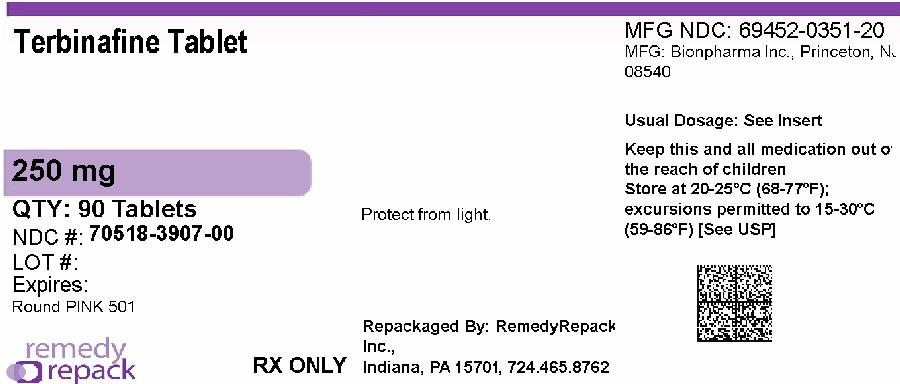
- Tablets (250 mg)
- Cream (1%)
- Solution (1%)
AI-synthesized from BNF references - general information only, not a substitute for professional medical advice or the current BNF. Verify doses with a pharmacist.
Molecular reference: Terbinafine
PubChem CID 1549008Molecular formula: C21H25N
Mechanism of action
Terbinafine inhibits the enzyme squalene monooxygenase (also called squalene epoxidase), preventing the conversion of squalene to 2,3-oxydosqualene, a step in the synthesis of ergosterol. This inhibition leads to decreased ergosterol, which would normally be incorporated into the cell wall, and accumulation of squalene. Generation of a large number of squalene containing vesicles in the cytoplasm may leach other lipids away from, and further weaken, the cell wall.
Pharmacodynamics
Terbinafine is an allylamine antifungal that inhibits squalene epoxidase (also known as squalene monooxygenase) to prevent the formation of ergosterol and cause an accumulation of squalene, weakening the cell wall of fungal cells. Terbinafine distributes into tissues and has a long terminal elimination half life, so the duration of action is long. Overdose with terbinafine is rare, even above the therapeutic dose, so the therapeutic index is wide. Patients taking oral terbinafine should have liver function tests performed prior to treatment to reduce the risk of liver injury.
Source: PubChem (NCBI) · pathways from PathBank, Reactome, WikiPathways & PharmGKB.
This drug in other countries
The same active ingredient registered across other registries we cover - including different brands.
- DERMAFIN CREAM · Nextgen Pharmaceuticals
- FINAMARK 250 · Sai Pharmaceuticals
- FUCLEAR CREAM · Medcure Healthcare
- FUCLEAR TABLET · Medcure Healthcare
- FUNGIFIN CREAM · Universal Corporation
- FUNGISIL · Krishna Chemists
- AKRISIL · Akriti Pharmaceuticals
- Binafin · Seoul Pharma
- Binafin · Lincoln Pharmaceuticals
- Binafin · Lincoln Pharmaceuticals
- Fungifex · Remedica
- Lamifen · Jamjoom Pharmaceuticals