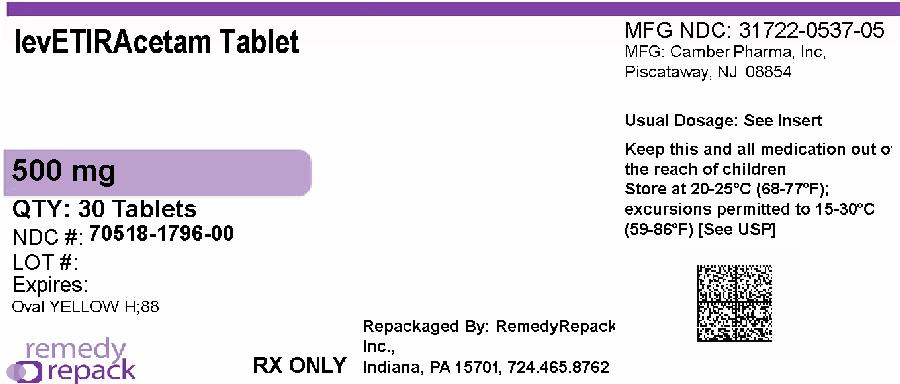
(levetiracetam · DailyMed)
LEVE-Q ORAL SOLUTION 100MG/ML
LEVETIRACETAM
What it does
Levetiracetam is a medication used to help control seizures in people with epilepsy.
Commonly used for: epilepsy, seizure disorders
Read more in plain English ↓Plain-language summary for general understanding - not medical advice. Always follow your pharmacist/doctor.
Ask about this medicine
Answers come only from this medicine's registration record, BNF monograph and interaction data - not medical advice.
Hard to find? We help patients in Kenya source rare medicines. We don't sell or dispense medicines - licensed pharmacies do.
Source this medicineRegistration & product details
Source: Pharmacy and Poisons Board · fetched 2026-01-28 19:30:31 · updated 2026-09-15 02:23:15
Drug Interactions
65Pharmacodynamic Warnings
Levetiracetam appears in TABLE 11: Drugs with CNS depressant effects
Severe (7)
Antiepileptics - decreases absorption
Iron chelators (dexrazoxane) might decrease the absorption of antiepileptics (fosphenytoin, phenytoin). Avoid.
Antiepileptics - decreases exposure
Lumacaftor is predicted to decrease the exposure to antiepileptics (carbamazepine, fosphenytoin, phenobarbital, phenytoin, primidone). Avoid.
Antiepileptics - decreases concentration
St John’s wort is predicted to decrease the concentration of antiepileptics (fosphenytoin, phenobarbital, phenytoin, primidone). Avoid.
Antiepileptics - increases risk of overheating and dehydration
Hydroxyzine potentially increases the risk of overheating and dehydration when given with antiepileptics (zonisamide). Avoid in children.
Antiepileptics - increases risk of overheating and dehydration
Haloperidol potentially increases the risk of overheating and dehydration when given with antiepileptics (zonisamide). Avoid in children.
Antiepileptics - decreases absorption
Dexrazoxane might decrease the absorption of antiepileptics (fosphenytoin, phenytoin). Avoid.
Antiepileptics - increases risk of overheating and dehydration
Oxybutynin potentially increases the risk of overheating and dehydration when given with antiepileptics (zonisamide). Avoid in children.
Moderate (25)
Antiepileptics - increases concentration
Intravenous chloramphenicol increases the concentration of antiepileptics (fosphenytoin, phenytoin) and antiepileptics (fosphenytoin, phenytoin) affect the concentration of intravenous chloramphenicol
Antiepileptics - decreases concentration
Diazoxide decreases the concentration of antiepileptics (fosphenytoin, phenytoin) and antiepileptics (fosphenytoin, phenytoin) are predicted to decrease the effects of diazoxide. Monitor concentration
Antiepileptics - increases concentration
Disulfiramincreasestheconcentrationofantiepileptics (fosphenytoin,phenytoin).Monitorconcentrationandadjust dose.rStudy →AlsoseeTABLE12p.1520
Antiepileptics - increases concentration
Fluorouracilincreasestheconcentrationofantiepileptics (fosphenytoin,phenytoin).Monitorconcentrationandadjust dose.rAnecdotal 1xidneppA|snoitcaretnI A1 https://www.facebook.c (Books-Courses-Medic
Antiepileptics - decreases concentration
Folates are predicted to decrease the concentration of antiepileptics (fosphenytoin, phenobarbital, phenytoin, primidone). Monitor concentration and adjust dose.
Unknown (33)
Antiepileptics - increases risk of overheating and dehydration
Acetazolamide potentially increases the risk of overheating and dehydration when given with antiepileptics (zonisamide). Avoid in children.
Antiepileptics - increases risk of visual disturbances
Alcohol potentially increases the risk of visual disturbances when given with antiepileptics (retigabine).
Antiepileptics - decreases exposure
Enzalutamide is predicted to slightly decrease the exposure to antiepileptics (brivaracetam).
Antiepileptics - decreases exposure
Apalutamidepotentiallydecreasestheexposureto antiepileptics(valproate).nTheoretical
Antiepileptics - increases concentration
Capecitabine increases the concentration of antiepileptics (fosphenytoin, phenytoin).
Data from BNF 85 (British National Formulary). This is not a substitute for professional medical advice. Matched via: class
About this medicine
Levetiracetam is a medication used to help control seizures in people with epilepsy.
What it treats
- epilepsy
- seizure disorders
How it works
It helps to stabilize electrical activity in the brain, reducing the chance of seizures.
Who it's for
It is for people diagnosed with epilepsy who experience seizures.
Drug class
Antiepileptics
Cautions
- • Be cautious if taking other medications that affect the brain, as they may increase side effects.
AI-assisted summary grounded in BNF data - general information only, not medical advice. Always confirm with your pharmacist or doctor.
Clinical monograph: Levetiracetam
BNF-referencedLevetiracetam is an antiepileptic drug primarily used in the management of epilepsy and other seizure disorders. It is recognized for its unique mechanism of action, which distinguishes it from other antiepileptic medications. Levetiracetam is typically well tolerated and has a wide therapeutic index, making it a preferred choice in various clinical settings. Its ability to modulate synaptic transmission without affecting normal neuronal activity contributes to its efficacy in seizure control.
Indications
- Epilepsy
- Focal seizures
- Generalized tonic-clonic seizures
- Myoclonic seizures in juvenile myoclonic epilepsy
Mechanism of action
Levetiracetam exerts its antiepileptic effects by binding to synaptic vesicle protein 2A (SV2A), a protein found on synaptic vesicles within the central nervous system. This binding is thought to play a crucial role in vesicle exocytosis and the modulation of synaptic transmission. By stimulating pre-synaptic SV2A, levetiracetam may inhibit the release of neurotransmitters during pathological conditions without interfering with normal neurotransmission. Additionally, it has been shown to indirectly affect GABAergic transmission and may inhibit N-type calcium channels, although the implications of these actions for its antiepileptic effects remain to be fully understood.
Pharmacodynamics
Levetiracetam prevents seizure activity primarily by selectively inhibiting hypersynchronized epileptiform burst firing, while preserving normal neuronal transmission. It has a wide therapeutic index, which implies a lower risk of toxicity compared to other antiepileptic drugs. However, it is important to monitor patients for potential emergence or worsening of depressive symptoms, suicidal ideation, and behavioral changes, as there is an associated increased risk of such effects with the use of antiepileptic medications, including levetiracetam.
Pharmacokinetics
Levetiracetam is rapidly absorbed after oral administration, with peak plasma concentrations typically achieved within 1 to 1.5 hours. It is primarily eliminated by the kidneys, with approximately 66% of an administered dose excreted unchanged in the urine. The half-life of levetiracetam is approximately 7 to 8 hours in adults, and it does not undergo significant metabolism, which limits drug-drug interactions. Dose adjustments may be necessary in patients with renal impairment.
Adverse effects
- Drowsiness
- Fatigue
- Irritability
- Dizziness
- Nausea
- Vomiting
- Aseptic meningitis
- Suicidal behaviour
- Severe cutaneous adverse reactions
- Hypersensitivity reactions
Interactions
- Other antiepileptic drugs
- Alcohol
- CNS depressants
Precautions
- Cautions in patients with renal impairment
- Monitor for signs of depression or suicidal ideation
- Consider withdrawal if rash or signs of hypersensitivity occur
Pregnancy
Limited data suggest no harmful effects, but caution is advised.
Breast-feeding
Present in breast milk, but limited data indicate no harmful effects on the infant.
Storage
Store in a cool, dry place away from direct sunlight. Keep out of reach of children.
Formulations
- Oral solution
- Tablets
- Dispersible tablets
- Injection
AI-synthesized from BNF references - general information only, not a substitute for professional medical advice or the current BNF. Verify doses with a pharmacist.
Molecular reference: Levetiracetam
PubChem CID 5284583Molecular formula: C8H14N2O2
Mechanism of action
The exact mechanism through which levetiracetam exerts its anti-epileptic effects is unclear, but is thought to be unique amongst other anti-epileptic medications. Current knowledge suggests that levetiracetam’s binding to synaptic vesicle protein 2A (SV2A) is a key driver of its action. SV2A is a membrane-bound protein that is found on synaptic vesicles and is ubiquitous throughout the CNS - it appears to play a role in vesicle exocytosis and in the modulation of synaptic transmission by increasing the available amount of secretory vesicles available for neurotransmission. Stimulation of pre-synaptic SV2A by levetiracetam may inhibit neurotransmitter release, but this action does not appear to affect normal neurotransmission. This has led to the suggestion that levetiracetam exclusively modulates the function of SV2A only under pathophysiological conditions. Levetiracetam and related analogues showed a correlation between affinity for SV2A and anti-epileptic potency, further suggesting that action at this site contributes to the anti-epileptic activity of the drug. Levetiracetam has also been shown to indirectly affect GABAergic neurotransmission (despite having no direct effect on GABAergic or glutamatergic receptors) and modulate ionic currents. Similarly, levetiracetam has been shown in vitro to inhibit N-type calcium channels. How, or even if, these actions are implicated in its anti-epileptic action have yet to be elucidated. The precise mechanism by which levetiracetam exerts its antiepileptic effect is unknown. The antiepileptic activity of levetiracetam was assessed in a number of animal models of epileptic seizures. Levetiracetam did not inhibit single seizures induced by maximal stimulation with electrical current or different chemoconvulsants and showed only minimal activity in submaximal stimulation and in threshold tests. Protection was observed, however, against secondarily generalized activity from focal seizures induced by pilocarpine and kainic acid, two chemoconvulsants that induce seizures that mimic some features of human complex partial seizures with secondary generalization. Levetiracetam also displayed inhibitory properties in the kindling model in rats, another model of human complex partial seizures, both during kindling development and in the fully kindled state. The predictive value of these animal models for specific types of human epilepsy is uncertain. In vitro and in vivo recordings of epileptiform activity from the hippocampus have shown that levetiracetam inhibits burst firing without affecting normal neuronal excitability, suggesting that levetiracetam may selectively prevent hypersynchronization of epileptiform burst firing and propagation of seizure activity. Levetiracetam at concentrations of up to 10 muM did not demonstrate binding affinity for a variety of known receptors, such as those associated with benzodiazepines, GABA (gammaaminobutyric acid), glycine, NMDA (N-methyl-D-aspartate), re-uptake sites, and second messenger systems. Furthermore, in vitro studies have failed to find an effect of levetiracetam on neuronal voltage-gated sodium or T-type calcium currents and levetiracetam does not appear to directly facilitate GABAergic neurotransmission. However, in vitro studies have demonstrated that levetiractem opposes the activity of negative modulators of GABA- and glycine-gated currents and partially inhibits N-type calcium currents in neuronal cells. A saturable and stereoselective neuronal binding site in rat brain tissue has been described for levetiracetam. Experimental data indicate that this binding site is the synaptic vesicle protein SV2A, thought to be involved in the regulation of vesicle exocytosis. Although the molecular significance of levetiracetam binding to synaptic vesicle protein SV2A is not understood, levetiracetam and related analogs showed a rank order of affinity for SV2A which correlated with the potency of their antiseizure activity in audiogenic seizure-pro
Pharmacodynamics
Levetiracetam appears to prevent seizure activity via the selective inhibition of hypersynchronized epileptiform burst firing without affecting normal neuronal transmission, though the exact mechanism through which this occurs is unclear. The therapeutic index of levetiracetam is wide, making it relatively unique amongst other anti-epileptic medications. Anti-epileptic drugs, including levetiracetam, may increase the risk of suicidal ideation or behaviour - patients taking levetiracetam should be monitored for the emergence or worsening of depressive symptoms, suicidal ideation, and behavioural abnormalities.
Source: PubChem (NCBI) · pathways from PathBank, Reactome, WikiPathways & PharmGKB.
This drug in other countries
The same active ingredient registered across other registries we cover - including different brands.
- Epiend · Otsuka Pharmaceutical
- GULEVON
- KEPPROLIN · Lincoln Pharmaceuticals
- KEPPROLIN · Lincoln Pharmaceuticals Limited
- LEVANEXT 1000 · Msn Laboratories
- LEVANEXT 250 · Msn Laboratories
- KEPPROLIN · Lincoln Pharmaceuticals
- LETRAM · Hetero Drugs
- LEVULEX 500 · Pulse Pharmaceuticals
- LEVULEX 750 · Pulse Pharmaceuticals
- QUETRA · Remedica Ltd
- QUETRA · Remedica Ltd
- LEVANEXT 250 · Msn Laboratories Private Limited
- LEVIGRESS 250 · La Renon Healthcare
- Levanext 1000 · Msn Laboratories Private Limited
- Levanext 750 · Msn Laboratories Private Limited
- Levetroy · Troikaa Pharmaceuticals
- Levigress 500 Tablets · Stanford Laboratories