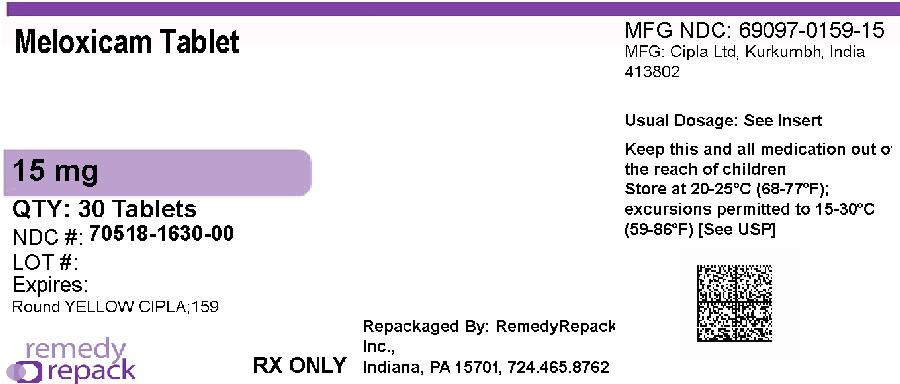
(meloxicam · DailyMed)
MELOZEN 15
Meloxicam
What it does
Meloxicam is a type of non-steroidal anti-inflammatory drug (NSAID) used to relieve pain and reduce inflammation.
Commonly used for: arthritis (osteoarthritis and rheumatoid arthritis), pain relief (including menstrual pain and other types of pain)
Read more in plain English ↓Plain-language summary for general understanding - not medical advice. Always follow your pharmacist/doctor.
Ask about this medicine
Answers come only from this medicine's registration record, BNF monograph and interaction data - not medical advice.
Medicine sourcing is available in Kenya only. We don't sell or dispense medicines - licensed pharmacies do.
Sourcing - Kenya onlyRegistration & product details
Source: South African Health Products Regulatory Authority · fetched 2026-04-15 21:26:13 · updated 2026-09-13 04:01:45
Drug Interactions
14Pharmacodynamic Warnings
Meloxicam appears in TABLE 2: Drugs that cause nephrotoxicity
Meloxicam appears in TABLE 4: Drugs with antiplatelet effects
Meloxicam appears in TABLE 16: Drugs that increase serum potassium
Meloxicam appears in TABLE 18: Drugs that cause hyponatraemia
Severe (1)
Mifamurtide - decreases efficacy
NSAIDs(high-dose)arepredictedtodecreasetheefficacyof mifamurtide.Avoid.rTheoretical
Moderate (5)
Antiarrhythmics - increases exposure
NSAIDs (celecoxib) are predicted to increase the exposure to antiarrhythmics (flecainide, propafenone). Monitor and adjust dose.
Cladribine - increases exposure
NSAIDs(sulindac)mightincreasetheexposuretocladribine. Avoidoradjustdose.oTheoretical
Flecainide - increases exposure
NSAIDs (celecoxib) are predicted to increase the exposure to antiarrhythmics (flecainide, propafenone). Monitor and adjust dose.
Pemetrexed - increases exposure
NSAIDs are predicted to increase the exposure to pemetrexed. Use with caution or avoid. Also see TABLE 2 p. 1517
Propafenone - increases exposure
NSAIDs (celecoxib) are predicted to increase the exposure to antiarrhythmics (flecainide, propafenone). Monitor and adjust dose.
Unknown (8)
Alendronate - increases risk of gastrointestinal irritation
NSAIDs are predicted to increase the risk of gastrointestinal irritation when given with bisphosphonates (alendronate, ibandronate).
Bisphosphonates - increases risk of gastrointestinal irritation
NSAIDs are predicted to increase the risk of gastrointestinal irritation when given with bisphosphonates (alendronate, ibandronate).
Bisphosphonates - increases risk of renal impairment
NSAIDs are predicted to increase the risk of renal impairment when given with bisphosphonates (clodronate).
Clodronate - increases risk of renal impairment
NSAIDs are predicted to increase the risk of renal impairment when given with clodronate.
Deferasirox - increases risk of gastrointestinal bleeding
NSAIDs are predicted to increase the risk of gastrointestinal bleeding when given with deferasirox.
Deferiprone - increases exposure
NSAIDs(diclofenac)arepredictedtoincreasetheexposureto deferiprone.oTheoretical
Ibandronate - increases risk of gastrointestinal irritation
NSAIDs are predicted to increase the risk of gastrointestinal irritation when given with bisphosphonates (alendronate, ibandronate).
Ironchelators - increases risk of gastrointestinal bleeding
NSAIDs are predicted to increase the risk of gastrointestinal bleeding when given with iron chelators (deferasirox).
Data from BNF 85 (British National Formulary). This is not a substitute for professional medical advice. Matched via: class
About this medicine
Meloxicam is a type of non-steroidal anti-inflammatory drug (NSAID) used to relieve pain and reduce inflammation.
What it treats
- arthritis (osteoarthritis and rheumatoid arthritis)
- pain relief (including menstrual pain and other types of pain)
How it works
Meloxicam works by blocking certain substances in the body that cause inflammation and pain.
Who it's for
It is typically prescribed for adults who are experiencing pain or inflammation due to certain conditions.
Drug class
NSAIDs
Cautions
- • Be careful if you are taking other drugs that can harm the kidneys.
- • Avoid using with drugs that prevent blood clotting.
- • Use cautiously if you are taking medications that can raise potassium levels in the blood.
- • Watch out for drugs that can cause low sodium levels in the blood.
AI-assisted summary grounded in BNF data - general information only, not medical advice. Always confirm with your pharmacist or doctor.
Clinical monograph: Meloxicam
BNF-referencedMeloxicam is a nonsteroidal anti-inflammatory drug (NSAID) primarily used for its analgesic and anti-inflammatory properties. It is effective in relieving pain and inflammation associated with various musculoskeletal disorders, including osteoarthritis, rheumatoid arthritis, and ankylosing spondylitis. Meloxicam acts by inhibiting cyclooxygenase enzymes, leading to a decrease in the synthesis of prostaglandins, which are mediators of pain and inflammation.
Indications
- Pain and inflammation in musculoskeletal disorders
- Osteoarthritis
- Rheumatoid arthritis
- Ankylosing spondylitis
Dosage
Children: For children aged 16-17 years, the dose is 7.5 mg once daily, increased if necessary up to 15 mg once daily. For children aged 12-17
Adults: The typical adult dosage is 15 mg once daily, reduced to 7.5 mg once daily if necessary.
Mechanism of action
Meloxicam inhibits prostaglandin synthetase (cyclooxygenase 1 and 2) enzymes, resulting in decreased synthesis of prostaglandins that sensitize neuronal pain receptors. This inhibition leads to its analgesic and anti-inflammatory effects. It preferentially inhibits COX-2, which may reduce gastrointestinal irritation compared to non-selective NSAIDs.
Pharmacodynamics
Meloxicam exhibits anti-inflammatory, analgesic, and antipyretic effects. It has been shown to decrease markers of inflammation, such as erythrocyte sedimentation rate (ESR) and C-reactive protein (CRP), in patients with rheumatoid arthritis. While meloxicam is designed to cause less gastrointestinal irritation due to its COX-2 selectivity, it still carries risks associated with gastrointestinal symptoms, including inflammation, bleeding, and ulceration.
Pharmacokinetics
Meloxicam is well-absorbed following oral administration, with peak plasma concentrations typically reached within 4 to 5 hours. It has a half-life of approximately 15 to 20 hours, allowing for once-daily dosing. The drug is extensively metabolized in the liver, and its metabolites are primarily excreted in the urine. Patients with renal or hepatic impairment may require dose adjustments or careful monitoring due to altered pharmacokinetics.
Contra-indications
- Active gastrointestinal bleeding
- Active gastrointestinal ulceration
- History of gastrointestinal bleeding related to previous NSAID therapy
- History of significant renal impairment
- History of coronary artery bypass graft surgery
- History of hypersensitivity to aspirin or any other NSAID, including those who have experienced asthma, angioedema, urticaria, or rhinitis precipitated by these agents
Adverse effects
- Gastrointestinal discomfort
- Gastrointestinal bleeding
- Nausea
- Vomiting
- Headache
- Constipation
- Diarrhea
- Renal impairment
- Cardiovascular events
- Delayed onset of labor
- Potential exacerbation of asthma symptoms
Interactions
- Increased risk of gastrointestinal side effects when used with other NSAIDs
- May interfere with the effects of antihypertensive medications
- Caution advised with anticoagulants due to increased bleeding risk
- May reduce the effectiveness of diuretics
Precautions
- Use with caution in patients with a history of gastrointestinal disorders, such as ulcerative colitis or Crohn's disease
- Use with caution in elderly patients due to increased risk of serious side effects
- Monitor renal function in patients with renal impairment
- Long-term use may lead to decreased female fertility, which is reversible upon discontinuation
Pregnancy
Avoid unless the potential benefit outweighs the risk. Avoid during the third trimester due to risk of fetal ductus arteriosus closure and potential persistent pulmonary hypertension in the newborn.
Breast-feeding
Use with caution; present in milk in animal studies, manufacturer advises avoiding use during breastfeeding.
Storage
Store in a cool, dry place away from light. Keep out of reach of children.
Formulations
- Meloxicam 7.5 mg oral tablets
- Meloxicam 15 mg oral tablets
- Meloxicam 500 mg oral suspension
AI-synthesized from BNF references - general information only, not a substitute for professional medical advice or the current BNF. Verify doses with a pharmacist.
Molecular reference: Meloxicam
PubChem CID 54677470Molecular formula: C14H13N3O4S2
Mechanism of action
Meloxicam inhibits prostaglandin synthetase (cylooxygenase 1 and 2) enzymes leading to a decreased synthesis of prostaglandins, which normally mediate painful inflammatory symptoms. As prostaglandins sensitize neuronal pain receptors, inhibition of their synthesis leads to analgesic and inflammatory effects. Meloxicam preferentially inhibits COX-2, but also exerts some activity against COX-1, causing gastrointestinal irritation. Meloxicam, an oxicam derivative that is structurally related to piroxicam, is a nonsteroidal anti-inflammatory agent (NSAIA) exhibiting analgesic, antipyretic, and anti-inflammatory actions. In vitro and in vivo studies indicate that meloxicam inhibits the cyclooxygenase-2 (COX-2) isoform of prostaglandin endoperoxide synthase (prostaglandin G/H synthase [PGHS]) to a greater extent than the COX-1 isoform. However, meloxicam's COX-2 selectivity is dose dependent and is diminished at higher dosages. Therefore meloxicam sometimes has been referred to as a "preferential" rather than "selective" COX-2 inhibitor. To investigate the effect of meloxicam on human polymorphonuclear leukocyte (PMN) adhesion to human synovial cell (HSC), and to explore its mechanism. MTT colorimetry was used to determine the adhesion effect of PMN to HSC. Cell-ELISA and RT-PCR methods were used to determine the expression of ICAM-1 and VCAM-1. Nuclear transcription factor-kappa B (NF-kappa B) was measured by electrophoretic mobility shift assay (EMSA) method. Meloxicam was found to effectively inhibit TNF-alpha (50 u.mL-1 for 12 hr) and IL-1 beta (50 u.mL-1 for 12 hr)-induced adhesion of PMN to HSC (IC50 3.38 X 10(-7) mol.L-1 and 3.56 X 10(-6) mol.L-1, respectively) in a concentration-dependent manner. ICAM-1 protein and mRNA expression induced by TNF-alpha (50 u.mL-1) were inhibited by meloxicam at 1 X 10(-6)-1 X 10(-5) mol.L-1. The activation of NF-kappa B was also inhibited by meloxicam at 1 X 10(-6)-1 X 10(-5) mol.L-1. These results suggest that meloxicam inhibit TNF-alpha stimulated PMN-HSC adhesion and expression of ICAM-1 by suppressing the activity of NF-kappa B. /Investigators/ compared the effects of therapeutically equivalent doses of meloxicam and indomethacin, a preferential inhibitor of the constitutive cyclooxygenase (COX-1), on platelet aggregation and platelet thromboxane formation, which are exclusively COX-1 dependent, physiological renal, and total body prostaglandin E2 (PGE2) production. In a randomized cross-over design, 14 healthy female volunteers received meloxicam 7.5 mg per day for 6 days or indomethacin 25 mg three times per day for 3 days; the wash-out period was 5 days, and drug intake was adapted to the menstrual cycle. On the day before treatment and on the last day of each treatment period the following parameters were evaluated: maximum platelet aggregation and thromboxane B2 (TXB2) formation in response to 1.0 mmol/L arachidonic acid; 24-hour urinary excretion of PGE2 and 7 alpha-hydroxy-5, 11-diketo-tetranor-prosta-1, 16-dionic acid (PGE-M), the index metabolites of renal and total body PGE2 synthesis, respectively, were assessed by gas chromatography/tandem mass spectrometry. Maximum platelet aggregation and TXB2 formation were almost completely inhibited by indomethacin (-87% and -99%, respectively; p < 0.001, each) as compared to control (100%), but remained unaffected by meloxicam (-1% and +4%, respectively). Meloxicam showed no significant effects on urinary PGE2 excretion (-13%) and only slight effects on PGE-M excretion (-22%; p < 0.05), whereas indomethacin reduced urinary PGE2 excretion (-43%; p < 0.05) as well as PGE-M excretion (-36%; p < 0.001). /This/ data shows, that meloxicam 7.5 mg per day is COX-1 sparing in humans in vivo.
Pharmacodynamics
Meloxicam is an anti-inflammatory, analgesic analgesic with antipyretic effects in fever. Prostaglandins are substances that contribute to inflammation. This drug also exerts preferential actions against COX-2, which may reduce the possible gastrointestinal effects of this drug. In humans, meloxicam has demonstrated the ability to decrease erythrocyte sedimentation rate(ESR) in patients with rheumatoid arthritis, and to decrease ESR, C-reactive protein (CRP), as well as aquaporin-1 expression. As with other NSAIDS, prolonged use of meloxicum can result in renal or cardiovascular impairment or thrombotic cardiovascular events. A note on gastrointestinal effects As meloxicam preferentially inhibits COX-2, it is thought to cause less gastrointestinal irritation compared to other NSAIDS. Despite this, it still carries a risk of gastric inflammation, bleeding and ulceration. In one study, patients on meloxicam suffered from gastrointestinal symptoms at a rate of 13% compared to 19% of those on [diclofenac]. GI events were found to be less severe in the meloxicam-treated patients.
Biological pathways
Source: PubChem (NCBI) · pathways from PathBank, Reactome, WikiPathways & PharmGKB.
This drug in other countries
The same active ingredient registered across other registries we cover - including different brands.
- APOCAM 15 MG · Globe Pharmacy
- APOCAM 7.5 MG · Globe Pharmacy
- AROXICAM 15 · Simba Pharmaceuticals
- AROXICAM 7.5 · Simba Pharmaceuticals
- BENACAM 15MG TABLETS · Benmed Pharmaceuticals
- BENACAM 7.5MG TABLETS · Benmed Pharmaceuticals
- AROXICAM 7.5 · Aurobindo Pharma
- Aroxicam 15 · Aurobindo Pharma
- M-Cam 15 · Unichem Laboratories
- M-Cam 7.5 · Unichem Laboratories
- MELBEK 7.5 mg · Nobel Ilac
- MELONEX
- ARTHROCAM ORAL SUSPENSION 0.5mg (Each ml contains Meloxicam 0.5mg) · Veko Care
- ARTHROCAM ORAL SUSPENSION 1.5MG · Veko Care
- M-CAM TABLETS ( Meloxicam 15mg) · Unichem Laboratories
- M-CAM TABLETS ( Meloxicam 7.5mg) · Unichem Laboratories
- MELONAX 15 TABLETS (Each uncoated tablet contains Meloxicam 15mg) · Strides Pharma