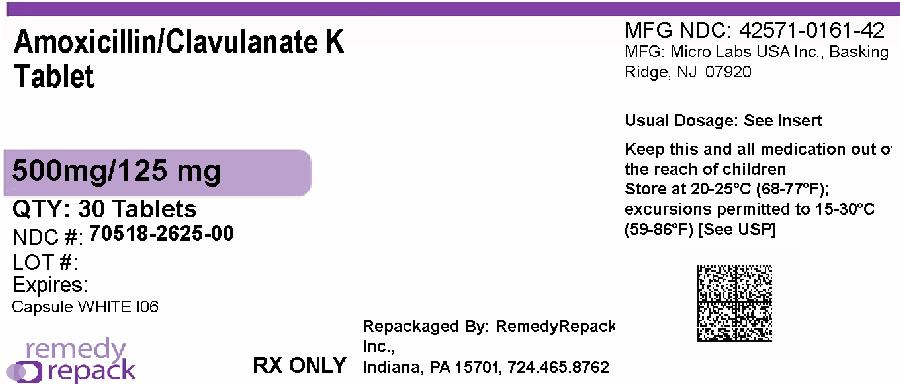
(clavulanate · DailyMed)
RAPICLAV 156.25 SUSPENSION
Diluted Potassium Clavulanate 31.250mg/5ml
What it does
Clavulanate is a medication that helps fight bacterial infections, often used alongside other antibiotics.
Commonly used for: bacterial infections, infections caused by certain bacteria
Read more in plain English ↓Plain-language summary for general understanding - not medical advice. Always follow your pharmacist/doctor.
Ask about this medicine
Answers come only from this medicine's registration record, BNF monograph and interaction data - not medical advice.
Medicine sourcing is available in Kenya only. We don't sell or dispense medicines - licensed pharmacies do.
Sourcing - Kenya onlyRegistration & product details
Source: Botswana Medicines Regulatory Authority · fetched 2026-04-15 20:42:56 · updated 2026-10-20 04:32:03
About clavulanate
Clavulanate is a medication that helps fight bacterial infections, often used alongside other antibiotics.
What it treats
- bacterial infections
- infections caused by certain bacteria
How it works
Clavulanate works by inhibiting the enzymes that bacteria use to resist antibiotics, making the antibiotics more effective.
Who it's for
It is for patients who have bacterial infections that require treatment, especially when other antibiotics may not work.
Cautions
- • Avoid using with other drugs that can harm the liver.
AI-assisted summary grounded in BNF data - general information only, not medical advice. Always confirm with your pharmacist or doctor.
About diluted
Diluted medications are used to prepare other medicines or treatments by mixing them with a liquid to make them easier to take or apply.
What it treats
- various medical treatments
How it works
Dilution helps to reduce the strength of a medicine, making it safer and easier for patients to use.
Who it's for
Patients who need medications in a less concentrated form.
AI-assisted summary grounded in BNF data - general information only, not medical advice. Always confirm with your pharmacist or doctor.
Clinical monograph: clavulanate
BNF-referencedClavulanate is a beta-lactam compound that is primarily used as a beta-lactamase inhibitor. It is often combined with penicillin antibiotics, such as amoxicillin, to enhance their effectiveness against bacteria that produce beta-lactamase enzymes, which can render these antibiotics ineffective. Clavulanate itself has limited antibacterial activity but plays a crucial role in overcoming bacterial resistance mechanisms.
Indications
- Bacterial infections caused by beta-lactamase producing organisms
- Community-acquired pneumonia
- Respiratory tract infections
- Urinary tract infections
- Skin and soft tissue infections
Dosage
Children: Paediatric dosing of clavulanate should be determined based on the specific indication and the formulation used. Refer to the BNF for
Adults: The usual adult dose of clavulanate varies depending on the specific antibiotic it is combined with, generally ranging from 125 mg to 250 mg, taken every 8 hours when combined with amoxicillin.
Mechanism of action
Clavulanate works by irreversibly binding to the active site of beta-lactamase enzymes. By inhibiting these enzymes, clavulanate protects beta-lactam antibiotics from degradation, allowing them to exert their antibacterial effects effectively. This mechanism enhances the spectrum of activity of the co-administered antibiotic, thereby improving clinical outcomes in infections caused by beta-lactamase producing organisms.
Pharmacodynamics
Clavulanate exhibits a time-dependent antibacterial effect, characterized by its ability to maintain effective concentrations against beta-lactamase producing bacteria. Its pharmacodynamic properties are mainly influenced by its interaction with beta-lactam antibiotics, enhancing their efficacy in treating infections. The overall effect is a synergistic relationship that increases the potency of the antibiotic treatment.
Pharmacokinetics
Clavulanate is usually administered orally or parenterally, and it is rapidly absorbed from the gastrointestinal tract. It reaches peak plasma concentrations within 1 to 2 hours after administration. The drug is widely distributed in body tissues, with a volume of distribution indicative of good tissue penetration. Clavulanate undergoes hepatic metabolism, primarily by conjugation, and is excreted largely in the urine as metabolites. The elimination half-life is approximately 1 hour, necessitating frequent dosing for optimal therapeutic effect.
Contra-indications
- Hypersensitivity to clavulanate or any component of the formulation
- History of jaundice or hepatic impairment related to previous use of beta-lactam antibiotics
Adverse effects
- Diarrhea
- Nausea
- Vomiting
- Rash
- Hepatic dysfunction
- Allergic reactions
Interactions
- Probenecid may increase concentrations of clavulanate
- Anticoagulants may have altered effects due to changes in gut flora
Precautions
- Monitor liver function during prolonged therapy
- Use cautiously in patients with renal impairment
- Assess for history of allergy to penicillins or cephalosporins
Pregnancy
Clavulanate is classified as category B. Animal studies have not shown teratogenic effects, but adequate and well-controlled studies in pregnant women are lacking.
Breast-feeding
Clavulanate is excreted in breast milk. Caution is advised when administering to nursing mothers.
Storage
Store in a cool, dry place away from direct light. Keep out of reach of children.
Formulations
- Clavulanate potassium 125 mg/5 mL
- Clavulanate potassium 250 mg/5 mL
AI-synthesized from BNF references - general information only, not a substitute for professional medical advice or the current BNF. Verify doses with a pharmacist.
Clinical monograph: diluted
Diluted solutions refer to preparations in which a concentrated substance has been mixed with a solvent, typically water, to decrease the concentration of the active ingredient. This process is widely used in pharmacology to adjust the potency of medications for safe administration, particularly in pediatrics or when a lower dose is required. The dilution of drugs can facilitate easier administration, enhance absorption, and reduce the risk of adverse effects.
Indications
- Pediatric dosing adjustments
- Intravenous therapy
- Intramuscular injections
- Topical applications
- Oral medications for easier swallowing
Dosage
Children: Refer to the BNF for Children for appropriate dosing adjustments based on age and weight.
Adults: Refer to specific drug guidelines for appropriate dilution and dosage based on the active ingredient.
Mechanism of action
The mechanism of action of a diluted drug depends on the specific active ingredient within the solution. Generally, when a drug is diluted, its pharmacological effects are proportional to its concentration. The active molecules interact with specific receptors or enzymes in the body, leading to a desired therapeutic effect. For example, an analgesic diluted for oral administration will still bind to pain receptors, albeit at a lower intensity compared to its concentrated form.
Pharmacodynamics
Pharmacodynamics refers to the relationship between drug concentration and its effect on the body. In diluted solutions, the pharmacodynamic properties of the active ingredient remain intact, though the therapeutic effect may be reduced due to the lower concentration. The efficacy of the drug is influenced by factors such as receptor affinity, intrinsic activity, and the presence of other substances in the formulation.
Pharmacokinetics
Pharmacokinetics involves the absorption, distribution, metabolism, and excretion (ADME) of drugs. For diluted drugs, absorption can be affected by the dilution medium, which may enhance or delay the onset of action. Distribution is generally influenced by the volume of distribution of the active ingredient. Metabolism occurs primarily in the liver, where the drug is biotransformed, and excretion is typically via the kidneys. The pharmacokinetic profile may differ based on the dilution level and formulation.
Pregnancy
Consult a healthcare provider, as the effects of diluted preparations can vary depending on the active ingredient.
Breast-feeding
Consult a healthcare provider, as the safety of diluted preparations during breastfeeding can depend on the active ingredient.
Storage
Store in a cool, dry place away from direct sunlight. Ensure that the specific active ingredient's storage requirements are followed.
AI-synthesized from BNF references - general information only, not a substitute for professional medical advice or the current BNF. Verify doses with a pharmacist.
Molecular reference: clavulanate
PubChem CID 16204478Molecular formula: C8H8NO5-
Biological pathways
Source: PubChem (NCBI) · pathways from PathBank, Reactome, WikiPathways & PharmGKB.
This drug in other countries
The same active ingredient registered across other registries we cover - including different brands.
- AC-CLAV 1000 TABLETS (Each film coated tablet contains Amoxicillin and Cluvalanate Potassium 1000mg · Kiux Pharma
- AC-CLAV 625 TABLETS (Each film coated tablet contains Amoxicillin and Clavulanate Potassium 625 · Kiux Pharma
- ACICLAVCARE 1G TABLETS (Each film-coated tablet contains Amoxicillin trihydrate / Potassium clavulanate 1g) · East African Overseas
- ACINET 1.2G INJECTION (Each vial contains Amoxicillin Sodium/Potassium Clavulanate 1g/0.2g · East African Creasteas
- ACINET 228.5MG/5ML DRY SUSPENSION (Each 5ml of reconstituted suspension contains Amoxicillin Trihydrate/Potassium Clavulanate 200mg/28.5mg) · Indchemie Health Specialities
- ACINET 457MG/5ML DRY SUSPENSION (Each 5ml of reconstituted suspension contains Amoxicillin Trihydrate/Potassium Clavulanate 400mg/57mg) · Indchemie Health Specialities