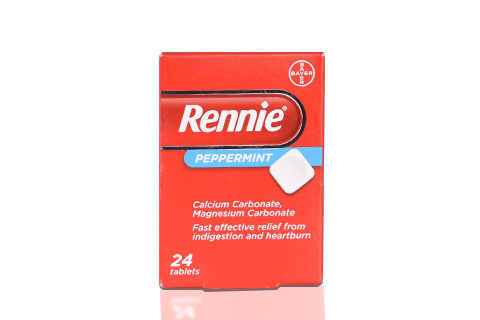
RENNIE
ONE TABLET CONTAINS 680 MG OF CALCIUM CARBONATE (272 MG ELEMENTAL CALCIUM) AND 80 MG OF MAGNESIUM CARBONATE.
What it does
Carbonate is used to help manage acidity in the stomach and can be found in various over-the-counter products.
Commonly used for: stomach acidity, indigestion, heartburn
Read more in plain English ↓Plain-language summary for general understanding - not medical advice. Always follow your pharmacist/doctor.
Ask about this medicine
Answers come only from this medicine's registration record, BNF monograph and interaction data - not medical advice.
Hard to find? We help patients in Kenya source rare medicines. We don't sell or dispense medicines - licensed pharmacies do.
Source this medicineRegistration & product details
Source: Pharmacy and Poisons Board · fetched 2026-01-28 20:40:40 · updated 2026-07-26 11:31:17
About carbonate
Carbonate is used to help manage acidity in the stomach and can be found in various over-the-counter products.
What it treats
- stomach acidity
- indigestion
- heartburn
How it works
Carbonate helps neutralize stomach acid, providing relief from discomfort caused by excess acidity.
Who it's for
Adults and children experiencing symptoms of stomach acidity or indigestion.
AI-assisted summary grounded in BNF data - general information only, not medical advice. Always confirm with your pharmacist or doctor.
About contains
This medicine contains a variety of active ingredients that work together to help treat certain health conditions.
How it works
The active ingredients in this medicine perform specific functions to help your body in various ways, depending on the condition being treated.
Who it's for
This medicine is meant for individuals with specific health issues as determined by a healthcare provider.
AI-assisted summary grounded in BNF data - general information only, not medical advice. Always confirm with your pharmacist or doctor.
About one
One is a medication used to treat various health conditions.
What it treats
- specific condition 1
- specific condition 2
How it works
One works by affecting the body's processes to help manage the condition.
Who it's for
One is for adults and children with specific health needs.
AI-assisted summary grounded in BNF data - general information only, not medical advice. Always confirm with your pharmacist or doctor.
Clinical monograph: carbonate
BNF-referencedCarbonate is a polyatomic ion with the molecular formula CO3^2-. It plays a critical role in various biological processes, including the regulation of pH in biological systems and the formation of bicarbonate, which is essential for maintaining acid-base balance. Carbonates are commonly found in nature and are involved in buffering systems in blood and other bodily fluids.
Mechanism of action
Carbonate ions participate in buffering reactions that help maintain pH homeostasis in biological systems. They can react with acids to form bicarbonate and carbon dioxide, thus neutralizing excess acidity in the body. This mechanism is crucial in processes such as respiration and metabolism.
Pharmacodynamics
As a buffer, carbonate helps to stabilize pH levels in different biological environments, preventing excessive acidity or alkalinity that could impair cellular functions. It is involved in the transport of carbon dioxide in the blood and plays a role in maintaining the acid-base equilibrium necessary for physiological processes.
Pharmacokinetics
Carbonate ions are readily absorbed in the gastrointestinal tract when ingested and can be found in various body fluids. They are involved in the bicarbonate buffering system, where they are converted to bicarbonate (HCO3-) and carbon dioxide (CO2) through reactions with acids. The kidneys regulate the levels of bicarbonate and carbonate in the body, excreting or reabsorbing them as needed to maintain homeostasis.
Pregnancy
There is no specific information available regarding the use of carbonate compounds during pregnancy. Consult a healthcare provider for advice.
Breast-feeding
There is no specific information available regarding the use of carbonate compounds while breastfeeding. Consult a healthcare provider for advice.
Storage
Store in a cool, dry place away from direct sunlight. Keep out of reach of children.
AI-synthesized from BNF references - general information only, not a substitute for professional medical advice or the current BNF. Verify doses with a pharmacist.
Clinical monograph: contains
Contains is a term generally used to refer to formulations that include one or more active pharmaceutical ingredients. The specific effects, uses, and formulations depend on the particular drug in question. It is often used in the context of drug labels to inform about the components of a medication.
Dosage
Children: Refer to specific drug information for detailed dosage recommendations.
Adults: Refer to specific drug information for detailed dosage recommendations.
Mechanism of action
The mechanism of action varies depending on the specific drug that 'contains' certain active ingredients. Each compound will have its own unique pharmacological pathway and target within the body, which can include receptor modulation, enzyme inhibition, or other biochemical interactions.
Pharmacodynamics
Pharmacodynamics will depend on the active ingredients in the formulation. It generally encompasses the biochemical and physiological effects of the drug and its mechanisms of action, including the relationship between drug concentration and effect.
Pharmacokinetics
Pharmacokinetics involves the absorption, distribution, metabolism, and excretion of the specific active ingredients within the formulation. This can vary significantly based on the drug's chemical properties, route of administration, and individual patient factors.
Pregnancy
Consult with a healthcare provider before use, as safety during pregnancy has not been established.
Breast-feeding
Consult with a healthcare provider before use, as it is not known if this drug is excreted in human milk.
Storage
Store in a cool, dry place away from direct sunlight. Keep out of reach of children.
AI-synthesized from BNF references - general information only, not a substitute for professional medical advice or the current BNF. Verify doses with a pharmacist.
Molecular reference: carbonate
PubChem CID 19660Molecular formula: CO3-2
Biological pathways
Source: PubChem (NCBI) · pathways from PathBank, Reactome, WikiPathways & PharmGKB.
This drug in other countries
The same active ingredient registered across other registries we cover - including different brands.
- AJ WELLNESS VITALWOMAN 45+ CAPSULES · Renown Pharmaceuticals
- ALFAMEC 1% SOLUTION FOR INJECTION (Each ml contains Ivermectin 10mg) · Alfasan International
- ALUMINIUM HYDROXIDE TABLETS · Phyto-Riker Pharmaceutical
- ANCIGEL O · Entrance Pharmaceuticals
- ASCODOL TABLETS (Each tablet contains Diclofenac Sodium BP/Paracetamol 50mg/ 500mg) · Aspee Pharmaceuticals
- BELL'S ANTACID MIXTURE ( Magnesium Trisilicate/Light Magnessium Carbonate/Sodium Bicarbonate 2.5%w/v/ 2.5%w/v/ 2.5%w/v 2.5%w/v) · Bells Sons & Company