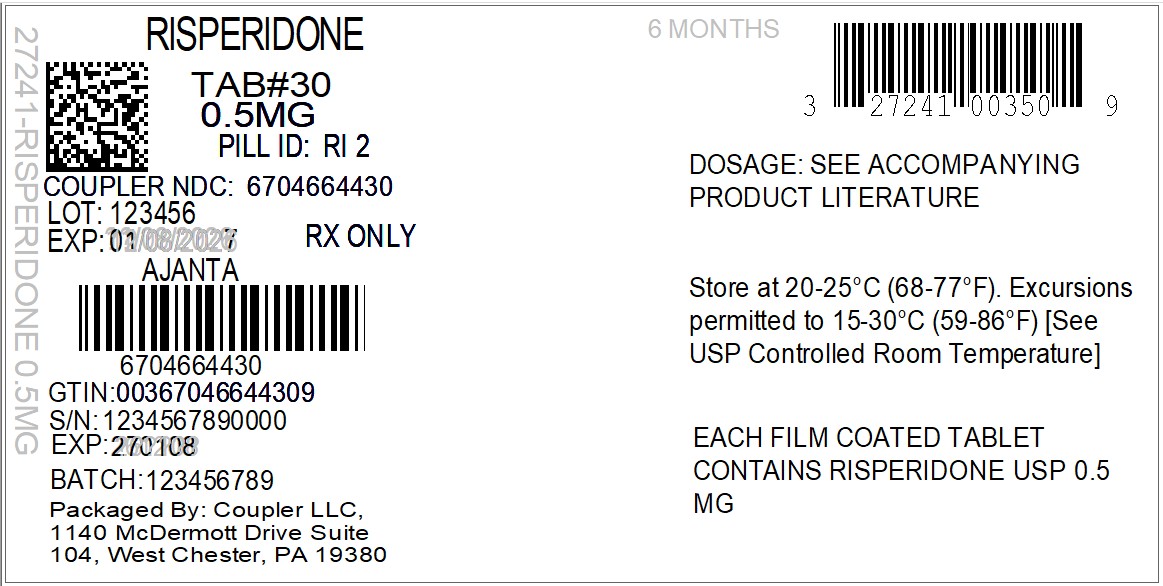
(risperidone · DailyMed)
RISABEX 1 mg/ml
Risperidone
What it does
Risperidone is an antipsychotic medication used to treat certain mental health conditions.
Commonly used for: schizophrenia, bipolar disorder, irritability associated with autism
Read more in plain English ↓Plain-language summary for general understanding - not medical advice. Always follow your pharmacist/doctor.
Ask about this medicine
Answers come only from this medicine's registration record, BNF monograph and interaction data - not medical advice.
Medicine sourcing is available in Kenya only. We don't sell or dispense medicines - licensed pharmacies do.
Sourcing - Kenya onlyRegistration & product details
Source: South African Health Products Regulatory Authority · fetched 2026-04-15 21:28:13 · updated 2026-09-16 04:01:09
Drug Interactions
11Pharmacodynamic Warnings
Risperidone appears in TABLE 8: Drugs that cause hypotension
Risperidone appears in TABLE 9: Drugs that prolong the QT interval
Risperidone appears in TABLE 11: Drugs with CNS depressant effects
Moderate (9)
Levodopa - decreases effects
Risperidone is predicted to decrease the effects of levodopa. Avoid or adjust dose. Also see TABLE 8 p. 1518.
Risperidone - increases exposure
Bupropion is predicted to increase the exposure to risperidone. Adjust dose.
Risperidone - increases exposure
Cinacalcet is predicted to increase the exposure to risperidone. Adjust dose.
Risperidone - increases exposure
Cobicistat is predicted to increase the exposure to risperidone. Adjust dose.
Risperidone - increases exposure
Idelalisib is predicted to increase the exposure to risperidone. Adjust dose.
Risperidone - decreases exposure
Mitotane is predicted to decrease the exposure to risperidone. Adjust dose.
Risperidone - increases exposure
Terbinafine is predicted to increase the exposure to risperidone. Adjust dose.
Risperidone - increases exposure
Clarithromycin is predicted to increase the exposure to antipsychotics, second generation (risperidone). Adjust dose. Also see TABLE 9 p. 1519
Risperidone - decreases exposure
Rifampicinispredictedtodecreasetheexposureto antipsychotics,secondgeneration(risperidone).Adjustdose. oStudy 1xidneppA|snoitcaretnI A1 https://www.facebook.c (Books-Courses-Medic
Unknown (2)
Antipsychotics - additive effect
Antipsychotics,secondgeneration(clozapine)cancause constipation,ascanantipsychotics,secondgeneration (olanzapine,quetiapine);concurrentusemightincreasethe riskofdevelopingintestinalobstruction.rAnecdo
Risperidone - increases exposure
Ropeginterferon alfa is predicted to increase the exposure to antipsychotics, second generation (risperidone).
Data from BNF 85 (British National Formulary). This is not a substitute for professional medical advice. Matched via: exact
About this medicine
Risperidone is an antipsychotic medication used to treat certain mental health conditions.
What it treats
- schizophrenia
- bipolar disorder
- irritability associated with autism
How it works
Risperidone helps to balance certain chemicals in the brain that affect mood and behavior.
Who it's for
This medication is typically prescribed for adults and children with specific mental health issues.
Drug class
Antipsychotics
Cautions
- • Avoid if you are taking medications that lower blood pressure.
- • Be cautious if using drugs that can affect heart rhythm.
- • Use with care if you are on medications that cause drowsiness.
AI-assisted summary grounded in BNF data - general information only, not medical advice. Always confirm with your pharmacist or doctor.
Clinical monograph: Risperidone
BNF-referencedRisperidone is an atypical antipsychotic medication primarily used to treat various mental health disorders, including schizophrenia and bipolar disorder. It functions by modulating neurotransmitter activity in the brain, with a particular focus on dopamine and serotonin receptors. Unlike traditional antipsychotics, risperidone is noted for its lower incidence of extrapyramidal symptoms, making it a preferable option for many patients.
Indications
- Schizophrenia
- Bipolar disorder
- Acute and chronic psychosis
- Irritability associated with autistic disorder
- Manic episodes
Dosage
Adults: Initial dose: 2 mg daily in 1-2 divided doses
Mechanism of action
Risperidone primarily acts as an antagonist of the D2 dopaminergic receptors and 5-HT2A serotonergic receptors in the brain. By inhibiting D2 receptors, it reduces dopaminergic neurotransmission, which helps alleviate positive symptoms of schizophrenia like delusions and hallucinations. Its binding profile allows for rapid dissociation from D2 receptors, minimizing the risk of extrapyramidal symptoms. Additionally, through its high-affinity binding to 5-HT2A receptors, risperidone decreases serotonergic activity, addressing negative symptoms such as depression and reduced motivation.
Pharmacodynamics
Risperidone's pharmacodynamic profile is characterized by its ability to decrease dopaminergic and serotonergic activity in the central nervous system. This modulation results in the reduction of both positive and negative symptoms associated with schizophrenia and mood disorders. Its unique receptor binding properties, particularly its moderate affinity for D2 receptors compared to first-generation antipsychotics, contribute to a lower risk of extrapyramidal side effects, enhancing its therapeutic profile.
Pharmacokinetics
Risperidone is well-absorbed after oral administration, with peak plasma concentrations typically occurring within 1-2 hours. It undergoes extensive hepatic metabolism, primarily via the cytochrome P450 system, yielding active metabolites such as 9-hydroxyrisperidone. The drug exhibits a half-life of approximately 20 hours, with a longer duration of action due to its active metabolites. Renal excretion accounts for a significant route of elimination. Caution is advised in patients with hepatic or renal impairment, as dosage adjustments may be necessary.
Contra-indications
- Dehydration
- Dementia with Lewy bodies
- Prolactin-dependent tumors
Adverse effects
- Anemia
- Anxiety
- Appetite abnormalities
- Asthenia
- Chest discomfort
- Conjunctivitis
- Cough
- Depression
- Diarrhea
- Dyspnea
- Epistaxis
- Fall
- Fever
- Gastrointestinal discomfort
- Headache
- Hypertension
- Increased risk of infection
- Joint disorders
- Laryngeal pain
- Muscle spasms
- Nasal congestion
- Nausea
- Oedema
- Oral disorders
- Pain
- Sexual dysfunction
- Skin reactions
- Sleep disorders
- Urinary disorders
- Vision abnormalities
Interactions
- Bupropion - Moderate (increases exposure)
- Cinacalcet - Moderate (increases exposure)
- Cobicistat - Moderate (increases exposure)
- Idelalisib - Moderate (increases exposure)
- Levodopa - Moderate (decreases effects)
- Mitotane - Moderate (decreases exposure)
- Terbinafine - Moderate (increases exposure)
- Clarithromycin - Moderate (increases exposure)
- Rifampicin - Moderate (decreases exposure)
- Ropeginterferonalfa - Unknown (increases exposure)
Precautions
- Monitor for extrapyramidal symptoms due to D2 receptor occupancy
- Consider ECG in patients with a family history of sudden cardiac death
Pregnancy
Use only if potential benefit outweighs risk.
Breast-feeding
Use only if potential benefit outweighs risk-small amount present in milk.
Storage
Store at room temperature, away from moisture and heat.
Formulations
- Oral tablets
- Oral suspension
- Injection (Risperdal Consta)
AI-synthesized from BNF references - general information only, not a substitute for professional medical advice or the current BNF. Verify doses with a pharmacist.
Molecular reference: Risperidone
PubChem CID 5073Molecular formula: C23H27FN4O2
Mechanism of action
Though its precise mechanism of action is not fully understood, current focus is on the ability of risperidone to inhibit the D2 dopaminergic receptors and 5-HT2A serotonergic receptors in the brain. Schizophrenia is thought to result from an excess of dopaminergic D2 and serotonergic 5-HT2A activity, resulting in overactivity of central mesolimbic pathways and mesocortical pathways, respectively. D2 dopaminergic receptors are transiently inhibited by risperidone, reducing dopaminergic neurotransmission, therefore decreasing positive symptoms of schizophrenia, such as delusions and hallucinations. Risperidone binds transiently and with loose affinity to the dopaminergic D2 receptor, with an ideal receptor occupancy of 60-70% for optimal effect. Rapid dissociation of risperidone from the D2 receptors contributes to decreased risk of extrapyramidal symptoms (EPS), which occur with permanent and high occupancy blockade of D2 dopaminergic receptors. Low-affinity binding and rapid dissociation from the D2 receptor distinguish risperidone from the traditional antipsychotic drugs. A higher occupancy rate of D2 receptors is said to increase the risk of extrapyramidal symptoms and is therefore to be avoided. Increased serotonergic mesocortical activity in schizophrenia results in negative symptoms, such as depression and decreased motivation. The high-affinity binding of risperidone to 5-HT2A receptors leads to a decrease in serotonergic activity. In addition, 5-HT2A receptor blockade results in decreased risk of extrapyramidal symptoms, likely by increasing dopamine release from the frontal cortex, and not the nigrostriatal tract. Dopamine level is therefore not completely inhibited. Through the above mechanisms, both serotonergic and D2 blockade by risperidone are thought to synergistically work to decrease the risk of extrapyramidal symptoms. Risperidone has also been said to be an antagonist of alpha-1 (α1), alpha-2 (α2), and histamine (H1) receptors. Blockade of these receptors is thought to improve symptoms of schizophrenia, however the exact mechanism of action on these receptors is not fully understood at this time. Risperidone has high affinity for several receptors, including serotonin receptors (5-HT 2A/2C), D2 dopamine receptors and alpha1 and H1 receptors. It has no appreciable activity at M1 receptors. Its primary metabolite (9-hydroxyrisperidone) is nearly equipotent compared with the parent compound at D2 and 5-HT 2A receptors. The exact mechanism of antipsychotic action of risperidone has not been fully elucidated but, like that of clozapine, appears to be more complex than that of most other antipsychotic agents and may involve antagonism of central type 2 serotonergic (5-HT2) receptors and central dopamine D2 receptors. Risperidone is an atypical antipsychotic drug that is widely prescribed to young patients with different psychotic disorders. The long-term effects of this antipsychotic agent on neuronal receptors in developing brain remain unclear and require further investigation. In this study, we examined the effects of long-term treatment of risperidone on two serotonin receptor subtypes in brain regions of juvenile rat. Levels of 5-HT(1A) and 5-HT(2A) receptors in forebrain regions of juvenile rats were quantified after 3 weeks of treatment with three different doses of risperidone (0.3, 1.0 and 3.0mg/kg). Findings were compared to previously reported changes in 5-HT receptors after risperidone treatment (3.0mg/kg) in adult rat brain. The three doses of risperidone selectively and dose-dependently increased levels of 5-HT(1A) receptors in medial-prefrontal and dorsolateral-frontal cortices of juvenile animals. The higher doses (1.0 and 3.0mg/kg) of risperidone also increased 5-HT(1A) receptor binding in hippocampal CA(1) region of juvenile but not adult rats. In contrast, the three doses of risperidone significantly reduced 5-HT(2A) labeling in medial-prefrontal and dorsolateral-frontal cortices in juven
Pharmacodynamics
The primary action of risperidone is to decrease dopaminergic and serotonergic pathway activity in the brain, therefore decreasing symptoms of schizophrenia and mood disorders. Risperidone has a high binding affinity for serotonergic 5-HT2A receptors when compared to dopaminergic D2 receptors in the brain. Risperidone binds to D2 receptors with a lower affinity than first-generation antipsychotic drugs, which bind with very high affinity. A reduction in extrapyramidal symptoms with risperidone, when compared to its predecessors, is likely a result of its moderate affinity for dopaminergic D2 receptors.
Source: PubChem (NCBI) · pathways from PathBank, Reactome, WikiPathways & PharmGKB.
This drug in other countries
The same active ingredient registered across other registries we cover - including different brands.
- RESPIDON 2 · Medox Pharmaceuticals
- RISDONE 1MG · Accord Healthcare
- RISDONE 1mg · Intas Pharmaceuticals Ltd
- RISDONE 1mg · Intas Pharmaceuticals Ltd
- RISDONE 2MG · Accord Healthcare
- RISDONE 4 MG TABLETS · Accord Healthcare
- Masrone · Micro Labs
- Risdone 1mg tablet · Dar Ai Dawa
- Risdone 2mg · Livestock Services
- Risdone 2mg film coated tablet · Dar Ai Dawa
- Risdone 2mg tablets · Livestock Services
- Risponse 1 · Jubilant Generics