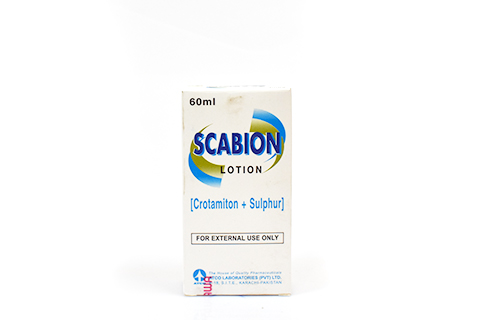
SCABION LOTION
CROTAMITON + SULPHUR
What it does
Crotamiton is a topical treatment used to relieve itching and treat scabies.
Commonly used for: itching (pruritus), scabies
Read more in plain English ↓Plain-language summary for general understanding - not medical advice. Always follow your pharmacist/doctor.
Ask about this medicine
Answers come only from this medicine's registration record, BNF monograph and interaction data - not medical advice.
Hard to find? We help patients in Kenya source rare medicines. We don't sell or dispense medicines - licensed pharmacies do.
Source this medicineRegistration & product details
Source: Pharmacy and Poisons Board · fetched 2026-01-28 21:36:53 · updated 2026-07-20 11:11:13
About crotamiton
Crotamiton is a topical treatment used to relieve itching and treat scabies.
What it treats
- itching (pruritus)
- scabies
How it works
Crotamiton works by killing the mites that cause scabies and soothing the skin to reduce itching.
Who it's for
Crotamiton is suitable for adults and children who are experiencing scabies or severe itching.
AI-assisted summary grounded in BNF data - general information only, not medical advice. Always confirm with your pharmacist or doctor.
About sulphur
Sulphur is a natural substance commonly used in skin treatments. It helps to improve various skin conditions.
What it treats
- acne
- seborrheic dermatitis
- scabies
How it works
Sulphur works by reducing oiliness and helping to kill bacteria on the skin, promoting healing.
Who it's for
Sulphur is for people dealing with certain skin problems like acne or scabies.
AI-assisted summary grounded in BNF data - general information only, not medical advice. Always confirm with your pharmacist or doctor.
Clinical monograph: Crotamiton
BNF-referencedCrotamiton is an antiparasitic and antipruritic medication primarily used to treat pruritus associated with scabies. It works by providing relief from itching through a counter-irritation mechanism, producing a cooling effect as it evaporates from the skin. Crotamiton is formulated as a topical cream and is indicated for various types of pruritus, including that which follows scabies infestation.
Indications
- Pruritus associated with scabies
- Pruritus due to sunburn
- General pruritus
Dosage
Children: For children aged 1 month to 2 years, apply as directed by a doctor; for children aged 3 to 17 years, apply 2-3 times a day.
Adults: Apply 2-3 times a day to the affected area.
Mechanism of action
Crotamiton is toxic to the scabies mite and relieves itching by producing a counter-irritation effect. As it evaporates from the skin, it creates a cooling sensation, which diverts attention from the itching. The exact mechanism by which crotamiton kills scabies is not fully understood.
Pharmacodynamics
Crotamiton is effective in alleviating pruritus, particularly in cases related to scabies or sunburn. Its cooling effect is beneficial in managing itching, as it distracts from the discomfort. This drug's antiparasitic properties help eliminate scabies mites, although the specific pathway involved remains unclear.
Pharmacokinetics
Crotamiton is applied topically, allowing for localized effects with minimal systemic absorption. The drug's pharmacokinetic profile involves rapid evaporation from the skin surface, which contributes to its cooling effect and antipruritic action. There is limited information available on its absorption, distribution, metabolism, and excretion in the human body.
Contra-indications
- Hypersensitivity to crotamiton or any excipients
- Acute exudative dermatoses
- Obstructive jaundice
- Endocrine disease
- Chronic renal disease
- Iron deficiency
- Certain malignant diseases
- Use on broken skin
- Use near mucosal surfaces
Adverse effects
- Local irritation
- Erythema
- Burning sensation
- Allergic reactions
- Drowsiness (when used for longer than recommended)
Precautions
- Avoid use on very inflamed skin
- Avoid excessive application
- Use on doctor’s advice for children under 3 years
- Avoid contact with eyes and mucous membranes
Pregnancy
Manufacturer advises to avoid, especially during the first trimester; no information available.
Breast-feeding
No information available; avoid application to nipple area.
Storage
Store at room temperature, away from moisture and direct light.
Formulations
- Cream
AI-synthesized from BNF references - general information only, not a substitute for professional medical advice or the current BNF. Verify doses with a pharmacist.
Clinical monograph: sulphur
BNF-referencedSulfur is a non-metallic element widely used in dermatological preparations due to its keratolytic, antibacterial, and antifungal properties. It is primarily applied topically for the treatment of various skin conditions, including acne and scabies. Its efficacy is attributed to the formation of active compounds that exert germicidal activity and facilitate the shedding of dead skin cells, making it a valuable agent in managing certain skin disorders.
Indications
- Acne vulgaris
- Scabies
- Seborrheic dermatitis
- Dandruff
- Pityriasis versicolor
Dosage
Children: Refer to
Adults: Refer to specific product instructions or BNF for appropriate topical application guidance.
Mechanism of action
Topically applied sulfur has mild antifungal and antibacterial activity. It is believed that sulfur forms hydrogen sulfide and/or polythionic acid upon application, which may exert germicidal effects. In vitro studies suggest that sulfur's antifungal activity is primarily due to its keratolytic action, which leads to the shedding of fungal spores and hyphae. The drug exhibits potent inhibitory effects against some streptococci and moderate effects against Staphylococcus aureus, while showing no activity against gram-negative bacteria. Its antibacterial effects may also result from the inactivation of sulfhydryl groups in bacterial enzyme systems. Additionally, sulfur is toxic to Sarcoptes scabiei, the parasite responsible for scabies.
Pharmacodynamics
Sulfur's pharmacodynamic properties include its keratolytic action, which helps in exfoliating the outer layer of skin and reducing the build-up of keratin. The antibacterial and antifungal activities contribute to its effectiveness against skin infections and conditions like acne. The exact pharmacodynamic pathways are not fully defined, but the combination of keratolytic, antibacterial, and antifungal effects underpins its therapeutic use in dermatology.
Pharmacokinetics
Sulfur is primarily used topically, and as such, its systemic absorption is minimal. Its local effects are achieved through direct application to the skin, where it acts on the surface and within the stratum corneum. The pharmacokinetics of sulfur involve minimal penetration into systemic circulation, leading to a lower risk of systemic side effects. The onset of action is relatively quick due to its localized effects.
Adverse effects
- Skin irritation
- Dryness
- Stinging
- Redness
- Peeling
Precautions
- Use with caution in patients with sensitive skin
- Avoid contact with eyes and mucous membranes
- Discontinue use if severe irritation occurs
Pregnancy
There are no adequate and well-controlled studies in pregnant women. Use only if clearly needed and the benefits outweigh the risks.
Breast-feeding
It is unknown if sulfur is excreted in human milk. Caution should be exercised when administered to a nursing woman.
Storage
Store in a cool, dry place away from moisture. Keep out of reach of children.
Formulations
- Topical cream
- Topical ointment
- Topical lotion
- Topical soap
AI-synthesized from BNF references - general information only, not a substitute for professional medical advice or the current BNF. Verify doses with a pharmacist.
Molecular reference: Crotamiton
PubChem CID 2883Molecular formula: C13H17NO
Mechanism of action
Crotamiton is an antiparasitic that is toxic to the scabies mite. Crotamiton also relieves itching by producing what is called a counter-irritation. As crotamiton evaporates from the skin, it produces a cooling effect. This cooling effect helps to divert your body's attention away from the itching.
Pharmacodynamics
Crotamiton is usually used to treat pruritis (itching of the skin) caused by scabies or sunburn. Crotamiton relieves itching by producing what is called a counter-irritation. As crotamiton evaporates from the skin, it produces a cooling effect. This cooling effect helps to divert your body's attention away from the itching. Due to this cooling effect it is also effective for the relief of sunburn. The drug is also believed to kill scabies through an unknown mechanism.
Source: PubChem (NCBI) · pathways from PathBank, Reactome, WikiPathways & PharmGKB.
Molecular reference: sulphur
PubChem CID 5362487Molecular formula: S
Mechanism of action
Topically applied sulfur has mild antifungal and antibacterial activity. It has been suggested that when applied topically to the skin, sulfur forms hydrogen sulfide and/or polythionic acid, which may exert germicidal activity. In vitro studies indicate that sulfur has little if any fungistatic or fungicidal activity. Therefore, sulfur's antifungal activity probably results largely from its keratolytic action, causing shedding of fungal spores and hyphae embedded within the stratum corneum. In vitro, sulfur has been shown to have some antibacterial activity; the drug has a potent inhibitory effect against some streptococci, a moderate inhibitory effect against Staphylococcus aureus, and no activity against gram-negative bacteria. It has been suggested that the drug's antibacterial activity may partly result from inactivation of sulfhydryl groups contained in bacterial enzyme systems, since the antibacterial effect of the drug has reportedly been neutralized by addition of cysteine and other sulfhydryl-containing compounds to the culture medium. Topically applied sulfur is reportedly toxic to the parasitic arthropod Sarcoptes scabiei. The exact mechanism(s) of action of "sulfur" in the treatment of acne is not fully understood but is presumed to involve the drug's keratolytic and antibacterial effects. Although some studies indicate that "sulfur" may also be comedogenic, other studies have been unable to substantiate this effect and the drug generally is considered effective in the topical treatment of acne. The aim of this research was to analyze the effects and the modes of action of elemental sulfur (S(0)) in bioluminescence and respiration of Vibrio fischeri cells and the enzymes crude luciferase, pure catalase, and alcohol dehydrogenase (ADH). Metallic copper removed sulfur and reduced the toxicity of acetone extracts of sediment samples analyzed in the bioluminescence test. The sulfur inhibition of cell bioluminescence was noncompetitive with decanal, the luciferase substrate; reversible, with maximum toxicity after 15 min (EC50 = 11.8 ug/L); and almost totally recovered after 2 hr. In vitro preincubation of crude luciferase extract with sulfur (0.28 ppm) weakly inhibited bioluminescence at 5 min, but at 30 min the inhibition reached 60%. Increasing the concentration of sulfur in the parts per million concentration range in vitro decreased bioluminescence, which was not constant, but depended on exposure time, and no dead-end/total inhibition was observed. The redox state of enzymes in the in vitro system significantly affected inhibition. Hydrogen peroxide restored fully and the reducing agent dithiothreitol, itself toxic, restored only partially luciferase activity in the presence of sulfur. Sulfur (5.5 ppm) slightly inhibited ADH and catalase, and dithiothreitol enhanced sulfur inhibition. High sulfur concentrations (2.2 ppm) inhibited the bioluminescence and enhanced the respiration rate of V. fischeri cells. Elemental sulfur data were interpreted to show that sulfur acted on at least a few V. fischeri cell sites: reversibly modifying luciferase at sites sensitive to/protected by oxidative and reducing agents and by affecting electron transport processes, resulting in enhanced oxygen consumption. Sulfur together with an enzyme reducing agent inhibited the oxidoreductive enzymes ADH and catalase, which have /thiol/ groups, metal ion cofactors, or heme, respectively, in their active centers. Sulfur must be converted to pentathionic acid (H2S5O6) in order to exert germicidal action. Presumably oxidation of sulfur to pentathionic acid is accomplished by certain microorganisms or by epidermal cells when element is applied to skin. Sulfur possesses a keratolytic property, which may be the basis for the therapeutic action of the element in certain cutaneous disorders unassociated with infection.
Source: PubChem (NCBI) · pathways from PathBank, Reactome, WikiPathways & PharmGKB.
This drug in other countries
The same active ingredient registered across other registries we cover - including different brands.