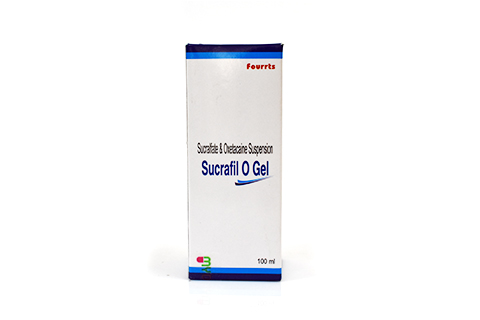
SUCRAFIL SUSPENSION
SUCRALFATE USP
What it does
Sucralfate is a medicine used to treat stomach and intestinal problems by forming a protective layer over sores and ulcers.
Commonly used for: stomach ulcers (peptic ulcers), gastroesophageal reflux disease (GERD), intestinal ulcers
Read more in plain English ↓Plain-language summary for general understanding - not medical advice. Always follow your pharmacist/doctor.
Ask about this medicine
Answers come only from this medicine's registration record, BNF monograph and interaction data - not medical advice.
Hard to find? We help patients in Kenya source rare medicines. We don't sell or dispense medicines - licensed pharmacies do.
Source this medicineRegistration & product details
Source: Pharmacy and Poisons Board · fetched 2026-01-28 19:54:56 · updated 2026-08-03 03:04:07
Drug Interactions
13Severe (1)
Sucralfate - increases risk of adverse effects
Sodium citrate is predicted to increase the risk of adverse effects when given with sucralfate. Avoid. Theoretical Sodium glucose co-transporter 2 inhibitors → see TABLE 14 p. 1520 (antidiabetic drugs
Unknown (12)
Bictegravir - decreases exposure
Sucralfateispredictedtodecreasetheexposuretobictegravir. Avoid.oTheoretical
Coumarins - decreases effects
Sucralfate potentially decreases the effects of coumarins (warfarin). Separate administration by 2 hours.
Digoxin - decreases absorption
Sucralfate decreases the absorption of digoxin. Separate administration by 2 hours.
Dolutegravir - decreases absorption
Sucralfate decreases the absorption of dolutegravir. Domperidone → see TABLE 9 p. 1519 (QT-interval prolongation)
Enteralfeeds - increases risk of blocked enteral or nasogastric tubes
Sucralfate increases the risk of blocked enteral or nasogastric tubes when given with enteral feeds. Separate administration by 1 hour.
Data from BNF 85 (British National Formulary). This is not a substitute for professional medical advice. Matched via: exact
About this medicine
Sucralfate is a medicine used to treat stomach and intestinal problems by forming a protective layer over sores and ulcers.
What it treats
- stomach ulcers (peptic ulcers)
- gastroesophageal reflux disease (GERD)
- intestinal ulcers
How it works
It works by coating the lining of the stomach and intestines, helping to protect them from acid and allowing healing.
Who it's for
It is for adults and children who have ulcers or other stomach lining issues.
AI-assisted summary grounded in BNF data - general information only, not medical advice. Always confirm with your pharmacist or doctor.
Clinical monograph: Sucralfate
BNF-referencedSucralfate is a gastroprotective agent primarily used in the treatment of gastric and duodenal ulcers. It is a complex of aluminum hydroxide and sulfated sucrose that forms a protective barrier over ulcerated mucosa, shielding it from gastric acid, pepsin, and bile. Sucralfate is often administered to promote healing in ulcerative conditions and prevent stress-related mucosal disease.
Indications
- Gastric ulcers
- Duodenal ulcers
- Prophylaxis of stress ulceration
- NSAID-associated ulcers
Dosage
Children: Refer to the BNF for Children for specific dosing information as it varies based on age and weight.
Adults: Adult: 1 g four times daily, taken on an empty stomach, or 2 g twice daily, depending on the clinical scenario. Maximum dosage is 8 g per day.
Mechanism of action
Sucralfate acts locally in the gastrointestinal tract. When it comes into contact with gastric acid, it undergoes a process of polymerization, forming a viscous gel that adheres to the ulcer site. This gel creates a physical barrier against further irritation and promotes healing by providing a conducive environment for repair. Additionally, sucralfate may stimulate mucosal defense mechanisms, including increased secretion of mucus and bicarbonate.
Pharmacodynamics
Sucralfate does not have systemic absorption; its effects are primarily localized within the gastrointestinal tract. The protective barrier it forms is effective against both acid and pepsin, reducing the damage to the mucosa and promoting ulcer healing. Its action is dose-dependent and requires administration on an empty stomach for optimal efficacy.
Pharmacokinetics
Sucralfate is minimally absorbed in the gastrointestinal tract, with over 90% of the administered dose remaining locally at the site of action. It has a half-life of approximately 6 to 12 hours, depending on the formulation and the individual patient's gastrointestinal transit time. It is excreted mainly in the feces and does not undergo significant hepatic metabolism.
Contra-indications
- Hypersensitivity to sucralfate or any of its components
- Patients with renal impairment (risk of aluminium accumulation)
- Children under 16 years (risk of Reye's syndrome)
Adverse effects
- Constipation
- Dry mouth
- Nausea
- Headache
- Vertigo
- Gastrointestinal disturbances
- Skin reactions
- Discoloration of mucous membranes
Interactions
- Sodium citrate: Severe interaction increasing risk of adverse effects
- Bictegravir: Unknown interaction decreasing exposure
- Warfarin: Unknown interaction decreasing effects
- Digoxin: Unknown interaction decreasing absorption
- Dolutegravir: Unknown interaction decreasing absorption
- Enteral feeds: Unknown interaction increasing risk of blocked enteral or nasogastric tubes
- Quinolones: Unknown interaction decreasing exposure
- Coumarins: Unknown interaction decreasing effects
- Sulpiride: Unknown interaction decreasing absorption
- Theophylline: Unknown interaction decreasing absorption
Precautions
- Caution in patients with renal impairment due to risk of aluminium accumulation
- Caution in patients receiving enteral feeds due to risk of bezoar formation
- Caution with concurrent use of other medications that may affect gastric pH
Pregnancy
Manufacturer advises to avoid unless essential; no information available regarding safety.
Breast-feeding
Amount probably too small to be harmful; limited information available.
Storage
Store in a cool, dry place away from direct sunlight. Keep out of reach of children.
Formulations
- Tablets
- Oral suspension
AI-synthesized from BNF references - general information only, not a substitute for professional medical advice or the current BNF. Verify doses with a pharmacist.
This drug in other countries
The same active ingredient registered across other registries we cover - including different brands.