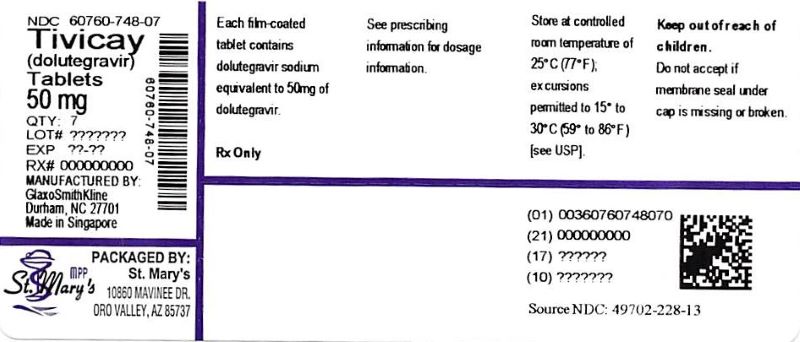
(dolutegravir · DailyMed)
TWINAQT TABLETS
DOLUTEGRAVIR & LAMIVUDINE TABLETS 50 MG/300 MG
What it does
Dolutegravir is an antiviral medication used to treat HIV (human immunodeficiency virus).
Commonly used for: HIV infection, human immunodeficiency virus (HIV)
Read more in plain English ↓Plain-language summary for general understanding - not medical advice. Always follow your pharmacist/doctor.
Ask about this medicine
Answers come only from this medicine's registration record, BNF monograph and interaction data - not medical advice.
Hard to find? We help patients in Kenya source rare medicines. We don't sell or dispense medicines - licensed pharmacies do.
Source this medicineRegistration & product details
Source: Pharmacy and Poisons Board · fetched 2026-01-28 19:18:13 · updated 2026-09-18 02:06:35
Drug Interactions
21Pharmacodynamic Warnings
Lamivudine appears in TABLE 12: Drugs that cause peripheral neuropathy
Moderate (4)
Dolutegravir - increases exposure
Atazanavir (alone or boosted with ritonavir) slightly increases the exposure to dolutegravir. Adjust dose-consult product literature.
Dopamine Receptor Agonists - increases exposure
Dolutegravir is predicted to increase the exposure to dopamine receptor agonists (pramipexole). Adjust dose.
Metformin - increases exposure
Dolutegravir increases the exposure to metformin. Adjust dose.
Pramipexole - increases exposure
Dolutegravir is predicted to increase the exposure to dopamine receptor agonists (pramipexole). Adjust dose.
Unknown (17)
Dolutegravir - decreases exposure
Antiepileptics (fosphenytoin, phenobarbital, phenytoin, primidone) are predicted to decrease the exposure to dolutegravir. Adjust dolutegravir dose, p. 705.
Dolutegravir - decreases exposure
Carbamazepine decreases the exposure to dolutegravir. Adjust dolutegravir dose, p. 705.
Dolutegravir - decreases exposure
Oxcarbazepine is predicted to decrease the exposure to dolutegravir. Adjust dolutegravir dose, p. 705.
Dolutegravir - decreases exposure
Dabrafenib is predicted to decrease the exposure to dolutegravir.
Dolutegravir - increases exposure
Encorafenibispredictedtoincreasetheexposureto dolutegravir.oTheoretical
Data from BNF 85 (British National Formulary). This is not a substitute for professional medical advice. Matched via: exact
About dolutegravir
Dolutegravir is an antiviral medication used to treat HIV (human immunodeficiency virus).
What it treats
- HIV infection
- human immunodeficiency virus (HIV)
How it works
It helps to control HIV by preventing the virus from multiplying in the body.
Who it's for
This medication is for adults and children who are infected with HIV.
AI-assisted summary grounded in BNF data - general information only, not medical advice. Always confirm with your pharmacist or doctor.
About lamivudine
Lamivudine is an antiviral medication used to treat certain viral infections.
What it treats
- HIV infection
- Chronic hepatitis B
How it works
It works by stopping the virus from multiplying in the body.
Who it's for
This medication is for adults and children who are infected with HIV or hepatitis B.
Cautions
- • Be careful if you are taking other medications that can cause nerve problems.
AI-assisted summary grounded in BNF data - general information only, not medical advice. Always confirm with your pharmacist or doctor.
Clinical monograph: Dolutegravir
BNF-referencedDolutegravir is an antiretroviral medication classified as an HIV integrase inhibitor. It is primarily used in the management of HIV infection, where it demonstrates potent antiviral activity by inhibiting the HIV integrase enzyme, crucial for viral replication. This drug has shown effectiveness both in treatment-naive patients and those with HIV-1 strains that exhibit resistance to other integrase inhibitors.
Indications
- HIV infection without resistance to other inhibitors of HIV integrase
- HIV infection in patients with resistance to other inhibitors of HIV integrase (specialist use only)
Dosage
Children: Refer to BNF for Children for appropriate dosing.
Adults: 50 mg once daily.
Mechanism of action
Dolutegravir inhibits the HIV integrase enzyme by binding to its active site, blocking the strand transfer step of retroviral DNA integration into the host cell genome. This step is essential for the replication of HIV, and by preventing this integration, dolutegravir effectively inhibits viral activity and replication.
Pharmacodynamics
Clinical trials have demonstrated that dolutegravir leads to a rapid and dose-dependent reduction of HIV-1 RNA in infected subjects. The antiviral response can be sustained for several days following the last dose, indicating its long half-life and strong binding affinity. This characteristic contributes to a high barrier to the development of resistance, making dolutegravir a potent option in combination therapy regimens.
Pharmacokinetics
Dolutegravir exhibits favorable pharmacokinetics, with a mean elimination half-life of approximately 14 hours. It is well absorbed following oral administration, with food enhancing its bioavailability. The drug is metabolized primarily by UGT1A1 and UGT1A9 enzymatic pathways, and it is excreted mainly via feces. Drug interactions may occur, particularly with medications that induce or inhibit UGT enzymes.
Contra-indications
- Hypersensitivity to dolutegravir or any of its excipients
Adverse effects
- Nausea
- Vomiting
- Drowsiness
- Increased weight
- Skin reactions
- Sleep disorders
- Hepatotoxicity
- Pancreatitis
- Osteonecrosis
Interactions
- Moderate increase in exposure with dopaminergic receptor agonists
- Moderate increase in exposure with pramipexole
- Moderate increase in exposure with metformin
- Moderate increase in exposure with atazanavir
- Unknown decrease in exposure with carbamazepine
- Unknown decrease in exposure with oxcarbazepine
- Unknown decrease in exposure with phenytoin
- Unknown decrease in exposure with primidone
- Unknown increase in exposure with encorafenib
- Unknown increase in concentration with fampridine
Precautions
- Use with caution in patients with HIV-1 subtype A6/A1, or BMI of 30 kg/m2 or more
- Caution in severe hepatic impairment
- Patients or carers should be advised on how to recognize signs of hypersensitivity
Pregnancy
Avoid unless potential benefit outweighs risk, no information available.
Breast-feeding
Avoid; may be present in milk for up to 12 months or longer after last prolonged-release injection.
Storage
Store in a cool, dry place, away from direct light.
Formulations
- Tablets: 50 mg and 30 mg
- Powder and solvent for solution for injection
AI-synthesized from BNF references - general information only, not a substitute for professional medical advice or the current BNF. Verify doses with a pharmacist.
Clinical monograph: Lamivudine
BNF-referencedLamivudine is a synthetic nucleoside analogue primarily used in the treatment of Human Immunodeficiency Virus (HIV) infections and chronic hepatitis B virus (HBV) infections. It is marketed under the brand name Epivir and functions as a nucleoside reverse transcriptase inhibitor (NRTI). By interfering with viral DNA synthesis, lamivudine plays a critical role in antiviral therapy, particularly in combination therapies for HIV.
Indications
- HIV infection in combination with other antiretroviral drugs
- Chronic hepatitis B infection with evidence of viral replication and active liver inflammation or fibrosis
Dosage
Children: For children aged 3 months to
Adults: For HIV infection, the adult dose is 150 mg every 12 hours or alternatively 300 mg once daily. For chronic hepatitis B, the recommended dose is 300 mg once daily.
Mechanism of action
Lamivudine is phosphorylated intracellularly to its active form, lamivudine triphosphate (L-TP). This active metabolite is incorporated into viral DNA by HIV reverse transcriptase and HBV polymerase, leading to DNA chain termination. Lamivudine competes with deoxycytidine triphosphate for binding to reverse transcriptase, and its incorporation into DNA results in the disruption of DNA synthesis due to the absence of a 3'-OH group necessary for chain elongation.
Pharmacodynamics
As a nucleoside reverse transcriptase inhibitor (NRTI), lamivudine disrupts the viral DNA synthesis pathway, particularly for HIV-1 and HBV. The active metabolite formed competes with natural nucleotides and incorporates into the growing viral DNA chain, ultimately leading to chain termination. This action inhibits the replication of the virus, thereby reducing viral load in infected individuals.
Pharmacokinetics
Lamivudine is absorbed via passive diffusion and is rapidly phosphorylated to its active triphosphate form within cells. Its bioavailability is approximately 80-85% when taken orally. The drug has a half-life of about 5-7 hours in plasma and is primarily eliminated via the kidneys through glomerular filtration and active tubular secretion. Renal impairment necessitates dose adjustments, particularly in patients with creatinine clearance below 50 mL/min.
Contra-indications
- Severe hypersensitivity to lamivudine or any of its excipients
- Patients with decompensated liver disease when used for chronic hepatitis B
Adverse effects
- Peripheral neuropathy
- Headache
- Nausea
- Diarrhea
- Fatigue
- Insomnia
- Malaise
- Cough
- Pharyngitis
- Respiratory tract infections
- Alopecia
- Arthralgia
Interactions
- Trimethoprim may increase exposure to lamivudine
- Concomitant use with other antiretroviral drugs should be evaluated for cross-resistance
Precautions
- Monitor liver function tests every 3 months in patients with chronic hepatitis B
- Recurrent hepatitis may occur upon discontinuation in chronic hepatitis B patients
- Use with caution in renal impairment; dose adjustments may be necessary if creatinine clearance is less than 50 mL/min
Pregnancy
Lamivudine is classified as category B, indicating that there are no known risks in humans, but caution should be exercised. It may be used during pregnancy if deemed necessary by the healthcare provider.
Breast-feeding
Lamivudine can be used with caution while breastfeeding, provided adequate measures are taken to prevent hepatitis B infection in infants.
Storage
Store in a cool, dry place away from direct sunlight. Keep out of reach of children.
Formulations
- Lamivudine 150 mg tablets
- Lamivudine 300 mg tablets
- Epivir oral solution
AI-synthesized from BNF references - general information only, not a substitute for professional medical advice or the current BNF. Verify doses with a pharmacist.
Molecular reference: Dolutegravir
PubChem CID 54726191Molecular formula: C20H19F2N3O5
Mechanism of action
Dolutegravir is an HIV-1 antiviral agent. It inhibits HIV integrase by binding to the active site and blocking the strand transfer step of retroviral DNA integration in the host cell. The strand transfer step is essential in the HIV replication cycle and results in the inhibition of viral activity. Dolutegravir has a mean EC50 value of 0.5 nM (0.21 ng/mL) to 2.1 nM (0.85 ng/mL) in peripheral blood mononuclear cells (PBMCs) and MT-4 cells. Dolutegravir inhibits HIV integrase by binding to the integrase active site and blocking the strand transfer step of retroviral deoxyribonucleic acid (DNA) integration which is essential for the HIV replication cycle. Strand transfer biochemical assays using purified HIV-1 integrase and pre-processed substrate DNA resulted in IC50 values of 2.7 nM and 12.6 nM.
Pharmacodynamics
HIV-1 infected subjects on dolutegravir monotherapy demonstrated rapid and dose-dependent reduction of antiviral activity with declines of HIV-1 RNA copies per ml. The antiviral response was maintained for 3 to 4 days after the last dose. The sustained response obtained in clinical trials indicates that dolutegravir has a tight binding and longer dissociative half-life providing it a high barrier to resistance. The combination therapy (ripivirine and dolutegravir) presented the same viral suppression found in previous three-drug therapies without integrase strand transfer inhibitor mutations or rilpivirine resistance.
Source: PubChem (NCBI) · pathways from PathBank, Reactome, WikiPathways & PharmGKB.
Molecular reference: Lamivudine
PubChem CID 60825Molecular formula: C8H11N3O3S
Mechanism of action
Lamivudine is a synthetic nucleoside analogue and is phosphorylated intracellularly to its active 5'-triphosphate metabolite, lamivudine triphosphate (L-TP). This nucleoside analogue is incorporated into viral DNA by HIV reverse transcriptase and HBV polymerase, resulting in DNA chain termination. Lamivudine enters cells by passive diffusion and is phosphorylated to its active metabolite, lamivudine triphosphate. Lamivudine triphosphate competes with deoxycytidine triphosphate for binding to reverse transcriptase, and incorporation into DNA results in chain termination. Lamivudine has very low affinity for human alpha and omega DNA polymerases, moderate affinity for beta DNA polymerase, and higher affinity for gamma DNA polymerase.
Pharmacodynamics
Lamivudine is a nucleoside reverse transcriptase inhibitor (NRTI) with activity against Human Immunodeficiency Virus Type 1 (HIV-1) and hepatitis B (HBV) to disrupt viral DNA synthesis. When phosphorylated, lamivudine can form active metabolites that compete for incorporation into viral DNA. Via DNA incorporation, lamivudine metabolites competitively inhibit the activity of the HIV reverse transcriptase enzyme and act as a chain terminator of DNA synthesis. Due to the lack of a 3'-OH group, incorporated nucleoside analogues prevent the formation of a 5' to 3' phosphodiester linkage that is essential for DNA chain elongation.
Biological pathways
Source: PubChem (NCBI) · pathways from PathBank, Reactome, WikiPathways & PharmGKB.
This drug in other countries
The same active ingredient registered across other registries we cover - including different brands.
- ABACAVIR / LAMIVUDINE DISPERSIBLE TABLETS · Micro Labs
- ABACAVIR / LAMIVUDINE DISPERSIBLE TABLETS · Micro Labs Limited
- ABLADO · Apl Health Care Limited
- ABLADO DT · Apl Health Care Limited
- ACRIPTEGA · Mylan Laboratories
- ACRIPTEGA · Mylan Laboratories Ltd
- ABACAVIR AND LAMIVUDINE TABLETS · Macleods Pharmaceuticals
- ABACAVIR SULFATE/LAMIVUDINE 120MG/60MG DISPERSIBLE TABLETS (Each dispersible tablet contains Abacavir Sulfate/Lamivudine 120mg/60mg) · Mylan Laboratories
- ABACAVIR/ LAMIVUDINE TABLETS (Each tablet contains Abacavir Sulfate/Lamivudine 600mg/300mg) · Sun Pharmaceutical Industries
- ABACAVIR/DOLUTEGRAVIR/LAMIVUDINE TABLETS FOR ORAL SUSPENSION (Each tablet contains: Abacavir Sulfate/Dolutegravir Sodium/Lamivudine 60mg/5mg/30mg) · Cipla
- ABACAVIR/DOLUTEGRAVIR/LAMIVUDINE TABLETS · Laurus Labs
- ABACAVIR/LAMIVUDINE 600MG/300MG TABLETS (Each film-coated tablet contains Abacavir Sulfate/Lamivudine 600mg/300mg) · Mylan Laboratories