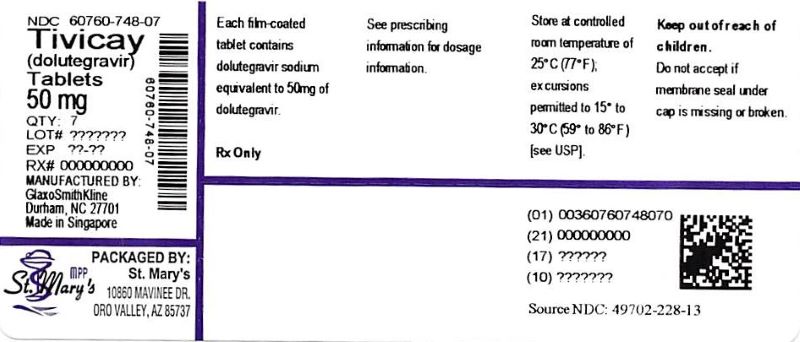
(dolutegravir · DailyMed)
Viropil 50/300/300 Tablets
Dolutegravir/Lmivudine/Tenefovir 50mg, 300mg and 300mg mg
What it does
Dolutegravir is an antiviral medication used to treat HIV (human immunodeficiency virus).
Commonly used for: HIV infection, human immunodeficiency virus (HIV)
Read more in plain English ↓Plain-language summary for general understanding - not medical advice. Always follow your pharmacist/doctor.
Ask about this medicine
Answers come only from this medicine's registration record, BNF monograph and interaction data - not medical advice.
Medicine sourcing is available in Kenya only. We don't sell or dispense medicines - licensed pharmacies do.
Sourcing - Kenya onlyRegistration & product details
Source: Zambia Medicines Regulatory Authority · fetched 2026-03-12 00:07:42 · updated 2026-11-05 03:40:52
Drug Interactions
20Moderate (4)
Dolutegravir - increases exposure
Atazanavir (alone or boosted with ritonavir) slightly increases the exposure to dolutegravir. Adjust dose-consult product literature.
Dopamine Receptor Agonists - increases exposure
Dolutegravir is predicted to increase the exposure to dopamine receptor agonists (pramipexole). Adjust dose.
Metformin - increases exposure
Dolutegravir increases the exposure to metformin. Adjust dose.
Pramipexole - increases exposure
Dolutegravir is predicted to increase the exposure to dopamine receptor agonists (pramipexole). Adjust dose.
Unknown (16)
Dolutegravir - decreases exposure
Antiepileptics (fosphenytoin, phenobarbital, phenytoin, primidone) are predicted to decrease the exposure to dolutegravir. Adjust dolutegravir dose, p. 705.
Dolutegravir - decreases exposure
Carbamazepine decreases the exposure to dolutegravir. Adjust dolutegravir dose, p. 705.
Dolutegravir - decreases exposure
Oxcarbazepine is predicted to decrease the exposure to dolutegravir. Adjust dolutegravir dose, p. 705.
Dolutegravir - decreases exposure
Dabrafenib is predicted to decrease the exposure to dolutegravir.
Dolutegravir - increases exposure
Encorafenibispredictedtoincreasetheexposureto dolutegravir.oTheoretical
Data from BNF 85 (British National Formulary). This is not a substitute for professional medical advice. Matched via: exact
About dolutegravir
Dolutegravir is an antiviral medication used to treat HIV (human immunodeficiency virus).
What it treats
- HIV infection
- human immunodeficiency virus (HIV)
How it works
It helps to control HIV by preventing the virus from multiplying in the body.
Who it's for
This medication is for adults and children who are infected with HIV.
AI-assisted summary grounded in BNF data - general information only, not medical advice. Always confirm with your pharmacist or doctor.
About lmivudine
Lamivudine is an antiviral medication used to treat certain viral infections.
What it treats
- HIV infection
- chronic hepatitis B
How it works
Lamivudine helps reduce the amount of virus in the body by blocking its ability to multiply.
Who it's for
This medication is for adults and children diagnosed with HIV or hepatitis B.
AI-assisted summary grounded in BNF data - general information only, not medical advice. Always confirm with your pharmacist or doctor.
About tenefovir
Tenofovir is a medication used to treat viral infections, particularly HIV and hepatitis B.
What it treats
- HIV infection
- Hepatitis B
How it works
Tenofovir works by stopping the virus from multiplying in the body, helping to lower the amount of virus present.
Who it's for
Tenofovir is for people living with HIV or chronic hepatitis B to help manage their condition.
AI-assisted summary grounded in BNF data - general information only, not medical advice. Always confirm with your pharmacist or doctor.
Clinical monograph: Dolutegravir
BNF-referencedDolutegravir is an antiretroviral medication classified as an HIV integrase inhibitor. It is primarily used in the management of HIV infection, where it demonstrates potent antiviral activity by inhibiting the HIV integrase enzyme, crucial for viral replication. This drug has shown effectiveness both in treatment-naive patients and those with HIV-1 strains that exhibit resistance to other integrase inhibitors.
Indications
- HIV infection without resistance to other inhibitors of HIV integrase
- HIV infection in patients with resistance to other inhibitors of HIV integrase (specialist use only)
Dosage
Children: Refer to BNF for Children for appropriate dosing.
Adults: 50 mg once daily.
Mechanism of action
Dolutegravir inhibits the HIV integrase enzyme by binding to its active site, blocking the strand transfer step of retroviral DNA integration into the host cell genome. This step is essential for the replication of HIV, and by preventing this integration, dolutegravir effectively inhibits viral activity and replication.
Pharmacodynamics
Clinical trials have demonstrated that dolutegravir leads to a rapid and dose-dependent reduction of HIV-1 RNA in infected subjects. The antiviral response can be sustained for several days following the last dose, indicating its long half-life and strong binding affinity. This characteristic contributes to a high barrier to the development of resistance, making dolutegravir a potent option in combination therapy regimens.
Pharmacokinetics
Dolutegravir exhibits favorable pharmacokinetics, with a mean elimination half-life of approximately 14 hours. It is well absorbed following oral administration, with food enhancing its bioavailability. The drug is metabolized primarily by UGT1A1 and UGT1A9 enzymatic pathways, and it is excreted mainly via feces. Drug interactions may occur, particularly with medications that induce or inhibit UGT enzymes.
Contra-indications
- Hypersensitivity to dolutegravir or any of its excipients
Adverse effects
- Nausea
- Vomiting
- Drowsiness
- Increased weight
- Skin reactions
- Sleep disorders
- Hepatotoxicity
- Pancreatitis
- Osteonecrosis
Interactions
- Moderate increase in exposure with dopaminergic receptor agonists
- Moderate increase in exposure with pramipexole
- Moderate increase in exposure with metformin
- Moderate increase in exposure with atazanavir
- Unknown decrease in exposure with carbamazepine
- Unknown decrease in exposure with oxcarbazepine
- Unknown decrease in exposure with phenytoin
- Unknown decrease in exposure with primidone
- Unknown increase in exposure with encorafenib
- Unknown increase in concentration with fampridine
Precautions
- Use with caution in patients with HIV-1 subtype A6/A1, or BMI of 30 kg/m2 or more
- Caution in severe hepatic impairment
- Patients or carers should be advised on how to recognize signs of hypersensitivity
Pregnancy
Avoid unless potential benefit outweighs risk, no information available.
Breast-feeding
Avoid; may be present in milk for up to 12 months or longer after last prolonged-release injection.
Storage
Store in a cool, dry place, away from direct light.
Formulations
- Tablets: 50 mg and 30 mg
- Powder and solvent for solution for injection
AI-synthesized from BNF references - general information only, not a substitute for professional medical advice or the current BNF. Verify doses with a pharmacist.
Clinical monograph: lmivudine
Lamivudine is an antiretroviral medication used primarily in the treatment of HIV infection and chronic hepatitis B virus (HBV) infection. It belongs to the nucleoside reverse transcriptase inhibitor (NRTI) class of drugs, inhibiting the replication of viral DNA. Lamivudine is often used in combination with other antiretroviral agents to enhance its effectiveness and reduce the potential for drug resistance.
Indications
- HIV infection
- Chronic hepatitis B virus infection
Dosage
Children: Refer to BNF for Children for appropriate dosing information based on age and weight.
Adults: Refer to specific guidelines and BNF resources for accurate dosing regimens tailored to individual patient needs.
Mechanism of action
Lamivudine is a cytosine analogue that inhibits reverse transcriptase, an essential enzyme for the replication of retroviruses such as HIV. By incorporating itself into the viral DNA chain during replication, lamivudine causes termination of the DNA chain, preventing further synthesis of viral genetic material, which ultimately leads to a decrease in viral load.
Pharmacodynamics
The pharmacodynamics of lamivudine involve its action as a competitive inhibitor of HIV-1 reverse transcriptase. Lamivudine exhibits synergistic effects when used in combination with other antiretroviral drugs, contributing to a more substantial reduction in HIV replication. The drug has a selective toxicity profile, showing minimal effects on host DNA polymerases, which aids in its safety and tolerability.
Pharmacokinetics
Lamivudine is well absorbed after oral administration, with a bioavailability of approximately 80-85%. It has a volume of distribution of about 1.3 L/kg and is primarily eliminated through renal excretion as unchanged drug. The half-life of lamivudine is approximately 5-7 hours in individuals with normal renal function. Dose adjustments are necessary for patients with renal impairment to avoid accumulation and toxicity.
Contra-indications
- Hypersensitivity to lamivudine or any component of the formulation
- Severe hepatic impairment
Adverse effects
- Headache
- Nausea
- Diarrhea
- Fatigue
- Lactic acidosis
- Hepatomegaly
- Pancreatitis
- Neuropsychiatric effects
Interactions
- Co-administration with other antiviral agents may lead to increased risk of toxicity or reduced efficacy
- Zidovudine may increase the risk of hematologic toxicity when used with lamivudine
Precautions
- Renal impairment may necessitate dosage adjustment
- Monitor for signs of lactic acidosis, especially in patients with risk factors
- Caution in patients with a history of pancreatitis
Pregnancy
Lamivudine is classified as pregnancy category B. Studies in pregnant women have not shown an increased risk of fetal harm, but caution is advised.
Breast-feeding
Lamivudine is excreted in breast milk. The decision to continue breastfeeding should consider the benefits of breastfeeding and the mother's need for lamivudine.
Storage
Store at room temperature, away from moisture and heat. Keep out of reach of children.
Formulations
- Tablets
- Oral solution
AI-synthesized from BNF references - general information only, not a substitute for professional medical advice or the current BNF. Verify doses with a pharmacist.
Clinical monograph: tenefovir
Tenofovir is an antiretroviral medication used primarily in the management of HIV infection and chronic hepatitis B virus (HBV) infection. It is a nucleotide reverse transcriptase inhibitor (NRTI) that works by inhibiting the reverse transcriptase enzyme, which is crucial for the replication of retroviruses such as HIV.
Indications
- HIV infection
- Chronic hepatitis B virus (HBV) infection
Dosage
Children: Refer to the BNF for Children for specific dosing recommendations in paediatric patients.
Adults: Refer to the current clinical guidelines or BNF for specific dosing recommendations in adults.
Mechanism of action
Tenofovir is converted intracellularly to its active form, tenofovir diphosphate. This active form competes with natural deoxyadenosine triphosphate for incorporation into viral DNA by reverse transcriptase, leading to chain termination and preventing further viral replication.
Pharmacodynamics
Tenofovir has a high barrier to resistance, and its efficacy is enhanced when used in combination with other antiretroviral drugs. It exhibits a dose-dependent antiviral effect against HIV and HBV, effectively reducing viral loads and improving immune function as indicated by CD4 cell counts.
Pharmacokinetics
Tenofovir is administered orally and has a bioavailability of approximately 25% when taken on an empty stomach. It is primarily excreted unchanged in the urine. The elimination half-life is about 17 hours, allowing for once-daily dosing in most cases. Food can increase the absorption of tenofovir, leading to higher plasma concentrations.
Contra-indications
- Hypersensitivity to tenofovir or any of its components
- Severe renal impairment (CrCl < 50 mL/min)
Adverse effects
- Nausea
- Diarrhea
- Headache
- Fatigue
- Renal toxicity
- Bone mineral density loss
- Hepatotoxicity
Interactions
- Coadministration with nephrotoxic agents may increase risk of renal impairment
- Tenofovir may decrease the effectiveness of atazanavir and other protease inhibitors
Precautions
- Monitor renal function regularly
- Assess bone mineral density in patients at risk for osteoporosis
- Use with caution in patients with a history of liver disease
Pregnancy
Tenofovir is classified as FDA pregnancy category B. Animal studies have not shown teratogenic effects, but adequate and well-controlled studies in pregnant women are lacking.
Breast-feeding
Tenofovir is excreted in breast milk. Caution should be exercised when administering to nursing mothers.
Storage
Store in a cool, dry place away from light. Keep out of reach of children.
Formulations
- Tenofovir disoproxil fumarate tablet
- Tenofovir alafenamide tablet
- Tenofovir disoproxil fumarate oral powder
AI-synthesized from BNF references - general information only, not a substitute for professional medical advice or the current BNF. Verify doses with a pharmacist.
Molecular reference: Dolutegravir
PubChem CID 54726191Molecular formula: C20H19F2N3O5
Mechanism of action
Dolutegravir is an HIV-1 antiviral agent. It inhibits HIV integrase by binding to the active site and blocking the strand transfer step of retroviral DNA integration in the host cell. The strand transfer step is essential in the HIV replication cycle and results in the inhibition of viral activity. Dolutegravir has a mean EC50 value of 0.5 nM (0.21 ng/mL) to 2.1 nM (0.85 ng/mL) in peripheral blood mononuclear cells (PBMCs) and MT-4 cells. Dolutegravir inhibits HIV integrase by binding to the integrase active site and blocking the strand transfer step of retroviral deoxyribonucleic acid (DNA) integration which is essential for the HIV replication cycle. Strand transfer biochemical assays using purified HIV-1 integrase and pre-processed substrate DNA resulted in IC50 values of 2.7 nM and 12.6 nM.
Pharmacodynamics
HIV-1 infected subjects on dolutegravir monotherapy demonstrated rapid and dose-dependent reduction of antiviral activity with declines of HIV-1 RNA copies per ml. The antiviral response was maintained for 3 to 4 days after the last dose. The sustained response obtained in clinical trials indicates that dolutegravir has a tight binding and longer dissociative half-life providing it a high barrier to resistance. The combination therapy (ripivirine and dolutegravir) presented the same viral suppression found in previous three-drug therapies without integrase strand transfer inhibitor mutations or rilpivirine resistance.
Source: PubChem (NCBI) · pathways from PathBank, Reactome, WikiPathways & PharmGKB.
This drug in other countries
The same active ingredient registered across other registries we cover - including different brands.
- ABACAVIR (AS SULFATE), DOLUTEGRAVIR (AS SODIUM) AND LAMIVUDINE 60 MG/ 5 MG/ 30 MG DISPERSIBLE TABLETS · Phillips Healthcare
- ABLADO DT · Simba Pharmaceuticals
- ACRIPTEGA · Surgilinks
- AUROTEG-50 · Simba Pharmaceuticals
- Abacavir Sulphate (600mg), Dolutegravir Sodium…
- DOLUTEGRAVIR (AS SODIUM) , LAMIVUDINE AND TENOFOVIR DISOPROXIL FUMARATE TABLETS 50 MG/300 MG/ 300 MG · Phillips Healthcare
- ABLADO · Apl Health Care Limited
- ABLADO DT · Apl Health Care Limited
- ACRIPTEGA · Mylan Laboratories
- ACRIPTEGA · Mylan Laboratories Ltd
- DIALDIN · Hetero Labs Limited
- DOBATAF-3 · Apl Health Care Limited
- ABACAVIR/DOLUTEGRAVIR/LAMIVUDINE TABLETS FOR ORAL SUSPENSION (Each tablet contains: Abacavir Sulfate/Dolutegravir Sodium/Lamivudine 60mg/5mg/30mg) · Cipla
- ABACAVIR/DOLUTEGRAVIR/LAMIVUDINE TABLETS · Laurus Labs
- ABACAVIR_DOLUTEGRAVIR_LAMIVUDINE TABLETS · Cipla
- ABLADO DT TABLETS · Apl Healthcare
- ABLADO TABLETS · Apl Healthcare
- ACRIPTEGA TABLETS (Each film-coated tablet contains Dolutegravir/Lamivudine/Tenofovir Disoproxil Fumarate 50mg/300mg/300mg) · Mylan Laboratories