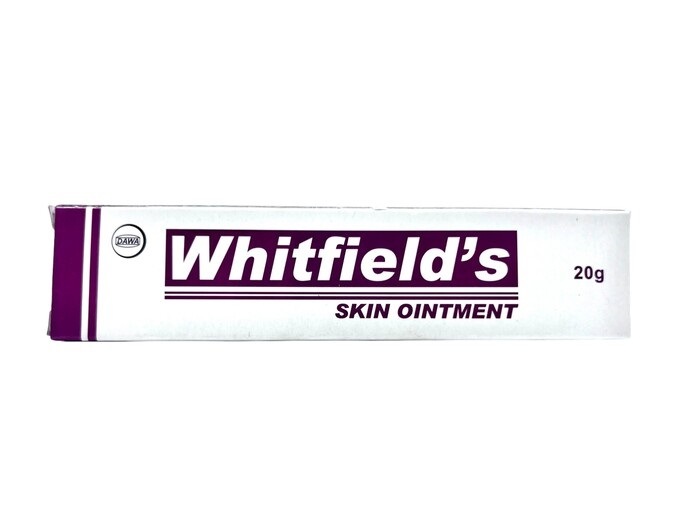
WHITFIELDS OINTMENT
BENZOIC ACID SALICYLIC ACID
What it does
Benzoic is used to treat various skin conditions and is often found in topical preparations.
Commonly used for: skin infections, fungal infections, eczema, dermatitis
Read more in plain English ↓Plain-language summary for general understanding - not medical advice. Always follow your pharmacist/doctor.
Ask about this medicine
Answers come only from this medicine's registration record, BNF monograph and interaction data - not medical advice.
Hard to find? We help patients in Kenya source rare medicines. We don't sell or dispense medicines - licensed pharmacies do.
Source this medicineRegistration & product details
Source: Pharmacy and Poisons Board · fetched 2026-01-28 21:20:53 · updated 2026-07-20 09:04:08
About benzoic
Benzoic is used to treat various skin conditions and is often found in topical preparations.
What it treats
- skin infections
- fungal infections
- eczema
- dermatitis
How it works
Benzoic helps to kill bacteria and fungi and reduces irritation in the skin.
Who it's for
This treatment is suitable for people with certain skin issues.
AI-assisted summary grounded in BNF data - general information only, not medical advice. Always confirm with your pharmacist or doctor.
About salicylic
Salicylic acid is a medication commonly used to treat skin conditions such as acne and warts. It helps to exfoliate the skin and reduce inflammation.
What it treats
- acne
- warts
- dandruff
- psoriasis
- seborrheic dermatitis
How it works
Salicylic acid works by helping the skin shed its outer layer, which can clear clogged pores and reduce the growth of skin cells that cause warts and other skin issues.
Who it's for
Salicylic acid is suitable for people with certain skin conditions like acne and warts, but it's important to use it as directed.
AI-assisted summary grounded in BNF data - general information only, not medical advice. Always confirm with your pharmacist or doctor.
Clinical monograph: benzoic
Benzoic acid is a simple aromatic carboxylic acid with the chemical formula C7H6O2. It is commonly used as a food preservative due to its antimicrobial properties and is found in various food products. In the pharmaceutical field, benzoic acid can be utilized in topical preparations for its antifungal and antibacterial effects. It is also used in the synthesis of other chemicals and as a solvent.
Indications
- Topical treatment of fungal infections
- Preservative in food and pharmaceutical products
- Treatment of hyperammonemia (as part of a combination therapy)
Dosage
Children: Refer to specific product guidelines and clinical protocols for pediatric dosing information.
Adults: Refer to specific product guidelines and clinical protocols for dosing information.
Mechanism of action
Benzoic acid exerts its antimicrobial effects primarily by disrupting the integrity of microbial cell membranes, leading to cell lysis. It can also inhibit certain metabolic pathways in bacteria, such as the conversion of pyruvate to acetyl-CoA, thereby limiting energy production in these organisms.
Pharmacodynamics
Benzoic acid demonstrates a concentration-dependent antibacterial and antifungal activity. The efficacy of benzoic acid is influenced by the pH of the environment; it is more effective in acidic conditions. The compound acts on a broad spectrum of microorganisms, including some bacteria and fungi, making it a useful preservative and therapeutic agent.
Pharmacokinetics
Benzoic acid is absorbed through the gastrointestinal tract when ingested and can be metabolized in the liver. It is primarily excreted in the urine as hippuric acid after conjugation with glycine. The half-life of benzoic acid varies but is generally around 1 to 2 hours. Its distribution in the body is rapid, with a volume of distribution that suggests extensive tissue binding.
Adverse effects
- Allergic reactions
- Skin irritation
- Nausea
- Vomiting
- Headache
Precautions
- Use with caution in individuals with known hypersensitivity to benzoates
- Monitor for signs of hypersensitivity reactions
Pregnancy
The safety of benzoic acid during pregnancy has not been established. Use only if the potential benefit justifies the potential risk to the fetus.
Breast-feeding
Benzoic acid is excreted in breast milk. Caution is advised when administered to nursing mothers.
Storage
Store in a cool, dry place, away from direct sunlight and moisture. Keep out of reach of children.
Formulations
- Topical creams
- Ointments
- Solutions
AI-synthesized from BNF references - general information only, not a substitute for professional medical advice or the current BNF. Verify doses with a pharmacist.
Clinical monograph: salicylic
BNF-referencedSalicylic acid is a beta hydroxy acid that is commonly used for its keratolytic and anti-inflammatory properties. It is primarily used in the treatment of skin conditions such as acne, psoriasis, and warts. Salicylic acid works by promoting the shedding of the outer layer of skin and reducing inflammation, making it effective in managing various dermatological issues. It also has a role in managing conditions related to joint pain and inflammation.
Indications
- Acne vulgaris
- Psoriasis
- Warts
- Seborrheic dermatitis
- Dandruff
- Hyperkeratosis
Dosage
Adults: For topical application, salicylic acid is typically applied once or twice daily, depending on the formulation and condition being treated. Specific dosing guidelines should be followed as per the BNF.
Mechanism of action
Salicylic acid exerts its effects by penetrating the skin and exfoliating the stratum corneum through keratolytic action, which helps in the dissolution of keratin and the removal of dead skin cells. This action facilitates the clearance of pores and can reduce acne lesions. Additionally, salicylic acid has anti-inflammatory properties that can help to decrease swelling and redness associated with various skin conditions. The compound is also known to inhibit the activity of enzymes involved in the synthesis of prostaglandins, which are mediators of inflammation.
Pharmacodynamics
The pharmacodynamics of salicylic acid involve its ability to enhance the turnover of skin cells and reduce the cohesiveness of keratinocytes in the stratum corneum. This leads to increased desquamation and a reduction in the formation of microcomedones in acne. Its anti-inflammatory effects are mediated through the inhibition of cyclooxygenase enzymes, leading to decreased production of pro-inflammatory mediators. This contributes to the reduction of inflammation and pain in affected areas.
Pharmacokinetics
Salicylic acid is absorbed percutaneously when applied topically, with systemic absorption increasing with higher concentrations and prolonged application. Once absorbed, it is metabolized predominantly in the liver to various conjugates, which are then excreted by the kidneys. The elimination half-life can vary based on the formulation and concentration used. For topical applications, significant first-pass metabolism may occur, limiting systemic exposure and reducing potential systemic side effects.
Pregnancy
Salicylic acid is classified as pregnancy category C. Its use should be avoided during pregnancy unless the potential benefits outweigh the risks.
Breast-feeding
Salicylic acid is excreted in breast milk, and caution is advised when using it during breastfeeding.
Storage
Store in a cool, dry place away from direct light.
AI-synthesized from BNF references - general information only, not a substitute for professional medical advice or the current BNF. Verify doses with a pharmacist.
Molecular reference: salicylic
PubChem CID 73952057Molecular formula: C14H12MgO6+2
Source: PubChem (NCBI) · pathways from PathBank, Reactome, WikiPathways & PharmGKB.
This drug in other countries
The same active ingredient registered across other registries we cover - including different brands.
- Beprosalic · Hoe Pharmaceuticals
- Bezic · Aurochem Laboratories
- Cool Mint Listerine · Johnson & Johnson
- CureAfya’s BBE · Cure Afya
- DAWA YA MBA · Sri Balaji Pharma
- Dawa ya Mba (Anti - fungal lotion) · Prince Pharmaceuticals
- BETACOR-S COMBINATION PRODUCT OINTMENT
- COMPOUND-W 17 % W/W LIQUID
- DAWA-SALIC 0.05/3.0%W/V OINTMENT
- EXEVATE-MF 0.05/3%W/W OINTMENT
- LOCASALEN COMBINATION PRODUCT OINTMENT
- SALISULFA 5% %5%W/W OINTMENT
- ASHITOX POWDER (Each gram contains: Propionic Acid/Benzoic acid/Sorbic Acid /Acetic Acid/MOS/Aluminum Silicate 5.75%/1.5%/0.63%/7.00%/0.50%/84.62%) · Advanced Agrovets Biotechnologies
- ASPIRIN 300MG TABLETS · Geo Medicore
- ASPIRIN TABLETS · Letap Pharmaceuticals
- B- TOX POWDER (Each gram contains: Propionic acid/ Benzoic acid/ Sorbic acid/ Acetic acid/ Hydrated sodium calcium aluminosilicates 8.75%/ 1.5%/ 0.63%/ 10%) · Tradeon Band
- B-TOX POWDER POWDER ((Each gram contains: 8.75%/ 1.5%/ 0.63%/ 10%) · Tradeon Band
- ELICASAL OINTMENT · Jamjoom Pharmaceuticals
- BETASALIC OINTMENT · Atco Laboratories
- Benzoic Acid BP 6% w/w and Salicylic Acid BP 3% w/w · Regal Pharmaceuticals
- Benzoic Acid and Salicylic Acid · Dawa
- ENTEZMA OINTMENT · Centaur Pharmaceutical
- FERTILION-F · Softgel Healthcare
- MEDIVEN-S OINTMENT · Regal Pharmaceuticals