apremilast brands
2 registered brands containing apremilast in Kenya.
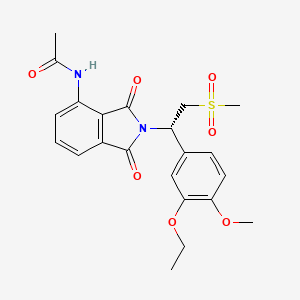
2D structure
Apremilast
PubChem CID 11561674Molecular formula: C22H24N2O7S
The full mechanism of action of this drug is not fully established, however, it is known that apremilast is an inhibitor of phosphodiesterase 4 (PDE4), which mediates the activity of cyclic adenosine monophosphate (cAMP), a second messenger. The inhibition of PDE4 by apremilast leads to increased intracellular cAMP levels. An increase in cAMP results in the suppression of inflammation by decreasing the expression of TNF-α, IL-17, IL-23, and other inflammatory mediators. The above inflammatory mediators have been implicated in various psoriatic conditions as well as Behcet's disease, leading to their undesirable inflammatory symptoms such as mouth ulcers, skin lesions, and arthritis. Apremilast administration leads to a cascade which eventually decreases the levels of the above mediators, relieving inflammatory symptoms. Apremilast is an orally administered phosphodiesterase-4 inhibitor, currently in phase 2 clinical studies of psoriasis and other chronic inflammatory diseases. The inhibitory effects of apremilast on pro-inflammatory responses of human primary peripheral blood mononuclear cells (PBMC), polymorphonuclear cells, natural killer (NK) cells and epidermal keratinocytes were explored in vitro, and in a preclinical model of psoriasis. Apremilast was tested in vitro against endotoxin- and superantigen-stimulated PBMC, bacterial peptide and zymosan-stimulated polymorphonuclear cells, immunonoglobulin and cytokine-stimulated NK cells, and ultraviolet B light-activated keratinocytes. Apremilast was orally administered to beige-severe combined immunodeficient mice, xenotransplanted with normal human skin and triggered with human psoriatic NK cells. Epidermal skin thickness, proliferation index and inflammation markers were analysed. Apremilast inhibited PBMC production of the chemokines CXCL9 and CXCL10, cytokines interferon-gamma and tumour necrosis factor (TNF)-alpha, and interleukins (IL)-2, IL-12 and IL-23. Production of TNF-alpha by NK cells and keratinocytes was also inhibited. In vivo, apremilast significantly reduced epidermal thickness and proliferation, decreased the general histopathological appearance of psoriasiform features and reduced expression of TNF-alpha, human leukocyte antigen-DR and intercellular adhesion molecule-1 in the lesioned skin. Apremilast displayed a broad pattern of anti-inflammatory activity in a variety of cell types and decreased the incidence and severity of a psoriasiform response in vivo. Inhibition of TNF-alpha, IL-12 and IL-23 production, as well as NK and keratinocyte responses by this phosphodiesterase-4 inhibitor suggests a novel approach to the treatment of psoriasis. Psoriasis and psoriatic arthritis are common clinical conditions that negatively impact health-related quality of life and are linked to serious medical comorbidities. Disease mechanisms involve local and systemic chronic inflammatory processes. Available biologic therapies specifically target single inflammatory mediators, such as tumor necrosis factor-a (TNF-a), in the context of a larger inflammatory signaling cascade. To interrupt this pathological cascade earlier in the response or further upstream, and return pro-inflammatory and anti-inflammatory signaling to a homeostatic balance, the use of a phosphodiesterase4 (PDE4) inhibitor has been explored. PDE4 is the major enzyme class responsible for the hydrolysis of cyclic adenosine monophosphate (cAMP), an intracellular second messenger that controls a network of pro-inflammatory and anti-inflammatory mediators. With PDE4 inhibition, and the resulting increases in cAMP levels in immune and non-immune cell types, expression of a network of pro-inflammatory and anti-inflammatory mediators can be modulated. Apremilast is an orally available targeted PDE4 inhibitor that modulates a wide array of inflammatory mediators involved in psoriasis and psoriatic arthritis, including decreases in the expression of inducible nitric oxide synthase, TNF-a, and interleukin (IL)-2
Source: PubChem (NCBI) · compound 11561674
| Product | Manufacturer | Status | Country |
|---|---|---|---|
| APREZO 30 MG |
Glenmark Pharmaceuticals | Registered | Kenya |
| APREZO STARTER PACK 10MG, 20MG, 30MG - COMMON BLEND |
Glenmark Pharmaceuticals | Registered | Kenya |