busulphan brands
1 registered brand containing busulphan in Kenya.
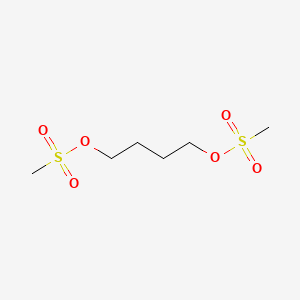
2D structure
busulphan
PubChem CID 2478Molecular formula: C6H14O6S2
Busulfan is an alkylating agent that contains 2 labile methanesulfonate groups attached to opposite ends of a 4-carbon alkyl chain. Once busulfan is hydrolyzed, the methanesulfonate groups are released and carbonium ions are produced. These carbonium ions alkylate DNA, which results in the interference of DNA replication and RNA transcription, ultimately leading to the disruption of nucleic acid function. Specifically, its mechanism of action through alkylation produces guanine-adenine intrastrand crosslinks. These crosslinks occur through a SN2 reaction guanine N7 nucleophilically attacks the carbon adjacent to the mesylate leaving group. This kind of damage cannot be repaired by cellular machinery and thus the cell undergoes apoptosis. The primary molecular action of busulfan is alkylation of intracellular nucleophiles. Both proteins and nucleic acids are affected. With regard to DNA, busulfan reacts with guanine residues to form a fourcarbon di-guanine DNA cross-linkage with release of methylsulfonate. The DNA cross-linkage causes misreading of the DNA code and single-strand breakage. The degree of DNA cross-linkage has been shown to be proportional to the dose and cytotoxicity of the compound. Busulfan-induced crosslinkages of DNA to nuclear proteins may also occur and is considered a cytotoxic mechanism. Busulfan has also been reported to esterify phosphate groups of chromosomal DNA, accounting for the fragmentation of chromosomes seen in various cell types after treatment. Chromosomal damage further contributes to the overall cytotoxic effect. Studies of cloned tumour and normal cells indicate that busulfan interrupts certain parts of the cell mitotic cycle. While busulfan can act on cells at any stage of mitosis, similar to other alkylating agents, in vitro studies with tumour cell lines indicate that replicating cells are most sensitive to busulfan in the late G1 phase and that progression through the cell cycle is blocked in the G2 phase. Cultured cells in the S-phase, which involves DNA synthesis, are not as affected because the DNA repair systems are active at this stage. Clinically, busulfan is cytotoxic to proliferating tissues, especially granulopoietic cells in the bone marrow.
Source: PubChem (NCBI) · compound 2478
| Product | Manufacturer | Status | Country |
|---|---|---|---|
| MYLERAN 2MG |
Beta Healthcare | - | Kenya |