International reference: 1 US FDA recall for this ingredient
Subpotent Drug:The titratable iodine contained in the Povidone-Iodine prep pads is below label claim of 0.85%. (dressing)
US-market enforcement records (OpenFDA), shown for reference - not specific to this product in Kenya.
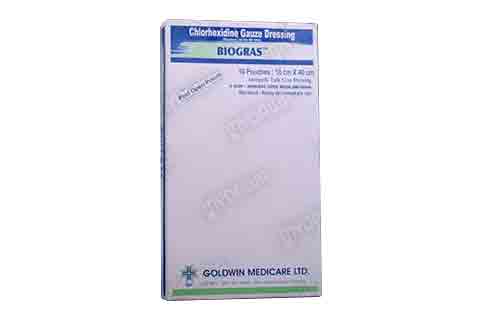
BIOGRAS
CHLORHEXIDINE GAUZE DRESSING BP
What it does
Chlorhexidine is an antiseptic used to clean skin and prevent infections.
Commonly used for: skin infections, wound cleaning, gum disease (gingivitis) prevention
Read more in plain English ↓Plain-language summary for general understanding - not medical advice. Always follow your pharmacist/doctor.
Ask about this medicine
Answers come only from this medicine's registration record, BNF monograph and interaction data - not medical advice.
Hard to find? We help patients in Kenya source rare medicines. We don't sell or dispense medicines - licensed pharmacies do.
Source this medicineRegistration & product details
Source: Pharmacy and Poisons Board · fetched 2026-01-28 21:34:13 · updated 2026-07-20 11:08:31
About chlorhexidine
Chlorhexidine is an antiseptic used to clean skin and prevent infections.
What it treats
- skin infections
- wound cleaning
- gum disease (gingivitis) prevention
How it works
Chlorhexidine kills or stops the growth of bacteria, helping to prevent infections.
Who it's for
It is suitable for adults and children needing skin or oral care.
Cautions
- • Avoid contact with eyes.
- • Do not use on deep wounds or serious burns without medical advice.
AI-assisted summary grounded in BNF data - general information only, not medical advice. Always confirm with your pharmacist or doctor.
About dressing
Dressing is a type of medical covering used to protect wounds and promote healing.
What it treats
- wound healing
- burn treatment
- post-surgery care
How it works
Dressing helps keep the wound clean, moist, and protected from infection, allowing the body to heal more effectively.
Who it's for
Anyone with a cut, scrape, burn, or surgical wound that needs protection and support during healing.
AI-assisted summary grounded in BNF data - general information only, not medical advice. Always confirm with your pharmacist or doctor.
About gauze
Gauze is a type of medical fabric used for dressing wounds and injuries.
What it treats
- wound care
- bandaging
- surgical dressings
How it works
Gauze helps to protect wounds from infection and keeps them clean while allowing air circulation.
Who it's for
Anyone needing to cover a wound or injury, including patients recovering from surgery.
Cautions
- • Ensure the gauze is sterile to avoid infection.
- • Change the gauze regularly to promote healing.
AI-assisted summary grounded in BNF data - general information only, not medical advice. Always confirm with your pharmacist or doctor.
Clinical monograph: Chlorhexidine
BNF-referencedChlorhexidine is an antimicrobial agent widely used for its broad-spectrum efficacy against various microorganisms, including both gram-positive and gram-negative bacteria, yeasts, and viruses. It is commonly employed in clinical settings for oral hygiene, skin antisepsis, and bladder irrigation due to its ability to disrupt microbial cell membranes, leading to cell death. Chlorhexidine is available in various formulations, including mouthwashes, solutions for skin disinfection, and irrigation solutions for urological procedures.
Indications
- Oral hygiene
- Skin antisepsis
- Bladder irrigation
- Urological surgery
- Management of infections associated with indwelling urinary catheters
Mechanism of action
Chlorhexidine's antimicrobial effects arise from its ability to disrupt microbial cell membranes. The positively charged chlorhexidine molecule interacts with negatively charged phosphate groups on microbial surfaces, compromising cell integrity and causing leakage of intracellular materials. This interaction allows chlorhexidine to enter the cell, precipitate cytoplasmic components, and ultimately induce cell death. At lower concentrations, chlorhexidine acts as a bacteriostatic agent, causing leakage of substances like potassium and phosphorus, while at higher concentrations, it exerts bactericidal effects.
Pharmacodynamics
Chlorhexidine exhibits broad-spectrum antimicrobial activity, effective against a variety of bacteria, yeasts, and viruses. Its action is dose-dependent, with lower concentrations (0.02%-0.06%) providing bacteriostatic effects, while higher concentrations (>0.12%) are bactericidal. Pharmacokinetic studies indicate that about 30% of chlorhexidine remains in the mouth after rinsing, allowing for slow release into oral fluids. This property, known as 'substantivity', helps prevent microbial colonization on surfaces like dentine, although prolonged use can lead to staining of oral surfaces.
Pharmacokinetics
Chlorhexidine is retained in the oral cavity at approximately 30% following rinsing, with a slow release into saliva. The pharmacokinetics of chlorhexidine indicate a high affinity for binding to tissues, which prolongs its antimicrobial action. The systemic absorption of chlorhexidine is minimal when used topically or as a rinse, making it safe for localized use. The elimination half-life and metabolism details are not well documented due to its primarily topical application.
Adverse effects
- Mucosal irritation
- Burning sensation
- Staining of teeth and oral surfaces
- Allergic reactions
Precautions
- Use with caution in patients with a history of hypersensitivity to chlorhexidine
- May cause irritation; discontinue if severe irritation occurs
- Staining may occur with prolonged use, particularly with oral formulations
Pregnancy
Chlorhexidine is generally considered safe for use during pregnancy; however, caution is advised and pregnant individuals should consult healthcare providers.
Breast-feeding
Chlorhexidine is considered safe during breastfeeding, but it is advisable to consult a healthcare provider.
Storage
Store at room temperature, away from light and moisture. Keep out of reach of children.
Formulations
- Irrigation solution (0.02% and 0.05%)
- Capsules (various strengths)
- Catheter maintenance solution (1:5000)
- Topical solutions for oral hygiene
AI-synthesized from BNF references - general information only, not a substitute for professional medical advice or the current BNF. Verify doses with a pharmacist.
Clinical monograph: dressing
Dressings are materials applied to wounds to promote healing, protect from infection, and minimize scarring. They can be made from various substances, including gauze, foam, hydrocolloid, and silicone. The choice of dressing depends on the type of wound, its location, and the stage of healing.
Indications
- Acute wounds
- Chronic wounds
- Surgical wounds
- Burns
- Pressure ulcers
- Diabetic foot ulcers
Dosage
Children: Refer to the relevant guidelines based on the specific type of wound and dressing used, considering the age and size of the child.
Adults: Dressings should be applied according to the type of wound and the dressing selected. Change the dressing as needed based on exudate levels and manufacturer's instructions.
Mechanism of action
Dressings provide a moist environment that facilitates healing, allowing cells to migrate and proliferate. They can absorb exudate, protect the wound from external contaminants, and maintain temperature, which is essential for cellular activity in the healing process.
Pharmacodynamics
The pharmacodynamic properties of dressings are primarily dependent on their composition and design. For example, hydrocolloid dressings swell in the presence of wound exudate, creating a gel-like substance that aids in moist wound healing. Some dressings may also have antimicrobial properties to reduce the risk of infection.
Pharmacokinetics
Dressings do not have pharmacokinetic properties in the traditional sense as they are not absorbed into the system. Instead, their effectiveness is determined by their ability to remain intact on the wound, manage exudate, and facilitate the healing process until the wound has sufficiently healed.
Pregnancy
Consult with a healthcare provider before use, as the safety of specific dressing materials during pregnancy may vary.
Breast-feeding
Consult with a healthcare provider regarding the use of dressings while breastfeeding, as some materials may not be advisable.
Storage
Store in a cool, dry place away from direct sunlight. Ensure dressings are kept in their original packaging until use to maintain sterility.
Formulations
- Hydrocolloid dressings
- Foam dressings
- Alginate dressings
- Transparent film dressings
- Hydrogels
- Antimicrobial dressings
AI-synthesized from BNF references - general information only, not a substitute for professional medical advice or the current BNF. Verify doses with a pharmacist.
Clinical monograph: gauze
Gauze is a thin, woven fabric typically made from cotton or a cotton blend. It is commonly used in medical settings for wound care, dressing, and as a barrier to protect wounds from infection. Its porous nature allows for absorption of exudate and facilitates air circulation, promoting healing. Gauze can be sterile or non-sterile, and it is available in various sizes and thicknesses to suit different types of wounds.
Indications
- Acute wounds
- Chronic wounds
- Surgical incisions
- Burns
- Pressure ulcers
- Trauma wounds
Dosage
Children: Refer to the guidance for adult dosing, as pediatric use is similar and should be based on clinical assessment of the wound and exudate.
Adults: The dosage or application frequency of gauze depends on the specific wound type and the amount of exudate. It is typically changed as needed, based on clinical assessment.
Mechanism of action
Gauze functions primarily as a physical barrier to protect wounds from external contaminants and further injury. It absorbs exudate from wounds, which helps to maintain a moist environment conducive to healing. The open weave of gauze allows for breathability, which is essential in preventing maceration of the surrounding skin.
Pharmacodynamics
As a non-pharmacological product, gauze does not have pharmacodynamic properties in the traditional sense. Its effectiveness is related to its physical characteristics, such as absorbency, flexibility, and ability to protect wounds. The interaction with the wound environment aids in managing exudate and reducing the risk of infection.
Pharmacokinetics
Gauze does not undergo pharmacokinetic processes such as absorption, distribution, metabolism, or excretion, as it is not an active pharmaceutical ingredient. Instead, it provides a mechanical function in wound management. The duration of action is dependent on the frequency of dressing changes, which is influenced by the amount of exudate produced by the wound.
Pregnancy
Gauze is considered safe for use during pregnancy as it is a non-pharmacological material used primarily for wound care.
Breast-feeding
Gauze is safe for use during breastfeeding, as it is unlikely to affect breast milk or the nursing infant.
Storage
Store in a cool, dry place, away from direct sunlight and moisture. Ensure that the packaging remains sealed until use to prevent contamination.
Formulations
- Sterile gauze pads
- Non-sterile gauze pads
- Gauze rolls
AI-synthesized from BNF references - general information only, not a substitute for professional medical advice or the current BNF. Verify doses with a pharmacist.
Molecular reference: Chlorhexidine
PubChem CID 9552079Molecular formula: C22H30Cl2N10
Mechanism of action
Chlorhexidine’s broad-spectrum antimicrobial effects are due to its ability to disrupt microbial cell membranes. The positively charged chlorhexidine molecule reacts with negatively charged phosphate groups on microbial cell surfaces - this reaction both destroys the integrity of the cell, allowing leakage of intracellular material, and allows chlorhexidine to enter the cell, causing precipitation of cytoplasmic components and ultimately cell death. The specific means of cell death is dependent on the concentration of chlorhexidine - lower concentrations are bacteriostatic and result in leakage of intracellular substances such as potassium and phosphorous, whereas higher concentrations are bactericidal and cause cytoplasmic precipitation.
Pharmacodynamics
Chlorhexidine is a broad-spectrum antimicrobial with demonstrated activity against both gram-positive and gram-negative bacteria, yeasts, and viruses. Antimicrobial activity is dose-dependent - chlorhexidine is bacteriostatic at lower concentrations (0.02%-0.06%) and bactericidal at higher concentrations (>0.12%). Pharmacokinetic studies of oral chlorhexidine rinses indicate that approximately 30% of the active ingredient is retained in the mouth following rinsing, which is subsequently slowly released into oral fluids. This ability to adsorb to dentine, shared with tetracycline antibiotics such as [doxycycline], is known as "substantivity" and is the result of chlorhexidine's positive charge - it is likely that this substantivity plays at least some role in chlorhexidine's antimicrobial activity, as its persistence on surfaces such as dentine prevent microbial colonization. Dental chlorhexidine rinses may result in staining of oral surfaces, such as teeth. This effect is not ubiquitous and appears to be more significant with extended therapy (i.e. up to 6 months) - nevertheless, patients for whom oral staining is unacceptable should use chlorhexidine rinse with caution and for the shortest effective interval. Allergic reactions to chlorhexidine have been associated with the development of anaphylaxis.
Source: PubChem (NCBI) · pathways from PathBank, Reactome, WikiPathways & PharmGKB.
This drug in other countries
The same active ingredient registered across other registries we cover - including different brands.
- Argisept · Centaur Pharmaceuticals
- BL Citroxin · Bl Biopharm
- Burn Cream · Prince Pharmaceuticals
- Burnox · Shelys Pharmaceuticals
- CHX 7.1% GEL · Universal Corporation
- CHX MOUTH WASH · Universal Corporation
- BURNOX COMBINATION PRODUCT CREAM
- CHLORHEXIDINE 5%W/V LIQUID
- CLENORA_MOUTH_WASH 0.2%W/V SOLUTION
- DERMAZINE_PLUS COMBINATION PRODUCT CREAM
- HIBITANE CONCENTRATE 26%V/V SOLUTION
- HIBSCRUB 21.2%V/V SOLUTION
- EMGIDINE GEL (Each gram contains Chlorhexidine Gluconate 7.1%w/w) · S Kant Healthcare
- LYNXACLOX MOUTHWASH · Vega Biotec
- NESTER MOUTHWASH FRESH MINT · Ernest Chemist
- NESTER MOUTHWASH ORIGINAL · Ernest Chemist
- OMERINSE MOUTH WASH · Omer Investment
- QUADRAJEL SUSPENSION · Fourrts Laboratories
- BIOTAINE 2 %
- CORSODYL MOUTHWASH MINT
- CORSODYL MOUTHWASH ORIGINAL
- Fungalene
- Resmed Chlorhexidine Gluconate 0,2% Mouthwash
- ZHLORAPREP STERILE CLEAR