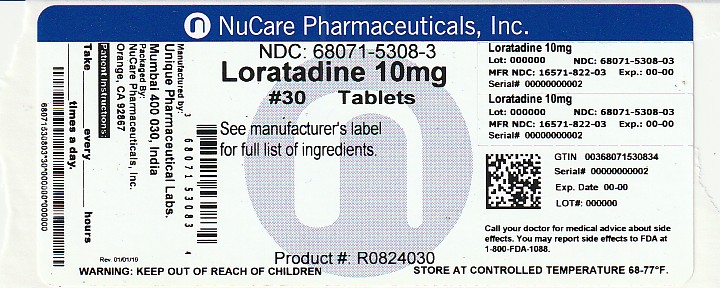
(loratadine · DailyMed)
LAURA 10 TABLETS
Loratadine 10mg
What it does
Loratadine is an antihistamine that helps relieve allergy symptoms.
Commonly used for: seasonal allergies (hay fever), chronic hives (urticaria)
Read more in plain English ↓Plain-language summary for general understanding - not medical advice. Always follow your pharmacist/doctor.
Ask about this medicine
Answers come only from this medicine's registration record, BNF monograph and interaction data - not medical advice.
Medicine sourcing is available in Kenya only. We don't sell or dispense medicines - licensed pharmacies do.
Sourcing - Kenya onlyRegistration & product details
Source: Botswana Medicines Regulatory Authority · fetched 2026-09-18 04:32:42
About this medicine
Loratadine is an antihistamine that helps relieve allergy symptoms.
What it treats
- seasonal allergies (hay fever)
- chronic hives (urticaria)
How it works
It blocks the action of histamine, a substance in the body that causes allergic symptoms.
Who it's for
It is suitable for adults and children over the age of 2 who have allergies.
AI-assisted summary grounded in BNF data - general information only, not medical advice. Always confirm with your pharmacist or doctor.
Clinical monograph: Loratadine
BNF-referencedLoratadine is a second-generation antihistamine used primarily for the symptomatic relief of allergic conditions such as seasonal allergic rhinitis and chronic idiopathic urticaria. It is known for its low sedative effects, making it suitable for individuals who need to avoid drowsiness while managing allergy symptoms.
Indications
- Seasonal allergic rhinitis
- Chronic idiopathic urticaria
Dosage
Children: Child 6–11 years: 30 mg twice daily. Child 12–17 years: 120 mg once daily for seasonal allergic rhinitis or 180 mg once daily for chronic idiopathic urticaria.
Adults: 120 mg once daily for seasonal allergic rhinitis or chronic idiopathic urticaria. Alternatively, 180 mg once daily may be prescribed depending on clinical judgement.
Mechanism of action
Loratadine exerts its effects by binding to H1 histamine receptors, which are found on various cell types, including epithelial, endothelial, and smooth muscle cells. It acts as an 'inverse agonist', stabilizing the inactive form of the H1 receptor and thereby preventing the actions of histamine, which is a key mediator in allergic responses. This mechanism effectively reduces the severity of symptoms associated with allergies.
Pharmacodynamics
Loratadine is selective for peripheral H1 receptors and does not significantly penetrate the central nervous system, resulting in minimal sedation and CNS depression. This pharmacodynamic profile helps to avoid common side effects associated with first-generation antihistamines, such as drowsiness and impaired psychomotor function.
Pharmacokinetics
Loratadine is well-absorbed after oral administration and undergoes extensive hepatic metabolism, primarily via cytochrome P450 enzymes. It has a long half-life, allowing for once-daily dosing. The drug is mainly excreted through urine and bile, with a small percentage eliminated unchanged. Dose adjustments may be necessary in individuals with renal impairment.
Contra-indications
- Acute porphyrias
Adverse effects
- Dizziness
- Drowsiness
- Headache
- Nausea
- Fatigue
- Abdominal pain
- Aggression
- Agitation
- Angioedema
- Appetite increased
- Arthralgia
- Depression
- Dyspnoea
- Hallucination
- Hepatitis
- Myalgia
- Oedema
- Palpitations
- Paraesthesia
- Seizure
- Skin reactions
- Suicidal ideation
- Syncope
- Tachycardia
- Taste altered
- Tremor
- Urinary disorders
- Vertigo
- Vision disorders
- Vomiting
- Weight increased
Interactions
- Other antihistamines
Precautions
- Patients and their carers should be advised that drowsiness can occur and may affect performance of skilled tasks such as cycling or driving.
- Avoid in patients with renal impairment if eGFR is less than 10 mL/minute/1.73 m2.
Pregnancy
Most manufacturers of antihistamines advise avoiding their use during pregnancy; however, there is no evidence of teratogenicity.
Breast-feeding
Most antihistamines are present in breast milk in varying amounts; although not known to be harmful, most manufacturers advise avoiding their use in mothers who are breast-feeding.
Storage
Store at room temperature, away from excessive heat and moisture.
Formulations
- Oral suspension
- Oral solution
- Tablet
AI-synthesized from BNF references - general information only, not a substitute for professional medical advice or the current BNF. Verify doses with a pharmacist.
Molecular reference: Loratadine
PubChem CID 3957Molecular formula: C22H23ClN2O2
Mechanism of action
Histamine release is a key mediator in allergic rhinitis and urticaria. As a result, loratadine exerts it's effect by targeting H1 histamine receptors. Loratadine binds to H1 histamine receptors found on the surface of epithelial cells, endothelial cells, eosinophils, neutrophils, airway cells, and vascular smooth muscle cells among others. H1 histamine receptors fall under the wider umbrella of G-protein coupled receptors, and exist in a state of equilibrium between the active and inactive forms. Histamine binding to the H1-receptor facilitates cross linking between transmembrane domains III and V, stabilizing the active form of the receptor. On the other hand, antihistamines bind to a different site on the H1 receptor favouring the inactive form. Hence, loratadine can more accurately be classified as an "inverse agonist" as opposed to a "histamine antagonist", and can prevent or reduce the severity of histamine mediated symptoms. All of the available H1 receptor antagonists are reversible, competitive inhibitors of the interaction of histamine with H1 receptors. /H1 Receptor Antagonists/ H1 antagonists inhibit most responses of smooth muscle to histamine. /H1 Antagonists Receptors/ Within the vascular tree, the H1 antagonists inhibit both the vasoconstrictor effects of histamine and, to a degree, the more rapid vasodilator effects that are mediated by H1 receptors on endothelial cells. /H1 Receptor Antagonists/ H1 antagonists strongly block the action of histamine that results in increased capillary permeability and formation of edema and wheal. /H1 Receptor Antagonists/ For more Mechanism of Action (Complete) data for LORATADINE (6 total), please visit the HSDB record page.
Pharmacodynamics
Like other 2nd generation antihistamines, loratadine is selective for peripheral H1 receptors. Loratadine does not penetrate effectively into the central nervous system and has poor affinity for CNS H1-receptors. These qualities result in a lack of CNS depressant effects such as drowsiness, sedation, and impaired psychomotor function.
Biological pathways
Source: PubChem (NCBI) · pathways from PathBank, Reactome, WikiPathways & PharmGKB.
This drug in other countries
The same active ingredient registered across other registries we cover - including different brands.
- CETIN SYRUP · Syner-med Pharmaceuticalsltd
- CETIN TABLETS · Syner-med Pharmaceuticalsltd
- DE-HISTAMINE TABLETS · Sai Pharmaceuticals
- FOLERIN 10MG TABLETS · Kulal International
- HISTACHLOR · Harleys
- LORALIFE TABLETS 10MG · Pharma Specialities
- Clarinase Repetabs · Sag Manufacturing
- Clarinase Repetabs · Schering-Plough
- Clarityne · Bayer
- Clarityne · Schering Plough
- Clarlorr 10mg Tablets · Cure Afya
- LORAPIN 10 · Pinnacle Life Science
- ATIDINE-10 TABLET (Each tablet contains Loratadine 10mg) · Atoz Pharmaceuticals
- CHILDREN'S ALLERGY RELIEF ORAL SOLUTION (Each 5ml contains Loratadine 5mg) · Bells Sons & Company
- CLARITYNE SYRUP (Each 5ml contains Loratadine 5mg) · Schering-Plough
- CLARITYNE TABLETS (Each tablet contains Loratadine 10mg) · Bayer
- EZEDE D ORAL SOLUTION · Xepa-Soul Pattinson
- LORATADINE SYRUP (Each 5ml contains Loratadine 5mg ) · Enicar Pharmaceutical
- CLARINASE REPETABS · Sag Manufacturing
- CLARITYNE SYRUP · Organon
- CLARITYNE TABLETS · Bayer
- LOREZE · Mega Lifesciences
- LORHISTINA 10MG TABLETS · Cosmos
- LORHISTINA SYRUP · Cosmos
- LORACTIV 10MG TABLETS
- LORACTIV 5MG/5ML SYRUP
- LORAS 10MG TABLET
- LORATYN-10 10MG TABLET
- LORFAST 10MG TABLET
- LORHISTINA 10MG TABLET