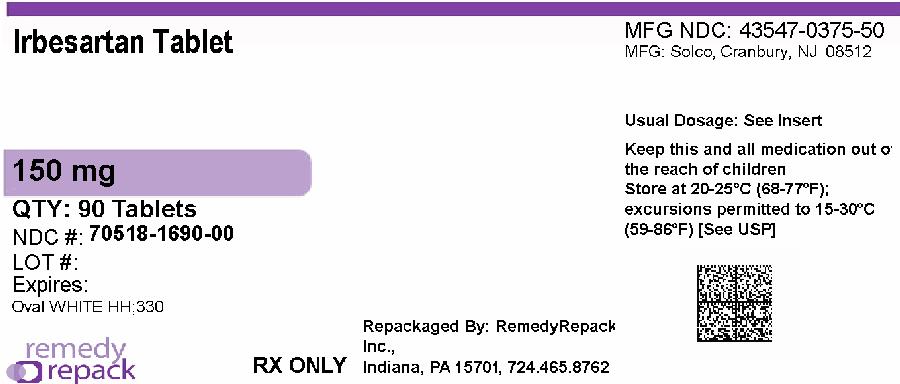
(irbesartan · DailyMed)
ARBI 300MG TABLET
IRBESARTAN
What it does
Irbesartan is a medication that helps lower blood pressure and protect the kidneys.
Commonly used for: high blood pressure (hypertension), kidney problems related to diabetes
Read more in plain English ↓Plain-language summary for general understanding - not medical advice. Always follow your pharmacist/doctor.
Ask about this medicine
Answers come only from this medicine's registration record, BNF monograph and interaction data - not medical advice.
Hard to find? We help patients in Kenya source rare medicines. We don't sell or dispense medicines - licensed pharmacies do.
Source this medicineRegistration & product details
Source: Pharmacy and Poisons Board · fetched 2026-01-28 20:02:51 · updated 2026-08-03 03:12:13
Drug Interactions
1Pharmacodynamic Warnings
Irbesartan appears in TABLE 7: Drugs that cause first dose hypotension
Irbesartan appears in TABLE 8: Drugs that cause hypotension
Irbesartan appears in TABLE 16: Drugs that increase serum potassium
Unknown (1)
Bulevirtide - affects efficacy
Irbesartanispredictedtoaffecttheefficacyofbulevirtide. Avoid.rTheoretical
Data from BNF 85 (British National Formulary). This is not a substitute for professional medical advice. Matched via: exact
About this medicine
Irbesartan is a medication that helps lower blood pressure and protect the kidneys.
What it treats
- high blood pressure (hypertension)
- kidney problems related to diabetes
How it works
Irbesartan works by blocking a substance in the body that causes blood vessels to tighten, helping them to relax and lower blood pressure.
Who it's for
Irbesartan is for adults with high blood pressure or certain kidney issues.
Drug class
Angiotensin-II receptor antagonists
Cautions
- • Be careful if you are taking other medications that can lower blood pressure.
- • Avoid medications that can cause low blood pressure.
- • Watch out for drugs that may increase potassium levels in the blood.
AI-assisted summary grounded in BNF data - general information only, not medical advice. Always confirm with your pharmacist or doctor.
Clinical monograph: Irbesartan
BNF-referencedIrbesartan is an angiotensin-II receptor antagonist commonly used to treat hypertension and to slow the progression of diabetic nephropathy in patients with type 2 diabetes. It works by blocking the action of angiotensin II, a potent vasoconstrictor, leading to vasodilation and reduced blood pressure. Irbesartan is usually administered orally and has a long duration of action, allowing for once-daily dosing.
Indications
- Hypertension
- Diabetic nephropathy in patients with type 2 diabetes
Dosage
Children: Refer to BNF for Children for specific dosing information.
Adults: Initially 75–150 mg once daily, may be increased to 300 mg once daily if tolerated.
Mechanism of action
Irbesartan prevents angiotensin II binding to the AT1 receptor in tissues such as vascular smooth muscle and the adrenal gland. It binds to the AT1 receptor with over 8500 times more affinity than to the AT2 receptor. By blocking angiotensin II from binding, irbesartan induces vascular smooth muscle relaxation and inhibits aldosterone secretion, which together lower blood pressure. This action counteracts the vasoconstrictive and sodium-retaining effects of angiotensin II.
Pharmacodynamics
Irbesartan is an effective angiotensin receptor blocker that lowers blood pressure and has a wide therapeutic index. It is well-tolerated at doses up to 900 mg daily, although typical therapeutic doses range from 150 mg. Its long half-life allows for once-daily dosing, making it convenient for patient adherence.
Pharmacokinetics
Irbesartan is well absorbed following oral administration, with peak plasma concentrations occurring within 1-2 hours. It undergoes extensive hepatic metabolism, primarily by glucuronidation, and is excreted via the urine and feces. The elimination half-life is approximately 11 hours, which supports its once-daily dosing regimen. Renal impairment may necessitate cautious use, especially in patients with creatinine clearance less than 30 mL/min.
Contra-indications
- Hypersensitivity to irbesartan or any of the excipients
- Severe hepatic impairment
- Bilateral renal artery stenosis or stenosis in a solitary kidney
Adverse effects
- Dizziness
- Fatigue
- Hypotension
- Angioedema
- Elevated blood urea or creatinine
- Hyperkalemia
- Gastrointestinal disturbances
Interactions
- Irbesartan and bulevirtide: Unknown (affects efficacy)
- Other antihypertensive agents may have additive effects
- Non-steroidal anti-inflammatory drugs (NSAIDs) may reduce the antihypertensive effect of irbesartan
Precautions
- Caution in patients with a history of angioedema
- Monitor renal function in patients with renal impairment
- Use with caution in patients with diabetes or heart failure
Pregnancy
Irbesartan is contraindicated during pregnancy due to potential harm to the fetus, particularly in the second and third trimesters.
Breast-feeding
Caution is advised as it is not known if irbesartan is excreted in human milk.
Storage
Store at room temperature, away from moisture and heat.
Formulations
- Irbesartan 75 mg tablets
- Irbesartan 150 mg tablets
- Irbesartan 300 mg tablets
- Oral suspension (special order)
AI-synthesized from BNF references - general information only, not a substitute for professional medical advice or the current BNF. Verify doses with a pharmacist.
Molecular reference: Irbesartan
PubChem CID 3749Molecular formula: C25H28N6O
Mechanism of action
Irbesartan prevents angiotensin II binding to the AT<sub>1</sub> receptor in tissues like vascular smooth muscle and the adrenal gland. Irbesartan and its active metabolite bind the AT<sub>1</sub> receptor with 8500 times more affinity than they bind to the AT<sub>2</sub> receptor. Irbesartan's prevention of angiotensin II binding causes vascular smooth muscle relaxation and prevents the secretion of aldosterone, lowering blood pressure. Angiotensin II would otherwise bind to the AT<sub>1</sub> receptor, inducing vasoconstriction and aldosterone secretion, raising blood pressure. Angiotensin II is a potent vasoconstrictor formed from angiotensin I in a reaction catalyzed by angiotensin-converting enzyme (ACE, kininase II). Angiotensin II is the principal pressor agent of the renin-angiotensin system (RAS) and also stimulates aldosterone synthesis and secretion by adrenal cortex, cardiac contraction, renal resorption of sodium, activity of the sympathetic nervous system, and smooth muscle cell growth. Irbesartan blocks the vasoconstrictor and aldosterone-secreting effects of angiotensin II by selectively binding to the AT1 angiotensin II receptor. There is also an AT2 receptor in many tissues, but it is not involved in cardiovascular homeostasis. Irbesartan is a specific competitive antagonist of AT1 receptors with a much greater affinity (more than 8500-fold) for the AT1 receptor than for the AT2 receptor and no agonist activity. Blockade of the AT1 receptor removes the negative feedback of angiotensin II on renin secretion, but the resulting increased plasma renin activity and circulating angiotensin II do not overcome the effects of irbesartan on blood pressure. Irbesartan does not inhibit ACE or renin or affect other hormone receptors or ion channels known to be involved in the cardiovascular regulation of blood pressure and sodium homeostasis. Because irbesartan does not inhibit ACE, it does not affect the response to bradykinin; whether this has clinical relevance is not known.
Pharmacodynamics
Irbesartan is an angiotensin receptor blocker used to treat hypertension and diabetic nephropathy. It has a long duration of action as it is usually taken once daily and a wide therapeutic index as doses may be as low as 150mg daily but doses of 900mg/day were well tolerated in healthy human subjects.
Biological pathways
Source: PubChem (NCBI) · pathways from PathBank, Reactome, WikiPathways & PharmGKB.
This drug in other countries
The same active ingredient registered across other registries we cover - including different brands.
- Co-Irda · Nobel Ilaç
- Co-Irda · Nobel Ilaç
- IRBEZYD H 150/12.5
- IRBIS 150 · Hetero Labs
- IRBIS 300 · Hetero Labs
- IRBIS-H 150 · Hetero Labs
- IRBESARTAN IMPACT 300MG · Sanofi Winthrop
- IRBESARTAN IMPACT150 · Sanofi Winthrop
- IRBESARTAN/AMLODIPINE BESILATE IMPACT 150MG/5MG · Sanofi Winthrop
- IRBESARTAN/AMLODIPINE BESYLATE IMPACT 300MG/10MG · Sanofi
- IRBESARTAN/AMLODIPINE BESYLATE IMPACT 300MG/5MG · Sanofi Winthrop
- IRBESARTAN/HYDROCHLOROTHIAZIDE IMPACT · Sanofi Winthrop Industrie
- IRBESARTAN IMPACT 150 MG · Sanofi Winthrop
- IRBESARTAN/HYDROCHLOROTHIAZIDE IMPACT 300 MG/12.5 MG FILM-COATED TABLETS · Troikaa Pharmaceuticals
- IRBIS 150 · Hetero Labs
- IRBIS 300 · Hetero Labs
- IRBIS HT -300/12.5 · Hetero Labs
- IRBIS-HT 150/12.5 · Hetero Labs
- APROVASC 5MG/300MG TABLETS · Sanofi
- APROVASC TABLETS (Each film-coated tablet contains Amlodipine besilate/ Irbesartan 10mg + 150mg) · Sanofi Aventis
- APROVASC TABLETS (Each film-coated tablet contains Amlodipine besilate/ Irbesartan 5mg + 150mg) · Sanofi Aventis
- APROVASC TABLETS (Each tablet contains Amlodipine besilate/ Irbesartan 10mg + 300mg) · Sanofi Aventis